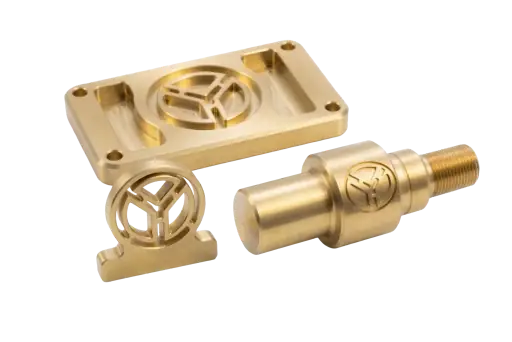
C360 brass is one of the most widely used copper alloys for high-speed CNC Machining, especially for turned parts, fittings, valves, and threaded components. It is valued for exceptional machinability, good corrosion resistance, and consistent production performance.
C360 brass, also known as free-cutting or free-machining brass, is a copper-zinc-lead alloy developed for fast, efficient production of precision machined components. The lead content improves chip formation and reduces cutting friction, which is why C360 is commonly treated as the benchmark material for brass machinability. It is especially well suited for CNC turning, CNC mill-turn, and other high-volume CNC machining operations where cycle time, tool life, tight tolerances, and surface finish are critical.
Specifications
C360 Free-Cutting Brass Specifications
Engineering-grade properties of C360 brass, including mechanical, physical, and machining characteristics relevant to precision turned and machined components. This data supports material selection for fittings, valves, fasteners, inserts, and other production hardware.
C360 Engineering Properties
Alloy Type
Free-Cutting Brass (Cu-Zn-Pb alloy)
Primary Characteristics
Exceptional machinability, good corrosion resistance, good thread quality, reliable surface finish
Tensile Strength (Ultimate)
48–77 ksi (330–530 MPa) depending on temper
Tensile Strength (Yield)
20–38 ksi (140–260 MPa) depending on temper
Shear Strength
31–45 ksi (210–310 MPa)
Elongation at Break
6–23% (varies with temper)
Hardness
Rockwell B 60–80 (typical, varies by temper)
Density
8.49 g/cm³ (0.307 lb/in³)
Elastic Modulus
15,000 ksi (100 GPa)
Poisson’s Ratio
0.31
Electrical Conductivity
≈ 26–28% IACS
Thermal Conductivity
≈ 120 W/m·K
Coefficient of Thermal Expansion
≈ 21 µm/m·°C
Melting Range
≈ 885–900 °C (≈ 1625–1650 °F)
Machinability
Excellent (industry benchmark for free-machining brass, often rated at 100%)
Formability
Moderate to limited compared to C260 and other more ductile brasses
Weldability
Limited
Solderability / Brazability
Good
Corrosion Resistance
Good (suitable for many industrial, plumbing, and atmospheric environments)
Copper (Cu): 60.0–63.0%, Lead (Pb): 2.5–3.0%, Iron (Fe): ≤0.35%, Zinc (Zn): balance
ASTM Standard
ASTM B16 / B16M
Performance
Material Performance Overview
Standardized comparison across key engineering and manufacturing criteria.
Strength
Weight
Machinability
Formability
Wear Resistance
Corrosion Resistance
Electrical Conductivity
Cost Efficiency
Ready to machine C360 brass parts?
Upload your CAD files and get a fast, engineering-reviewed quote. From prototype runs to production machining, we support precision brass components with reliable lead times.
Where C360 Free-Cutting Brass is Commonly Used
C360 brass is widely used in applications where machining speed, thread quality, dimensional consistency, and production efficiency matter more than deep forming performance. It is especially common in precision turned and screw machine components.
Precision CNC turned parts
Screw machine products
Hydraulic and pneumatic fittings
Valve stems and valve components
Sensor bodies and instrument parts
Fasteners, nuts, and threaded hardware
Electrical connectors and terminals
Adapters, couplings, and unions
Nozzles, gauges, and machined industrial hardware
Material FAQs
Brass C360 in CNC Machining and Production
Common questions about working with C360 free-cutting brass in precision machining and high-volume production environments.
The Machinability Standard
Brass C36000: The Gold Standard for High-Speed Precision Machining
Brass C360, also known as Free-Cutting Brass, is the universal benchmark against which the machinability of all other metals is measured. With a 100% machinability rating, it is engineered for high-volume production, offering unparalleled tool life and surface finish quality across CNC machining workflows.
In practice, C36000 provides the most cost-effective path for complex, high-tolerance components that require excellent corrosion resistance and natural antimicrobial properties without the high processing costs of steel or aluminum.
Key manufacturing characteristics of C360 Brass
100% Machinability Rating: Highly optimized for high-speed automated equipment, allowing for maximum feed rates and minimal tool wear.
Lead-Enhanced Matrix: The inclusion of lead (approx. 3%) acts as an internal lubricant and chip breaker, ensuring small, manageable chips during production.
Excellent Corrosion Resistance: Naturally resists oxidation and performs exceptionally well in plumbing, fluid power, and atmospheric applications.
High Dimensional Stability: Maintains tight tolerances even in complex geometries, making it the preferred material for CNC turning and precision fittings.
Natural Antimicrobial Properties: Inherently kills 99.9% of bacteria within hours, making it highly valuable for medical and high-touch consumer surfaces.
Aesthetic Versatility: Offers a premium 'gold-like' appearance that can be easily polished, plated, or lacquered for decorative and functional use.
Mechanical and physical properties of C36000 Brass
C360 is selected when production efficiency and part cost are the primary drivers. While it offers moderate strength, it is generally chosen over harder alloys like Bronze C95400 when the design focuses on intricate features and high-volume repeatability.
Typical performance profile
Exceptional surface finish directly from the machine
Good thermal and electrical conductivity for connector applications
Low magnetic permeability for electronic shielding
Excellent cold-workability for secondary knurling or crimping
Highly recyclable material with high scrap value
Why engineers choose it
Lowest processing cost per part due to extreme machining speeds
Ideal for parts with deep holes or complex internal threading
Superior thread quality and integrity in small-scale fasteners
Commonly specified for high-precision sensors, valves, and manifold blocks
Strengths and advantages of C36000 Brass
Maximum Production Throughput: Supports the shortest cycle times in the industry for CNC machining services.
Superior Tool Life: Significantly reduces machine downtime for tool changes compared to stainless steel.
Excellent Threading and Tapping: The material's 'short-chip' nature prevents bird-nesting and tool breakage in small threaded features.
Non-Sparking: Safe for use in hazardous or explosive environments.
High Conductivity: Provides reliable performance for electrical terminals and grounding hardware.
Clean Aesthetics: Provides a high-quality look for consumer-facing hardware without expensive secondary finishes.
Trade-offs and limitations of C360 Brass
Lead Content Compliance: Contains lead for machinability; not suitable for potable water systems in certain regions (consider lead-free alternatives).
Weldability: Not recommended for TIG/MIG welding due to lead content; joining should be done via soldering or brazing.
Moderate Strength: Not ideal for high-stress structural applications compared to 7075 Aluminum or steel.
Weight: Significantly denser (heavier) than aluminum alloys, which may impact weight-sensitive aerospace designs.
Dezincification: Can be susceptible to corrosion in specific high-salt or high-acid environments.
Fabrication and machining considerations for C360
Machining behavior
C360 is the ultimate material for high-speed production. It allows for ultra-fast CNC turning and produces a burr-free finish that often eliminates the need for secondary deburring.
Optimized for high-speed automated lathe operations
Produces very low cutting forces, allowing for thin-walled features
Predictable thermal expansion during long production runs
Hole features and threading
Standard for high-precision deep-hole drilling without wander
Supports exceptionally fine-pitch threads with high repeatability
Excellent for press-fit inserts and knurled surfaces
Joining and Finishing
While welding is avoided, C360 is excellent for mechanical assembly and chemical finishes.
Highly compatible with silver soldering and soft soldering
Responds beautifully to nickel, chrome, and tin plating
Can be antique-finished or blackened for architectural applications
Common applications for Free-Machining Brass C360
C360 Brass is the core material for millions of CNC machined components across the industrial landscape.
Precision gears, pinions, and shafts
High-pressure valve stems and bodies
Electronic connector pins and terminals
Plumbing fittings and sensor housings
Automotive sensors and fluid connectors
Architectural and ornamental hardware
Compressed gas fittings and regulators
Small fasteners, screws, and nuts
When C360 Brass is the best material choice
C360 is usually the right choice when you need a high-precision metal part produced at the lowest possible cost with excellent aesthetic and anti-corrosive properties.
When machining speed and tool life are critical for project budget
When parts require complex internal threads or deep-drilled holes
When the application requires a non-magnetic or non-sparking metal
When natural antimicrobial properties are a design requirement
When transitioning to high-volume production where cycle time is the primary cost driver