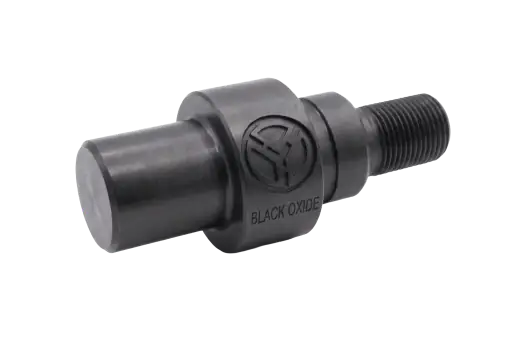
Black oxide is a chemical treatment used primarily on steel to create a uniform black surface with light anticorrosive protection and a clean industrial appearance. It is widely used on tools, fasteners, mechanical components, and industrial parts where glare reduction and improved surface appearance are desired.
Black oxide is a chemical conversion surface treatment used primarily on steel and other ferrous metals to create a uniform black layer that improves visual appearance and provides light corrosion resistance.
This finish is widely used on CNC machined parts, tools, fasteners, mechanical components, and industrial products where a uniform dark appearance is desired without adding significant thickness to the part.
Unlike thick coatings such as paint or powder coat, black oxide produces an extremely thin layer that maintains critical dimensions and preserves much of the original material texture.
Specifications
Black Oxide Finish Specifications
Key characteristics of black oxide finishing related to surface appearance, anticorrosive protection, and industrial applications on steel.
Black Oxide Finish Overview
Finish Type
Chemical conversion surface treatment for ferrous metals
Base Process
Chemical conversion through controlled oxidation baths
Main Purpose
Create uniform black appearance and light anticorrosive protection
Typical Appearance
Matte or satin black surface with uniform industrial finish
Typical Surface Roughness
Maintains virtually the original texture of the part
Secondary Operations
Can be complemented with oil or sealers to improve protection
Dimensional Impact
Very low due to the extremely thin treatment thickness
Corrosion Resistance
Light to moderate depending on sealers and environmental conditions
Cosmetic Performance
Good for dark industrial appearance and glare reduction
Lead Time
Generally fast for industrial production
Compatible Materials
Primarily steel, stainless steel, and other compatible ferrous metals
Typical Applications
Tools, fasteners, mechanical components, and industrial parts
Compatibility with Other Finishes
Can be combined with protective oils or additional anticorrosive treatments
Performance
Black Oxide Finish Performance Overview
General comparison of key criteria for finish selection on steel parts, mechanical components, and industrial applications requiring uniform black appearance, low dimensional impact, and light anticorrosive protection.
Dimensional Precision
Manufacturing Speed
Relative Cost
Cosmetic Appearance
Corrosion Resistance
Surface Durability
Visual Consistency
Production Suitability
Need parts with black oxide finishing?
Upload your CAD files or technical drawings and receive a fast quote for metal parts with black oxide finishing, ideal for mechanical, industrial applications, and components with uniform black appearance.
Where Black Oxide is Commonly Used
Black oxide finishing is widely used on steel parts and industrial components where uniform black appearance, low dimensional impact, glare reduction, and light surface protection are required. It is especially common on tools, fasteners, mechanical components, and functional parts.
Tools and mechanical components
Fasteners, screws, and bolts
CNC machined steel parts
Industrial components with black appearance
Parts requiring glare reduction
Shafts, bushings, and assembly components
Parts with critical tolerances
Functional components with low dimensional impact
Metal parts with dark industrial finish
Finish FAQs
Black Oxide FAQs
Common questions about black oxide finishing used on steel parts, mechanical components, and industrial applications.
Finish Guide
Black oxide: uniform black appearance, low dimensional impact, and functional industrial finish
Black oxide is a chemical conversion surface treatment widely used on steel and other ferrous metals to create a uniform black appearance with minimal dimensional change. Unlike thick coatings such as paint or powder coat, black oxide creates an extremely thin layer that preserves geometry, tolerances, and surface texture while improving industrial appearance and reducing glare.
Key things to know about black oxide finishing
Creates a uniform black appearance: Produces a clean dark surface with consistent industrial finish.
Has minimal dimensional impact: The chemical layer is extremely thin compared to other coatings.
Reduces surface glare: Widely used on tools and functional mechanical components.
Very common on steel and ferrous metals: Especially on industrial parts and fasteners.
Can slightly improve corrosion resistance: Especially when combined with oil or sealers.
Maintains original part texture and details: Ideal for components with critical tolerances.
How the black oxide process works
Black oxide uses a controlled chemical process to superficially transform steel and create a dark chemical conversion layer. The treatment is normally complemented with protective oils or sealers to improve anticorrosive performance.
Factors that influence the finish
Type of steel or ferrous material
Surface preparation and cleaning
Chemical process control
Use of subsequent oil or sealers
Geometry and initial surface condition
What to expect visually
Matte or satin black color
Uniform and functional surface
Minimal dimensional alteration
Clean industrial appearance
Strengths and advantages
Excellent dimensional compatibility: Ideal for precision parts and critical tolerances.
Economical and efficient process: Widely used in high-volume industrial production.
Maintains original details and geometries: Does not create thick layers on the surface.
Reduces surface glare: Especially useful on tools and mechanical components.
Compatible with multiple steel components: Very common on fasteners and functional parts.
Can be applied quickly in industrial manufacturing: Suitable for repeat production.
Limitations and trade-offs
Anticorrosive protection is limited: Especially without additional oils or sealers.
Not a highly decorative finish: Its primary function is industrial and functional.
Lower surface resistance than thick coatings: Not designed for severe abrasion.
Primarily compatible with ferrous metals: Limited compared to more universal finishes.
Appearance may vary based on base material: Different steels react differently.
Design and manufacturing considerations
When to specify black oxide
Black oxide is typically used when a uniform black appearance is needed with minimal dimensional change and low processing cost.
Fasteners and mechanical components
Tools and functional parts
Parts with critical tolerances
Applications where glare reduction is desired
When to consider another finish
Severe outdoor applications
Components with high corrosion exposure
Parts requiring custom decorative color
Surfaces exposed to intense abrasive wear
Documentation on the technical drawing
Clearly specify "black oxide"
Clarify if sealer or protective oil is required
Define cosmetic requirements when applicable
Indicate critical surfaces or functional areas
Common applications
Black oxide finishing is widely used on industrial steel components where uniform black appearance, low dimensional impact, and mechanical functionality are required.
Tools and mechanical components
Fasteners and hardware
CNC machined steel parts
Shafts, bushings, and functional components
Industrial parts with dark finish
Components with glare reduction
When black oxide is the best choice
Choose black oxide when you need a functional black appearance with minimal dimensional change and efficient industrial processing.
Choose black oxide for precision steel parts
Choose black oxide for tools and fasteners
Choose black oxide for functional industrial components
Choose black oxide when uniform black appearance is required without thick coatings