
Precision CNC Milling

Custom CNC
Milling Services

3, 4 & 5-axis CNC milling for prismatic parts, tight tolerances, and production-ready repeatability—optimized by manufacturing engineers.
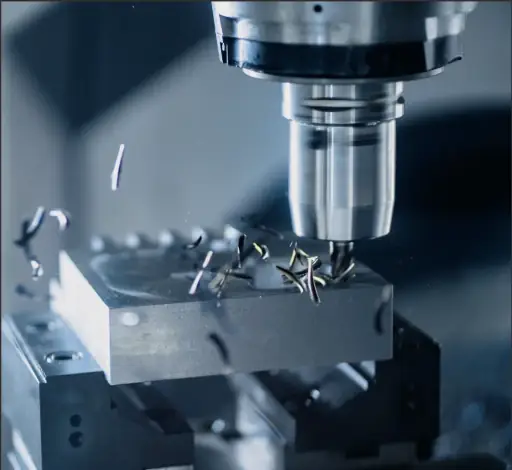
High-precision CNC milling center producing custom milled parts with tight tolerances

Precision

±0.001"

Lead Time

3–5 Days

Volumes

1–10k+ Pcs

In-House Process

CNC milling and dimensional inspection performed in-house.

Controlled

CNC Milling

Why Choose PREMSA for Custom CNC Milling

PREMSA delivers precision CNC milling services built for engineers who need tight tolerances, repeatable geometry, and dependable lead times. We machine production-grade metals and engineering plastics from your CAD data, with clear communication on manufacturability, cost drivers, and inspection requirements.

Our CNC milling workflow is engineering-driven: we validate critical features, confirm datums and GD&T intent, and recommend practical changes that reduce cycle time without sacrificing performance. This approach minimizes revisions, prevents tolerance stack-up issues, and improves first-pass yield for complex milled components.

From rapid CNC milling prototypes to scalable production, PREMSA supports consistent quality with documented processes, optional material certifications (MTR/CoC), and inspection reporting. Customers choose PREMSA for CNC milling because we deliver manufacturable solutions—accurate parts, predictable outcomes, and technical accountability.

What is CNC Milling?

CNC milling is a subtractive manufacturing process that uses rotating cutting tools to remove material from a solid block or plate and create precise 3D features. A CNC mill follows programmed toolpaths to machine pockets, slots, contours, holes, and planar surfaces with controlled tolerances and repeatable results.

Engineers use CNC milling for functional, production-grade parts that require high accuracy, strong material properties, and clean surface finishes. CNC milling is ideal for prismatic components, complex housings, fixtures, brackets, manifolds, and multi-face parts that benefit from 3-axis, 4-axis, or 5-axis machining strategies.

How CNC Milling Works

A practical workflow from CAD to finished milled parts—optimized for accuracy, cost, and lead time.

1. CAD Review & DFM

We review your 3D model and drawings to confirm datums, critical tolerances, wall thickness, internal radii, and tool access. This DFM step identifies risk areas early and aligns machining strategy with functional intent.

2. CAM Programming

Our engineers select tools and create optimized toolpaths for roughing, semi-finishing, and finishing based on material, feature depth, and surface finish (Ra) requirements. Programming choices directly impact cost-per-part and repeatability.

3. CNC Milling Operation

Parts are machined on calibrated CNC milling centers using controlled feeds/speeds and rigid workholding. Multi-axis setups reduce repositioning, improving geometric accuracy and minimizing tolerance stack-up.

4. Inspection & Verification

Critical dimensions are verified with appropriate metrology—calipers, height gages, optical tools, or CMM inspection. We can provide inspection reports and certification documentation when required.

Types of CNC Mills

3-Axis CNC Milling

The most common CNC milling setup for flat and prismatic parts. Best for pockets, slots, hole patterns, and planar features. Cost-effective for prototypes and production when features are accessible from standard orientations.

4-Axis CNC Milling (Indexed or Continuous)

Adds a rotary axis to machine multiple faces with fewer setups. Improves positional accuracy and reduces handling for parts requiring features around a circumference or multi-side machining.

5-Axis CNC Milling

Enables complex contours, angled features, and tight-tolerance multi-face machining in fewer setups. Ideal for aerospace surfaces, impellers, complex brackets, and parts where geometric precision and surface quality are critical.

Benefits of CNC Milling

High Accuracy & Repeatability

CNC milling produces consistent parts with predictable tolerances, making it ideal for assemblies, precision interfaces, and repeat production orders.

Production-Grade Materials

Machine real engineering metals and plastics—aluminum, steel, stainless, titanium, acetal, PEEK, and more—maintaining material integrity for end-use applications.

Complex Features in Fewer Setups

Multi-axis CNC milling reduces repositioning, improves geometric accuracy, and helps control true position, perpendicularity, and profile tolerances on multi-face parts.

Controlled Surface Finish Options

Achieve functional and cosmetic finishes with specified roughness (Ra), bead blasting, anodizing, plating, and other secondary operations tailored to your application.

Fast Prototyping to Scalable Production

CNC milling supports rapid iteration for prototypes and reliable scaling for low-to-mid volume manufacturing—without the cost and lead time of hard tooling.

DFM-Driven Cost Optimization

Practical DFM feedback—like increasing internal radii, reducing deep pockets, and limiting tight tolerances to critical features—can significantly lower cycle time and unit cost.

Capacity Benchmarks

Work Envelope & CNC Milling Capabilities

Maximum Part Size

CNC milling work envelope supported across 3-axis, 4-axis, and 5-axis platforms. Suitable for large prismatic components, multi-face machining, and complex fixturing where dimensional alignment across multiple planes is required.

40" x 20" x 20"

Minimum Feature Size

Minimum achievable feature size in CNC milling depends on material properties, cutter diameter, tool reach, and part rigidity. Fine features, thin walls, and tight internal radii are evaluated through DFM to ensure machining stability and repeatability.

±0.001" / 0.005" Rad

Batch Sizes & Volumes

CNC milling capacity supports everything from single-part prototypes to repeat production programs. Process documentation and inspection strategies scale with volume to maintain consistent quality.

1 – 10,000+ Parts

Exceeding these limits?

Non-standard part sizes, geometries, or machining constraints are reviewed regularly. Upload your CAD for a custom CNC milling engineering assessment.

CNC Milling Tolerances & GD&T

CNC milling tolerances and GD&T definitions directly influence machining strategy, setup planning, and inspection methods. Clearly identifying critical features enables proper tool selection, datum alignment, and repeatable results across multi-axis milling operations.

CategoryTechnical DescriptionTypical Notes
Standard CNC Milling TolerancesStandard tolerances commonly achieved in CNC milling without special environmental control or custom fixturing. Typical defaults include ±0.005" or ISO 2768-m for prismatic, multi-face milled components.

Apply standard tolerances wherever possible to reduce setup complexity and machining time.

Tight & Precision Milling TolerancesTolerances down to ±0.001" are achievable with stable datums, rigid workholding, controlled cutting forces, and optimized finishing strategies during CNC milling.

Restrict tight tolerances to functional features to control cost and inspection effort.

Threads & Tapped HolesThreaded features produced via CNC milling and tapping in accordance with ASME (UNC/UNF) or ISO metric standards. Thread depth and class selection impact tool life and cycle time.

Specify thread standard, class, depth, and preferred method (thread milling or tapping).

Surface Finish (Ra)Surface roughness in CNC milling is controlled by cutter geometry, step-over, spindle speed, and finishing passes. Typical as-milled surfaces range from Ra 125 to Ra 32, with finer finishes achievable on accessible features.

Call out Ra only on functional or cosmetic surfaces to avoid unnecessary finishing operations.

Inspection & GD&T VerificationVerification of milled features and GD&T characteristics such as flatness, perpendicularity, true position, and profile using calibrated CMMs and precision metrology equipment.

Define inspection scope early (spot check, full inspection, or FAI) to align expectations on cost and lead time.

Standard Reference: ISO 2768-m (Medium) unless otherwise specified

CNC Milling Materials

We machine a wide selection of production-grade metals and engineering plastics. Don’t see your specific material? Upload your spec and our team will confirm availability and custom machinability within 24 hours.

CNC Milling Metals

CNC Machining Plastics

Surface Finishes

Select a finish to enhance functional performance—including corrosion resistance, wear protection, electrical conductivity, or cosmetic requirements. Need a custom specification? Upload your print or finishing spec and our team will validate process compatibility and availability.

CNC Milling Finishing Options

CNC Milling Design Guidelines (DFM) (DFM)

Designing parts specifically for CNC milling improves manufacturability, shortens lead times, and reduces cost per part. These CNC milling DFM guidelines address tool accessibility, feature stability, and tolerance control to ensure predictable results across 3-axis and multi-axis milling operations.

Design FeatureTechnical Recommendation
Internal Corner Radii & End Mill AccessInternal corners should be designed to accommodate standard end mill diameters. Sharp internal corners increase tool deflection and machining time. As a guideline, use internal radii equal to or greater than 10–15% of pocket depth to improve surface finish and dimensional consistency.
Minimum Wall Thickness for CNC MillingThin walls are susceptible to vibration and deflection during milling. Maintain minimum wall thicknesses of approximately 0.020" (0.5 mm) for metals and 0.040" (1.0 mm) for plastics to preserve dimensional accuracy and surface integrity.
Hole Depth Ratios & Thread EngagementFor drilled features, limit depth-to-diameter ratios to 8–10× to maintain straightness and tool life. Threaded features typically require 1.5–2× diameter engagement; deeper threads add cost and risk without improving mechanical performance.
Undercuts, Side Features & Tool ReachUndercuts and side features requiring specialty cutters should be avoided unless functionally necessary. Features that can be machined in a single CNC milling setup reduce fixturing complexity and improve positional accuracy.
Setup Strategy & Machining ComplexityParts designed for standard 3-axis or 5-axis milling orientations reduce re-clamping and tolerance stack-up. Minimizing setup count is one of the most effective ways to lower CNC milling costs and improve repeatability.
2D Drawings, GD&T & Inspection RequirementsClearly define functional datums, GD&T callouts, thread specifications, and surface roughness (Ra) only where required. Complete and unambiguous drawings streamline CNC milling workflows and first-article inspection processes.

Applications & Industries

CNC Milling Applications

Structural Machined Components

Structural Machined Components

CNC milled plates, brackets, frames, and load-bearing components where flatness, parallelism, and positional accuracy across multiple faces are critical.

Multi-Face Precision Hardware

Multi-Face Precision Hardware

Prismatic parts requiring accurate feature-to-feature relationships across multiple setups or 5-axis orientations, driven by datum-based milling strategies.

Assembly-Ready Machined Parts

Assembly-Ready Machined Parts

Finished CNC milled components delivered to final tolerance and surface finish, ready for direct mechanical assembly without secondary operations.

FAQs & Knowledge Base

CNC Milling FAQs

PREMSA Industries

Ready to start your CNC milling project?

Upload your CAD files for a fast technical review focused on milling feasibility, tolerances, and setup strategy.

Typical Response: Under 2 Hours