
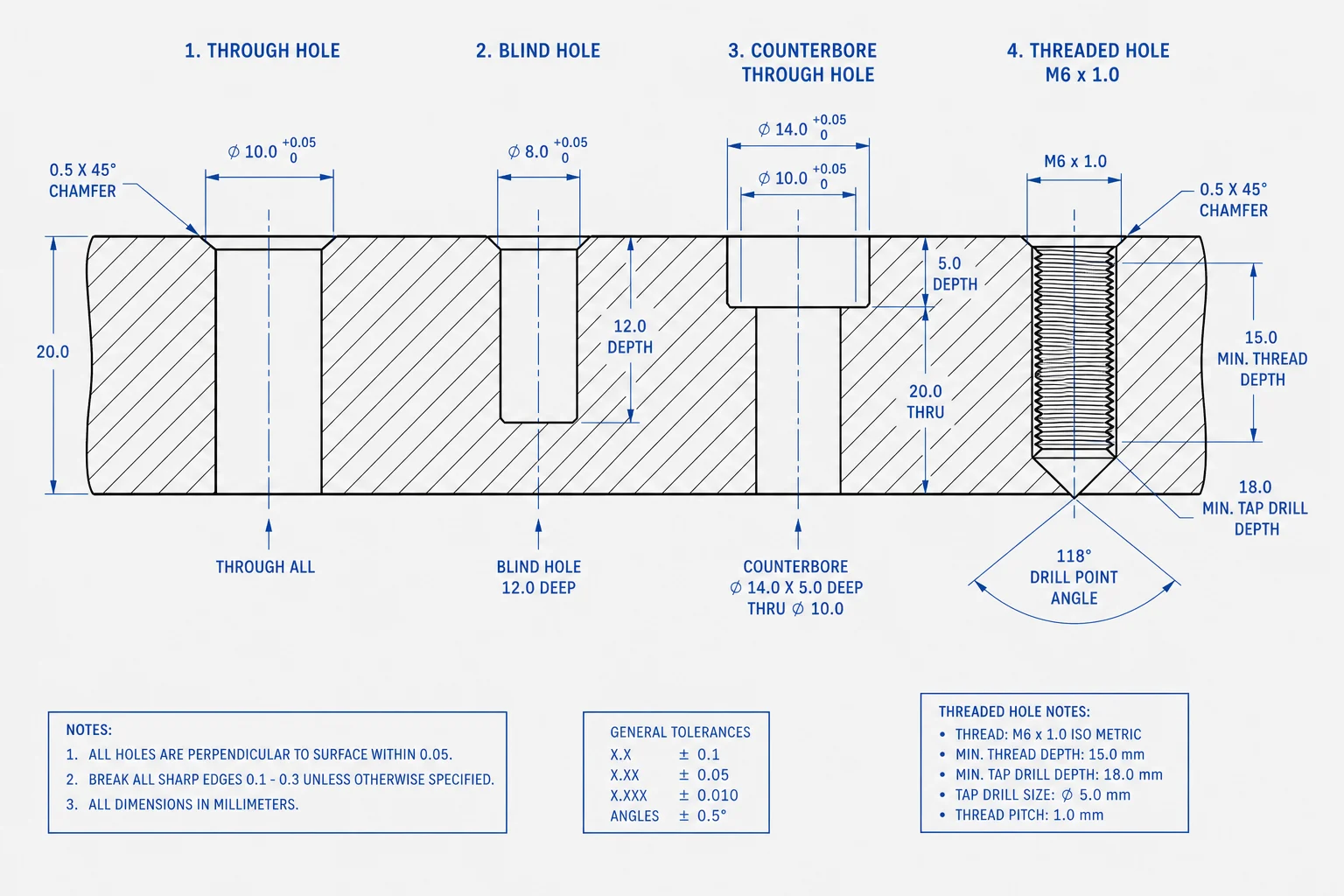
Tap drills, threads, and CNC hole diameters
An incorrect tap drill can turn a straightforward threading operation into an expensive problem. If the hole is too small, cutting torque rises, tool wear increases, and the risk of breaking a tap inside the part goes up. If the hole is too large, thread engagement drops and the joint may fail under load.
That is why it is important to validate the correct drill diameter before programming a CNC tapping cycle, releasing a manufacturing drawing, or submitting a STEP file for quote.
This tool provides quick tap drill lookups for the thread series most used in manufacturing:
- Metric coarse
- Metric fine
- UNC
- UNF
- NPT
In addition to the interactive calculator, you will find complete reference tables with inch and millimeter equivalents, standard drill diameters, number drills, letter drills, and common clearance holes used in CNC machining.
Why tap drill diameter matters
Thread strength is not defined by nominal size alone. Thread percentage, engagement depth, part material, and manufacturing method all influence the final result.
A difference of just a few tenths of a millimeter can affect:
- Mechanical strength of the threaded joint
- Tap tool life
- CNC cycle time
- Thread quality
- Risk of rework or scrap
For that reason, design engineers, CAM programmers, quality teams, and CNC operators constantly rely on tap drill charts, thread drill size tables, and drill-and-tap references during part development.
Common applications
This reference is useful for:
- CNC machined part design
- Manufacturing drawings
- CAM programming
- Drilling and tapping operations
- Dimensional inspection
- Cutting tool selection
- Prototype and production projects
If you are designing a part for manufacturing, we also recommend our CNC Design Guide, which covers thread depth, blind holes, helicoils, inserts, tolerances, and DFM recommendations to reduce manufacturing cost.