Key manufacturing characteristics of acrylic
- Clear: it transmits about 92% of light.
- Rigid: 2.7 GPa elastic modulus.
- UV resistant: it doesn’t yellow.
- Good finish: edges can be polished clear.
- Machinable: with CNC milling and CNC turning.

Loading…
Manufacturing services
CNC milling and turning · From 1 part
Clear acrylic plates, covers, sight windows, panels, lenses, brackets and display parts, milled and turned from your file. Upload your CAD and order online, starting at a single part.
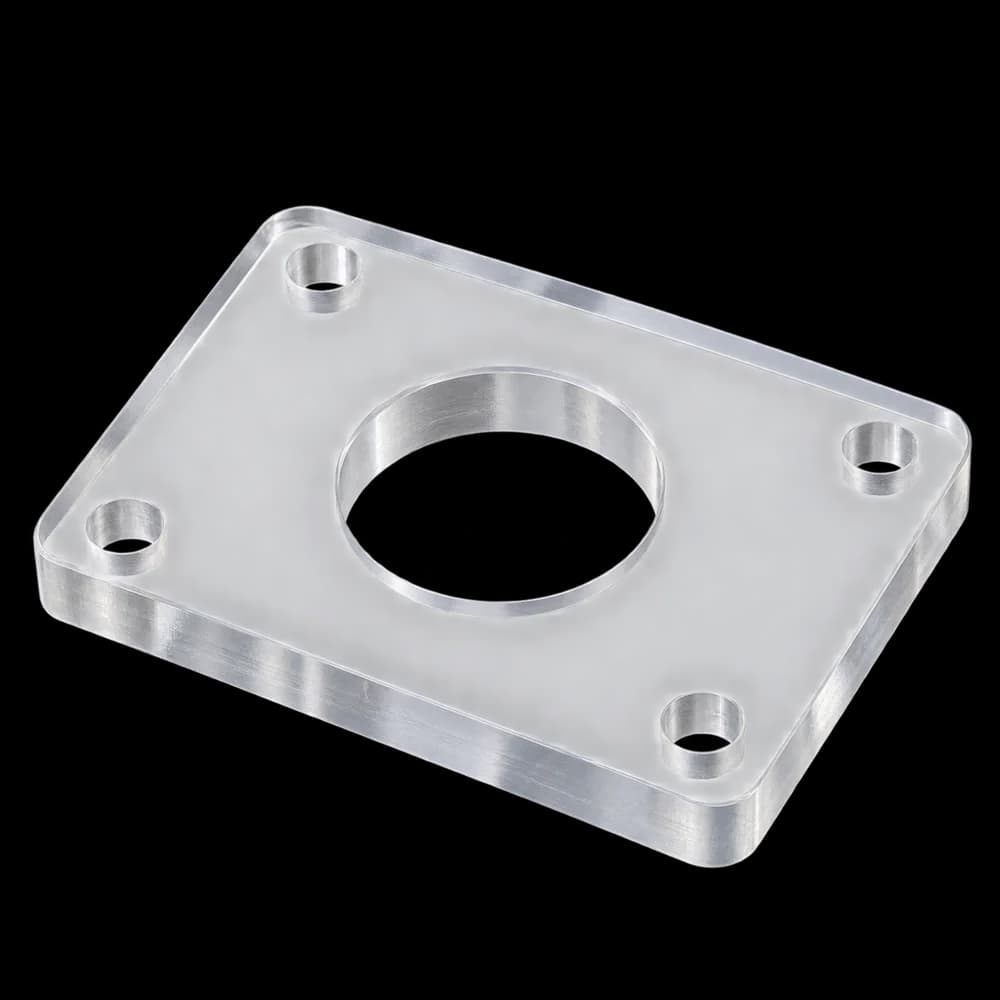
Adapter plate
Acrylic (PMMA) · 80 × 60 × 10 mm · Ø30 center bore · 4 × Ø5.5 holes · Polished edges · CNC milled
1 pc
$48.79 USD
per part
25 pcs
$9.55 USD
per part
-80.43%100 pcs
$8.13 USD
per part
-83.34%Acrylic (PMMA, polymethyl methacrylate) is a clear, rigid plastic. It transmits about 92% of light, weighs 1.18 g/cm³, takes 55–70 MPa in tension and holds up well in sunlight. That is why it is used for covers, sight windows, panels, lenses, plates and display parts. At PREMSA we CNC mill and turn it from your file, with polished edges if you need them, starting at a single part with an instant price.

Acrylic (PMMA) properties: optical, mechanical and thermal data to choose the material for your machined part.
Material Type
Amorphous thermoplastic (PMMA)
Primary Characteristics
Clear, rigid, good finish, UV resistant; brittle under hard impacts
Tensile Strength (Ultimate)
8,000–10,000 psi (55–70 MPa)
Flexural Strength
11,000–17,000 psi (75–117 MPa)
Elongation at Break
3–6%
Impact Resistance
Low to moderate: it can break under a hard impact
Hardness
Rockwell M90–M105
Density
1.18 g/cm³ (0.043 lb/in³)
Elastic Modulus
400,000 psi (2.7 GPa)
Light Transmission
≈92%
Refractive Index
1.49
Heat Deflection Temperature
90–105 °C (194–221 °F)
Glass Transition Temperature
~105 °C (221 °F)
Thermal Conductivity
0.19 W/m·K
Machinability
Good: it is machined with sharp tooling, a good feed and without heating the part so it doesn’t melt or chip; edges can be polished
Formability
Good (thermoforming compatible)
Chemical Resistance
Moderate: alcohol, solvents and some cleaners crack it
UV Resistance
Excellent: it doesn’t yellow in sunlight
Common Forms
Sheet, plate and rod; cast and extruded acrylic
Typical Applications
Covers and sight windows, clear panels, lenses and light guides, plates, display parts, signage, protective barriers
Rating across key engineering and manufacturing criteria.
Strength
Weight
Machinability
Optical Clarity
Impact Resistance
Formability
UV Resistance
Cost Efficiency
Upload your CAD file and get an instant price and delivery date. CNC milling and turning from one part to production.
We CNC mill and turn acrylic parts that have to be clear, rigid and finish well.
Clear plates and bases
Covers and lids
Sight windows
Equipment panels
Lenses and light guides
Display parts
Signage
Protective barriers
Custom acrylic parts
What people ask most about acrylic parts: what it is, uses, machining, polishing, clarity, strength, temperature, chemicals, outdoor use, price and tolerances.
Acrylic is chosen for parts you need to see through: covers, sight windows, panels, lenses, plates and display parts.
At PREMSA Industries we machine acrylic with CNC milling and turning from your file, from a prototype to production.
Acrylic is chosen when the part has to be clear, rigid and look good.
If your drawing doesn’t specify tolerances, we machine to ISO 2768-m (medium). On dimensions you call out —holes, pockets and fits— we can hold ±0.05 mm (±0.002 in), and critical dimensions are checked in inspection. Acrylic expands with heat, so tight dimensions are measured at room temperature.
Acrylic is machined with CNC milling, CNC turning, drilling and tapping. It is cut with sharp tooling, a good feed and air or coolant: if it heats up, it melts at the edge; if the tool is dull or the feed is rough, it chips. Holes are drilled with plastic drills and edges are polished last.
Because it is clear, rigid and machines well, acrylic is used in many parts made with CNC machining.
Acrylic is usually the right choice when the part has to be clear and rigid, without hard impacts or solvents.