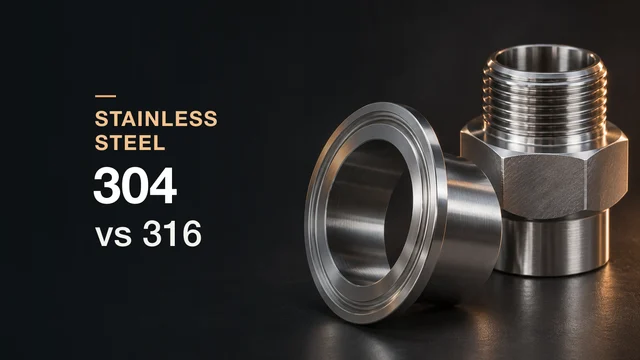

When a drawing says «stainless steel» and nothing else, the part gets quoted in 304. When it says 316, it is almost always because someone was thinking about corrosion. The two belong to the same family, look identical fresh off the machine, weigh the same and take practically the same load; what separates them is the 2 to 3 % molybdenum that 316 carries and 304 does not, and that detail decides whether a part survives years in contact with chlorides or starts pitting within months. It also decides the material price and how much it costs to machine.
This guide compares the two alloys using the numbers that matter for a machined part: composition, mechanical properties, corrosion, how they behave on the machine, welding, magnetism, temperature and what changes on the quote. At the end there is a worked case with the same fitting solved in 304 and in 316, and a short checklist for deciding without guessing.
304 vs 316: the short answer
If you only get to decide one thing, decide based on the environment the part will work in. Mechanical strength does not separate these two alloys; the medium does. This table summarizes where to start.
| What the part faces | Start with | Why |
|---|---|---|
| Indoors, urban weather, potable water, oils, air | 304 | Its passive layer holds up with no trouble; the molybdenum in 316 adds nothing here and costs more. |
| Food, dairy, brewing, cleaning with alkaline detergents | 304 | It is the food industry standard; 316 only when the process or the cleaning brings chlorides. |
| Seawater, brine, coastal environment, de-icing salt | 316 | Chlorides pit 304; the PREN of 23 to 28 in 316 holds up far longer before pitting. |
| Hypochlorite, dilute acids, chemical and pharmaceutical processes | 316 | Better general resistance to acids and to chloride corrosion; it is what sanitary and pharma standards call for. |
| Part that will be welded and not treated afterward | 304L or 316L | Low carbon keeps chromium carbides from precipitating next to the bead and corroding there. |
| Part that must stay non-magnetic after machining | 316 | Its austenite is more stable; 304 becomes slightly magnetic where it was deformed. |
| Sustained service above 500 °C | Either, with care | Both resist oxidation up to about 870 °C, but both sensitize between 425 and 860 °C unless they are L grades. |
| Cost the least and be available today | 304 | 20 to 35 % cheaper per kilogram, with more bar and plate sizes in stock. |
What 304, 316 and the L mean
The numbers do not describe a property: they are AISI designations that identify a composition. The letter that sometimes follows them does say something concrete about the material, and it is worth knowing what.
The austenitic family: chromium and nickel
304 is the most produced stainless steel in the world. It carries 18 to 20 % chromium and 8 to 10.5 % nickel on an iron base, with a maximum of 0.08 % carbon; hence the trade name «18-8». Chromium forms the passive oxide layer a few nanometers thick that protects the steel and regenerates itself in the presence of oxygen; nickel stabilizes the austenitic structure, which gives it its ductility, its toughness at low temperature and its non-magnetic behavior. It is ductile, weldable, formable and available at any distributor in bar, plate and tube.
The molybdenum in 316
316 starts from the same base but changes the recipe: 16 to 18 % chromium, 10 to 14 % nickel and, the part that matters, 2 to 3 % molybdenum. Molybdenum reinforces the passive layer right at the weak point of 304: localized attack by chloride ions. That is why 316 is called «marine grade» and why pharmaceutical, chemical and process equipment standards with aggressive cleaning call for it. The extra nickel needed to keep the austenite stable with molybdenum is, together with the molybdenum itself, what makes it more expensive.
What the L version is and when it matters
304L and 316L are the same alloys with carbon limited to 0.03 % instead of 0.08 %. Carbon is the welding problem: between 425 and 860 °C, the range the zone next to the bead passes through, carbon combines with chromium and forms carbides at the grain boundaries; that chromium stops protecting and the steel corrodes intergranularly right beside the weld. With 0.03 % carbon there is not enough for that to happen.
The price of the L is slightly less strength: minimum yield drops from 205 to 170 MPa and minimum tensile from 515 to 485 MPa. In practice much of the 304 and 316 sold today is «dual certified» (meets 304 and 304L at once, with low carbon and the strength of the standard grade thanks to nitrogen), so the distributor often delivers L without being asked. For a part that will not be welded, the L adds nothing; for one that will, it is the safe choice.
Mechanical properties side by side
The values are the ASTM A276 minimums for annealed bar, plus typical physical properties from data sheets. Minimums are what you design to; what actually arrives in a bar is usually well above them (around 290 MPa yield and 600 MPa tensile in both).
| Property | 304 | 316 | Difference |
|---|---|---|---|
| Minimum yield strength (0.2 %) | 205 MPa (30 ksi) | 205 MPa (30 ksi) | Same |
| Minimum tensile strength | 515 MPa (75 ksi) | 515 MPa (75 ksi) | Same |
| Minimum elongation in 50 mm | 40 % | 40 % | Same (typical 55 % vs 50 %) |
| Maximum hardness | 201 HB (92 HRB) | 217 HB (95 HRB) | 316 slightly harder |
| Elastic modulus | 193 GPa | 193 GPa | Same |
| Density | 8.00 g/cm³ | 8.00 g/cm³ | Same |
| Thermal conductivity (100 °C) | 16.2 W/m·K | 16.3 W/m·K | Same |
| Thermal expansion (0 to 100 °C) | 17.2 µm/m·K | 16.0 µm/m·K | 316 expands 7 % less |
| Electrical resistivity | 0.72 µΩ·m | 0.74 µΩ·m | Same in practice |
| Melting range | 1,400 to 1,450 °C | 1,375 to 1,400 °C | 316 melts slightly earlier |
| PREN (Cr + 3.3 Mo + 16 N) | 18 to 20 | 23 to 28 | 316 resists pitting better |
| Machinability (AISI 1212 = 100 %) | 45 % | 36 to 40 % | 316 cuts worse |
| Composition | Cr 18-20 · Ni 8-10.5 · C ≤ 0.08 | Cr 16-18 · Ni 10-14 · Mo 2-3 · C ≤ 0.08 | Molybdenum is the difference |
Strength: practically identical
There is nothing to argue here: the specification minimums are identical and typical bar values sit in the same band. A bracket, a shaft or a flange sized in 304 takes exactly the same load in 316 with the same geometry. If a part falls short on strength in 304, 316 does not rescue it; more section does, or switching to a precipitation-hardening stainless such as 17-4 PH, which plays in a different league (over 1,000 MPa yield).
Stiffness and hardness: the same
The elastic modulus is 193 GPa in both: they deflect the same under the same load. Annealed hardness is slightly higher in 316 (217 HB max vs 201), but that difference does not show in the wear of the part; it shows in the tool that cuts it. Both are far below a hardened steel, so for a sliding surface or a bearing seat neither is the right choice without a treatment or a coating.
Work hardening: what does matter on the machine
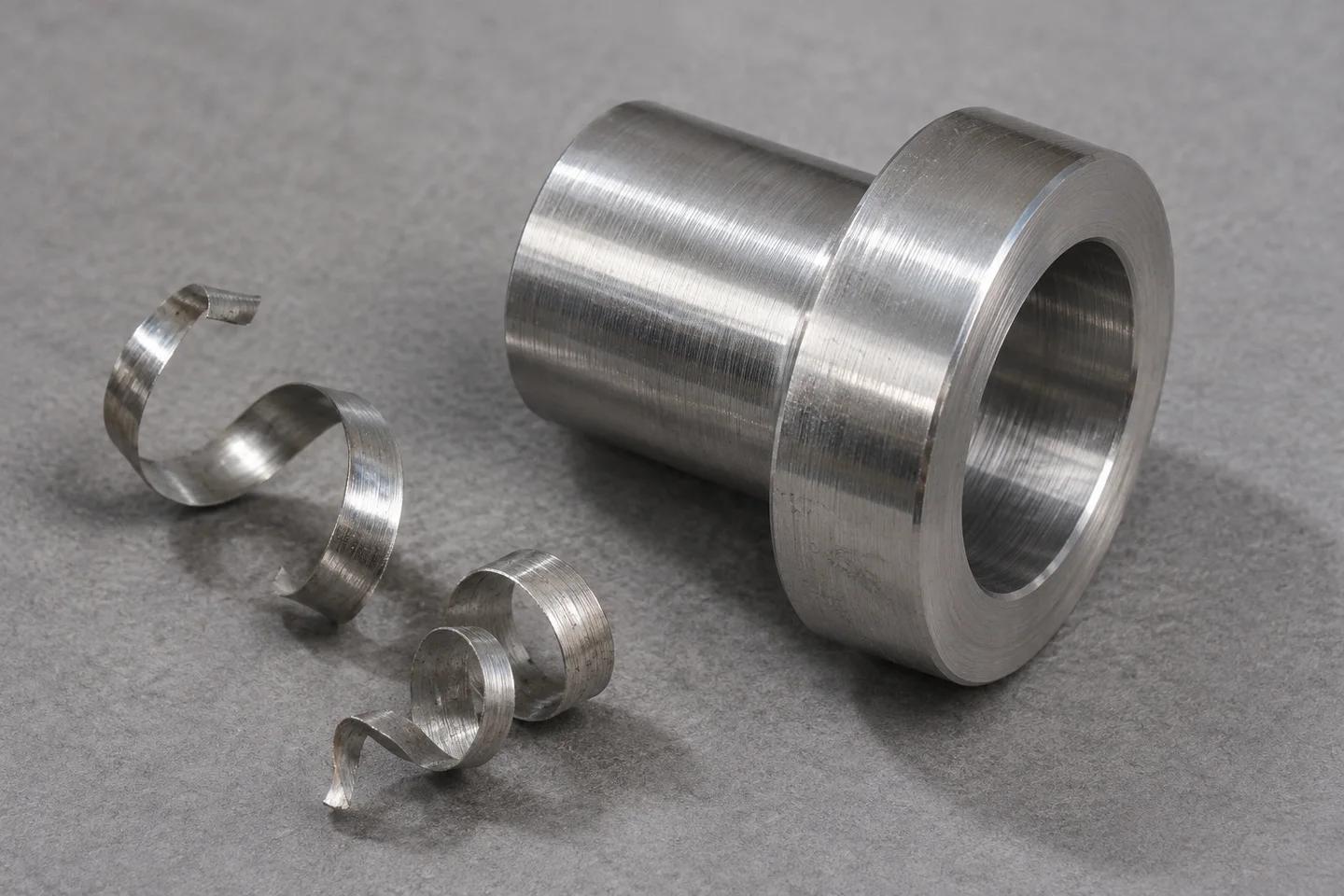
Austenitic steels harden a lot when deformed: 304 goes from about 200 MPa yield annealed to over 1,000 MPa with 60 % cold work. That is what makes them excellent to form and what makes them treacherous on the machine: every pass leaves a hardened layer a few hundredths deep on the surface, and if the next pass does not get under it, the tool rubs on hard material and wears out in minutes. 304 hardens somewhat faster than 316, but both demand the same discipline: constant feed, never let the tool dwell.
Weight and density: the same part weighs the same
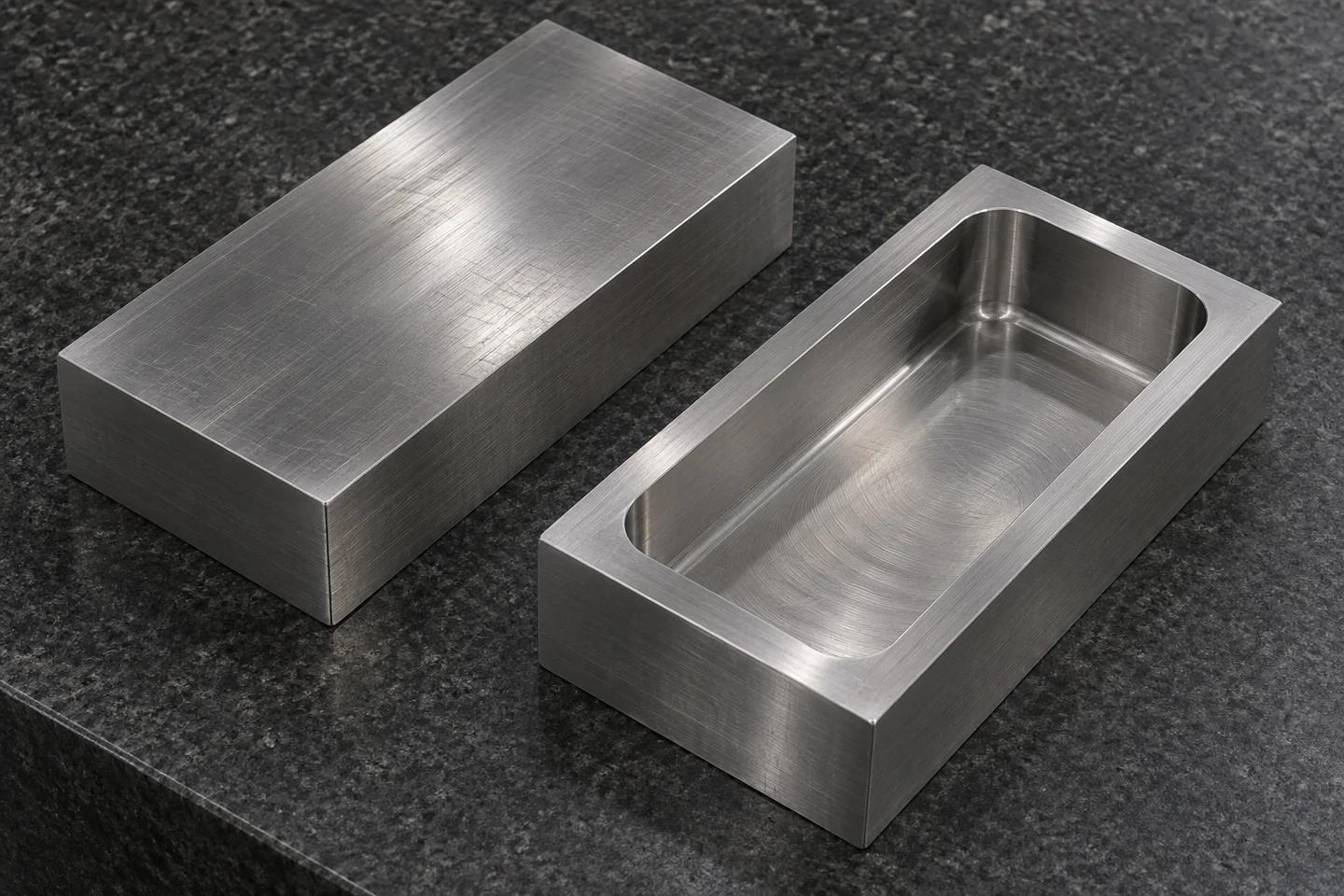
Both have a density of 8.00 g/cm³ (some data sheets give 7.99 for 316; the difference is smaller than the bar tolerance). A 100 cm³ block weighs 800 g in either one, almost three times what the same block weighs in aluminum. Switching from 304 to 316 does not move the weight of the part by a gram, so it does not move the freight either.
What is worth checking on a stainless part is whether it really has to be solid: at 8 g/cm³, a pocket that removes 50 cm³ removes 400 g. To quickly compare the mass of a geometry there is the part weight calculator.
Corrosion: the difference that justifies 316
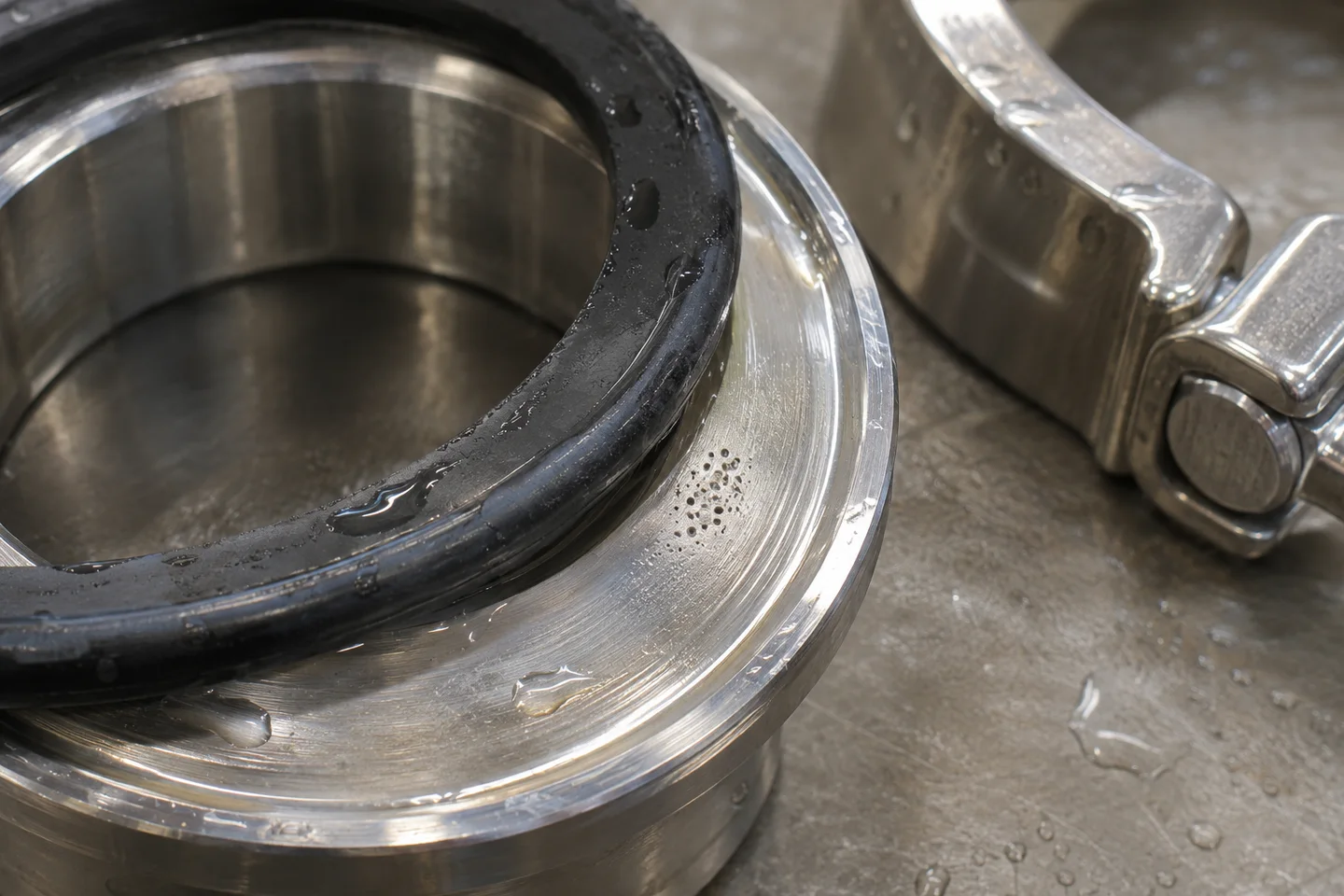
Both alloys protect themselves with the same passive chromium oxide layer, and in most environments both last decades without staining. The difference shows up in localized attack, which is how stainless actually fails: it does not rust evenly like carbon steel, it perforates at a point.
Pitting and chlorides: the PREN index
The chloride ion breaks the passive layer at very small points and, once the pore is open, the chemistry inside the pit turns acidic and keeps it growing. Resistance to this attack is summarized in the PREN (Pitting Resistance Equivalent Number), calculated from composition: PREN = % Cr + 3.3 × % Mo + 16 × % N. 304 lands between 18 and 20; 316 between 23 and 28. Each PREN point raises the temperature and chloride concentration at which the alloy starts to pit.
The rule of thumb equipment makers use: 304 handles water with up to about 200 ppm chlorides at room temperature; 316 up to about 1,000 ppm. Seawater has 19,000 ppm: neither is immune there, but 316 lasts years where 304 pits in months, and for permanent seawater immersion the conversation moves to duplex or super-austenitic grades.
Seawater, chemicals and cleaning
Where 316 pays for itself is in three scenarios. Coast and marine environments, even without immersion: the breeze deposits salt and humidity concentrates it in crevices and under fasteners. Chemical and pharmaceutical processes, where besides chlorides there are dilute acids (sulfuric, phosphoric, acetic) that 316 resists better thanks to its molybdenum. And aggressive cleaning: sodium hypochlorite, chlorinated disinfectants and acidic sanitizers used in food and beverage; a 304 part cleaned with chlorine every day ends up pitted in the crevices even if the product it handles is harmless.
Design detail weighs as much as alloy. A crevice (under a washer, in a thread, in a gasket seat) concentrates chlorides and depletes oxygen, and even 316 pits there. A 304 part with smooth surfaces, no crevices and good drainage outlasts a 316 part full of pockets where water stands.
Stress corrosion cracking
It is the most treacherous failure of austenitic stainless: a part in tension, in contact with chlorides and above about 60 °C cracks without warning and without visible general corrosion. Both grades are susceptible; 316 somewhat less thanks to its nickel and molybdenum, but it is not immune. If a part will work hot, loaded and with chlorides (a heat exchanger, a fitting on a hot process water line), the answer is not in choosing between 304 and 316: it is in lowering the stress, removing the crevices or moving to a duplex alloy.
Machinability: how each one behaves on the machine
Neither is an easy material. Compared with 1212 carbon steel (100 %), 304 rates 45 % machinability and 316 between 36 and 40 %: they cut at half the speed, wear tooling faster and work hardening has to be watched. The difference between them is smaller than the difference between either of them and a carbon steel.
Work hardening and built-up edge
The golden rule of austenitic stainless is that the tool cannot rub. If the feed is too light, the edge rubs the surface instead of cutting it, hardens it, and the next pass meets material at 40 HRC instead of 20. That is why feed per revolution or per tooth is kept above what you would use on carbon steel (0.1 mm per revolution minimum in turning, and never stop the feed with the tool in contact). 316, with its higher nickel content, is gummier and more prone to built-up edge: material welded to the edge that tears off and leaves a scored surface. It is fought with smooth coatings, plenty of coolant and speeds that keep the cutting zone stably hot.
Speeds and tooling
With coated carbide inserts (TiAlN or AlTiN), 304 turns at 120 to 180 m/min and 316 at 100 to 150 m/min; in milling with carbide end mills, 80 to 150 m/min depending on fixture rigidity, at 0.05 to 0.12 mm per tooth. Positive-rake geometries and sharp edges are used, not the robust roughing inserts meant for cast iron. The low thermal conductivity (16 W/m·K, a tenth of aluminum's) keeps the heat at the edge instead of carrying it away with the chip: high-pressure coolant is not optional. In CNC turning and CNC milling the starting parameters for 316 are those of 304 reduced by 15 to 20 %, and tool life is on the order of 20 to 30 % shorter.
Burrs and surface finish
Both leave long, stringy burrs at hole exits and slot edges: the ductility that makes them good to form is what stretches the chip instead of breaking it. The insert's chipbreaker and a firm feed help; hand deburring is quoted separately on parts with many edges. The as-machined finish is good in both (Ra 0.8 to 1.6 µm in finish turning is normal), and well-cut 316 gives a slightly brighter surface. For parts that will be mirror polished or electropolished, both respond the same; 316 is the usual one in sanitary work because electropolishing also improves its passive layer.
Tolerances and dimensional stability
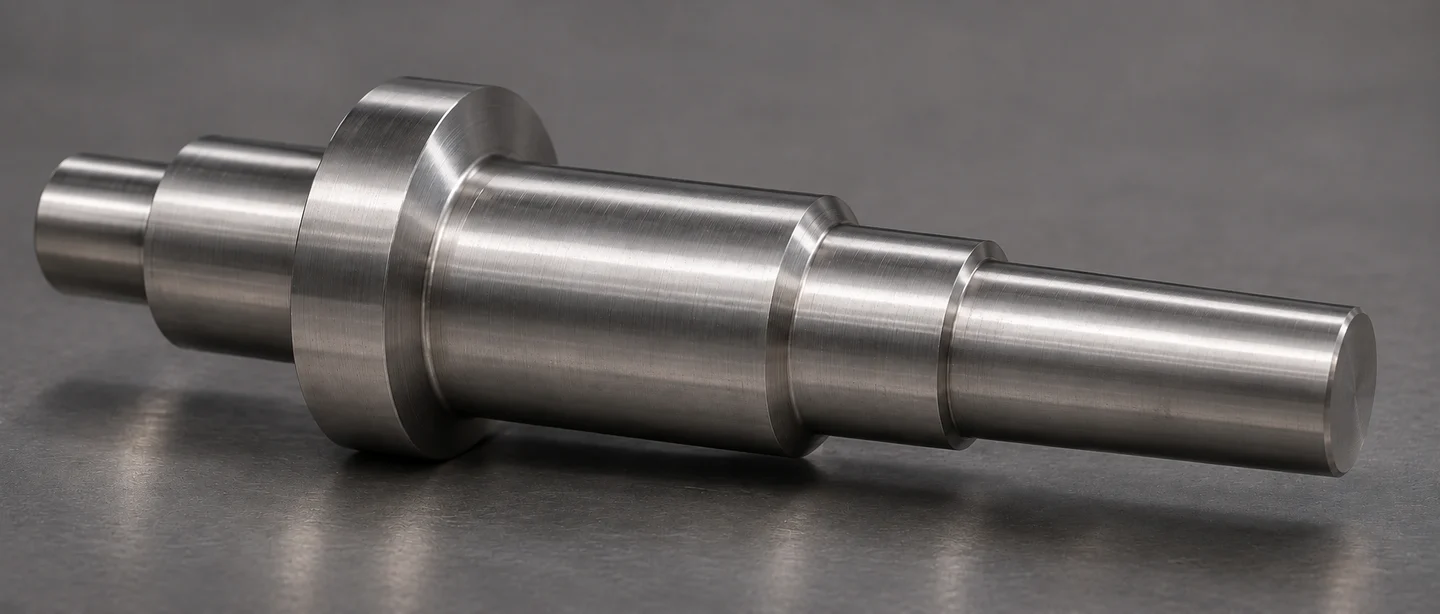
The achievable tolerances are the same in both: ±0.025 mm on controlled milled and turned dimensions, ±0.013 mm on diameters with a dedicated finishing operation, and ISO 2768 general tolerances on the rest. What limits them is not the alloy but the heat of the cut: stainless conducts poorly, the part heats unevenly and a dimension taken hot is wrong.
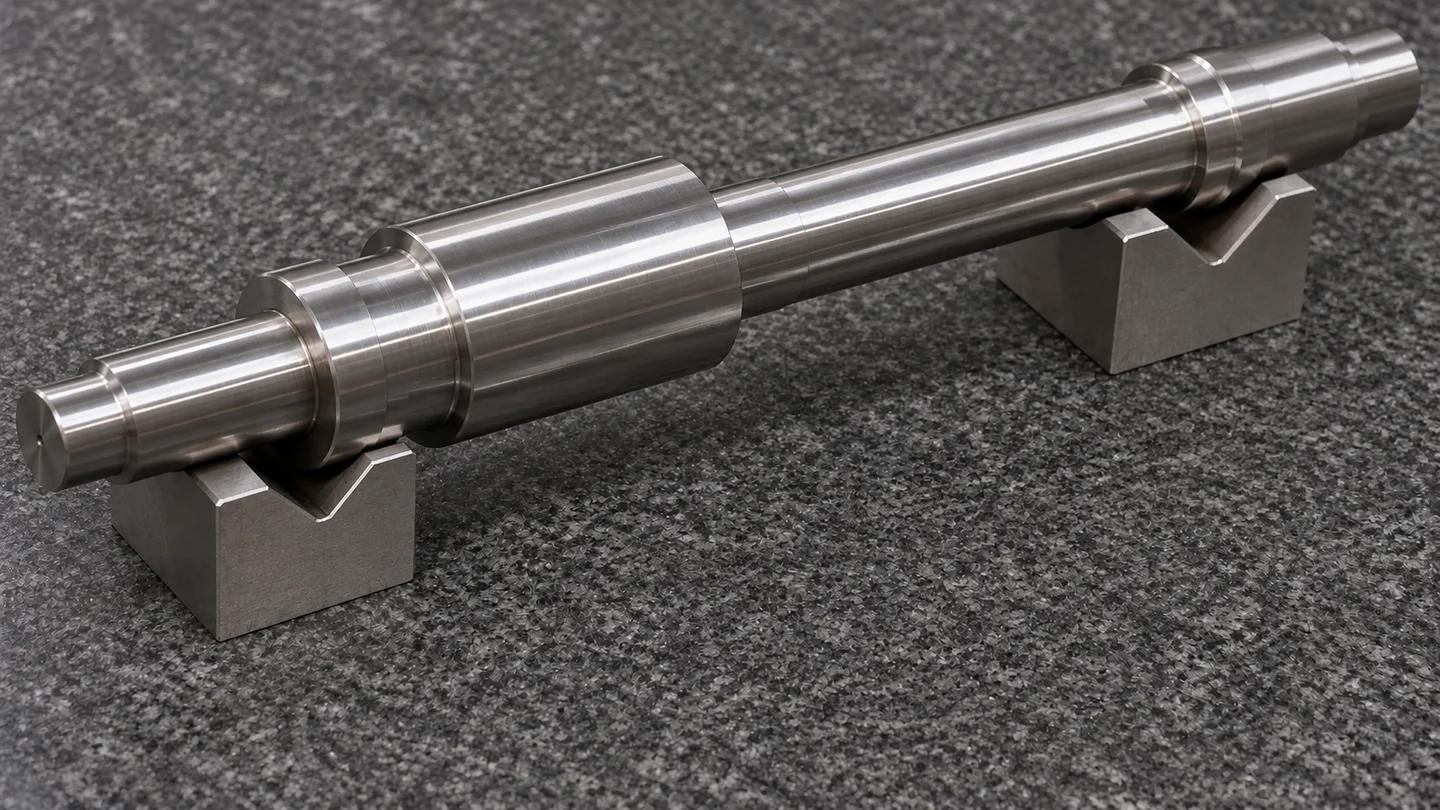
Thermal expansion is 17.2 µm/m·K in 304 and 16.0 in 316, higher than carbon steel (11.7) though lower than aluminum (23.6). A 200 mm shaft that comes off the machine at 35 °C and is measured at 20 °C measures 0.052 mm shorter in 304 and 0.048 mm shorter in 316. On tight tolerances the part is measured at temperature, and on a stainless part with carbon steel assembled to it, remember they expand differently.
Work hardening also leaves residual stress in the machined surface. On thin, long parts, aggressive one-sided roughing bows them; it is controlled by roughing symmetrically, leaving stock and finishing in a second operation, just like aluminum but with more reason.
Welding: both weld, with one warning
Both weld by TIG, MIG and resistance without preheat, with 308L filler for 304 and 316L for 316. They are among the most forgiving steels to weld: they do not harden on cooling, they do not cold crack and the heat-affected zone keeps its ductility.
The warning is sensitization. If carbon is at 0.08 %, the band next to the bead that passed through 425 to 860 °C precipitates chromium carbides at the grain boundaries, and that band corrodes intergranularly as soon as it sees an aggressive environment (the «weld decay» of the handbooks). The three ways out are: use the L version (304L or 316L), which is the simplest and what almost always arrives from the distributor anyway; limit heat input with short beads on thin parts; or solution anneal after welding (1,050 °C and fast cooling), which is expensive and distorts. For a machined part that will be welded into an assembly and work in a corrosive environment, the material is called out as L on the drawing.
Magnetism: why machined 304 attracts a magnet
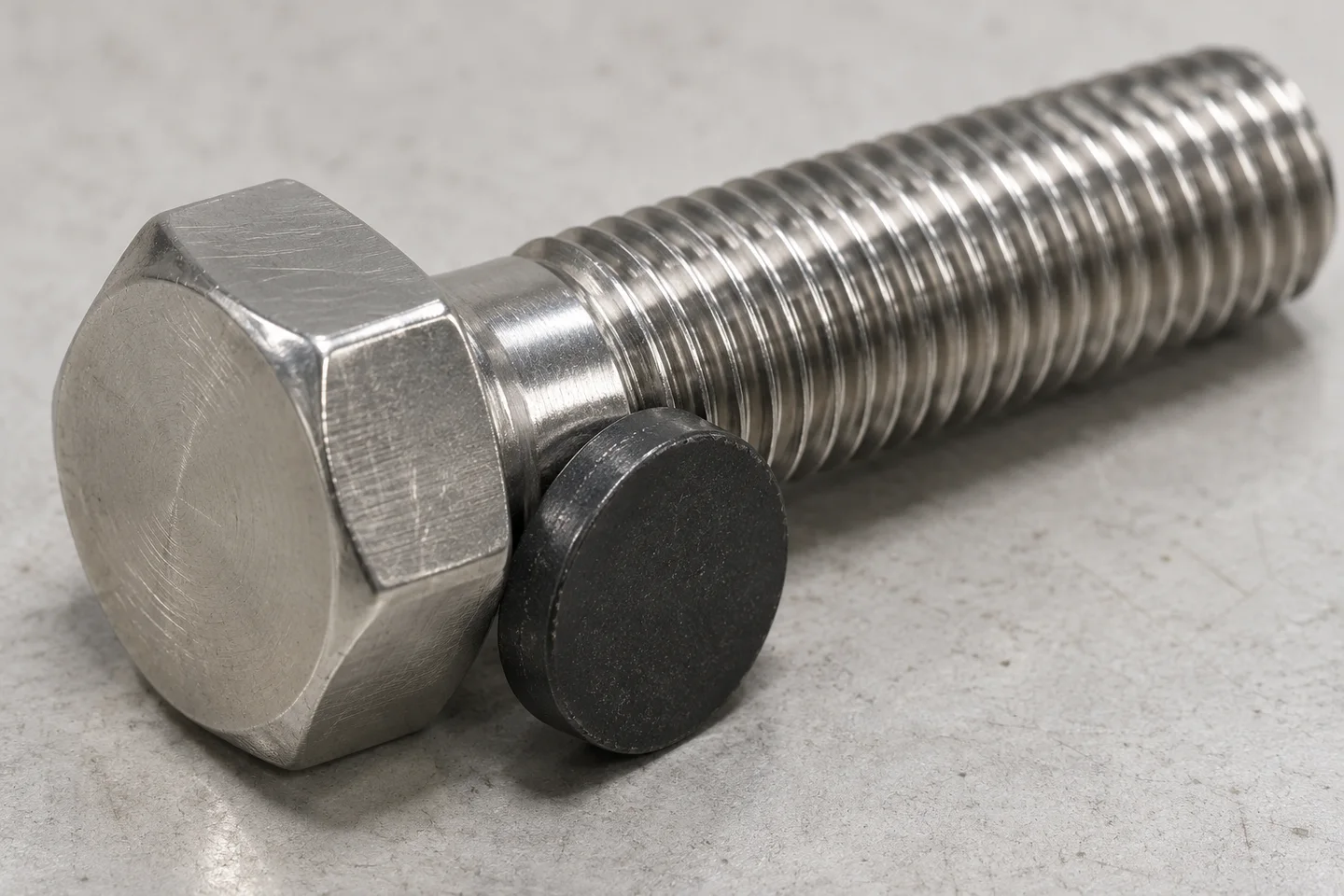
Annealed, 304 and 316 are austenitic and do not attract a magnet. It is a shop-floor test used to tell them from ferritic or martensitic stainless, and it sometimes gives a scare: a freshly machined or threaded 304 part does attract a magnet slightly where it was deformed.
What happens is that the austenite in 304 is not fully stable: cold deformation partly transforms it into martensite, which is magnetic. A rolled thread, a bend or an aggressive machining pass leaves a magnetic surface layer that does not mean the material is something else. 316, with more nickel and with molybdenum, has a more stable austenite and barely transforms; after machining it still does not attract a magnet appreciably. If the part goes near magnetic sensors, in MRI equipment or in instrumentation where low permeability is a requirement, 316 is the choice, and if the requirement is strict it has to be annealed after machining.
Temperature: how far each one works
In continuous service in air, both resist oxidation up to about 870 °C and in intermittent service up to about 925 °C, with 316 slightly better thanks to its composition. For parts that see heat, the question is not which resists more but which range they work in: between 425 and 860 °C both standard grades sensitize over time, just as they do next to a weld, and lose corrosion resistance. For sustained service in that range the L version or the stabilized grades are used.
At low temperature both are excellent: austenite has no ductile-to-brittle transition and they keep their toughness down to cryogenic temperatures. It is one of the reasons they are the material of liquefied gas valves and fittings. Mechanical strength drops with temperature similarly in both: at 500 °C they keep about two thirds of their room-temperature yield.
Availability and stock forms: bar and plate
304 is the stainless with the most sizes in stock: round bar from 3 mm to over 300 mm, square, hex, flat bar and plate from 3 mm to over 100 mm thick, at any industrial distributor. There is almost always a size that wraps the part with little excess, available the same day.
316 is also common in round bar and plate, but with fewer intermediate sizes and less stock in square and hex. In large diameters it may mean waiting on a central warehouse or buying a thicker size. For a quote that means two things: lead time can stretch a few days because of the material, and you may be paying for stainless that ends up as chips. Sizing the part around a commercial 316 size saves more than any tweak to the program, and at 8 g/cm³ and 316 prices, the excess shows on the bill.
For turned production parts where corrosion is not a requirement, there is also 303, 304 with sulfur added for fast machining: it cuts far better, but welds poorly and resists corrosion less.
Cost: what changes on the quote between 304 and 316
There is no single figure for how much more a 316 part costs, because it depends on how much of the total is material. What can be described is which lines move, and in which direction.
| Line item | 304 | 316 | How much it weighs |
|---|---|---|---|
| Raw material per kilogram | Baseline | 20 to 35 % more (nickel and molybdenum) | A lot on thick plate and large bar; less on small parts with heavy machining |
| Stock excess | Plenty of commercial sizes | Fewer sizes, more likely waste | At 8 g/cm³ the excess weighs, and in 316 it costs more |
| Cycle time | Baseline | 15 to 20 % longer (lower cutting speed) | Proportional to the part's machine time |
| Tool wear | High compared with carbon steel | 20 to 30 % higher than 304 | Shows on large lots |
| Deburring and hand finishing | Stringy burr | Same | Minutes per part on parts with many edges |
| Distortion risk | Present on thin parts | Same | Can force an extra operation |
| Lead time | Material available | Can add days if the size is not in stock | Variable |
The practical takeaway is that on a small part with a lot of machine time (a 60 g threaded fitting with two operations) the price difference between the two alloys is small, because material is a minor share of the cost and the cycle rises little. On a 25 mm thick, 400 mm square plate, material is the big line and 316 shows immediately. The instant quote tool prices both options on the same geometry; just switch the material and compare.
Typical applications of each alloy
Applications follow the logic of the environment. Where there are no chlorides or aggressive chemicals, it is 304. Where there are, or where an industry standard calls for it, it is 316.
| Industry | Typical in 304 | Typical in 316 |
|---|---|---|
| Food and beverage | Brackets, bushings, conveyor shafts, fittings in dry zones | Sanitary fittings, valves, parts in contact with brine or chlorinated cleaning |
| Pharmaceutical and biotech | Structure and supports outside the process | Everything that touches product: tri-clamp fittings, spargers, valve bodies, electropolished parts |
| Chemical and petrochemical | Hardware in dry zones | Fittings, flanges, instrument bodies, parts in contact with dilute acids |
| Marine and coastal | Not advisable; sheltered interior only | Deck hardware, pump shafts, fittings, outdoor equipment mounts |
| Automation and machinery | Shafts, bushings, spacers, plates, washdown fixtures | Parts in washdown cells with disinfectant, equipment in food plants |
| Medical and laboratory | Housings, mounts, tooling | Instruments, autoclavable components with chloride cycles, implants (316L or 316LVM) |
| Water and treatment | Potable water, pumps, fittings | Seawater, brine, chlorination, desalination plants |
| Architecture and outdoors | Interior and urban exterior | Coastal exterior, de-icing salt zones, pools |
Worked case: the same fitting in 304 and in 316
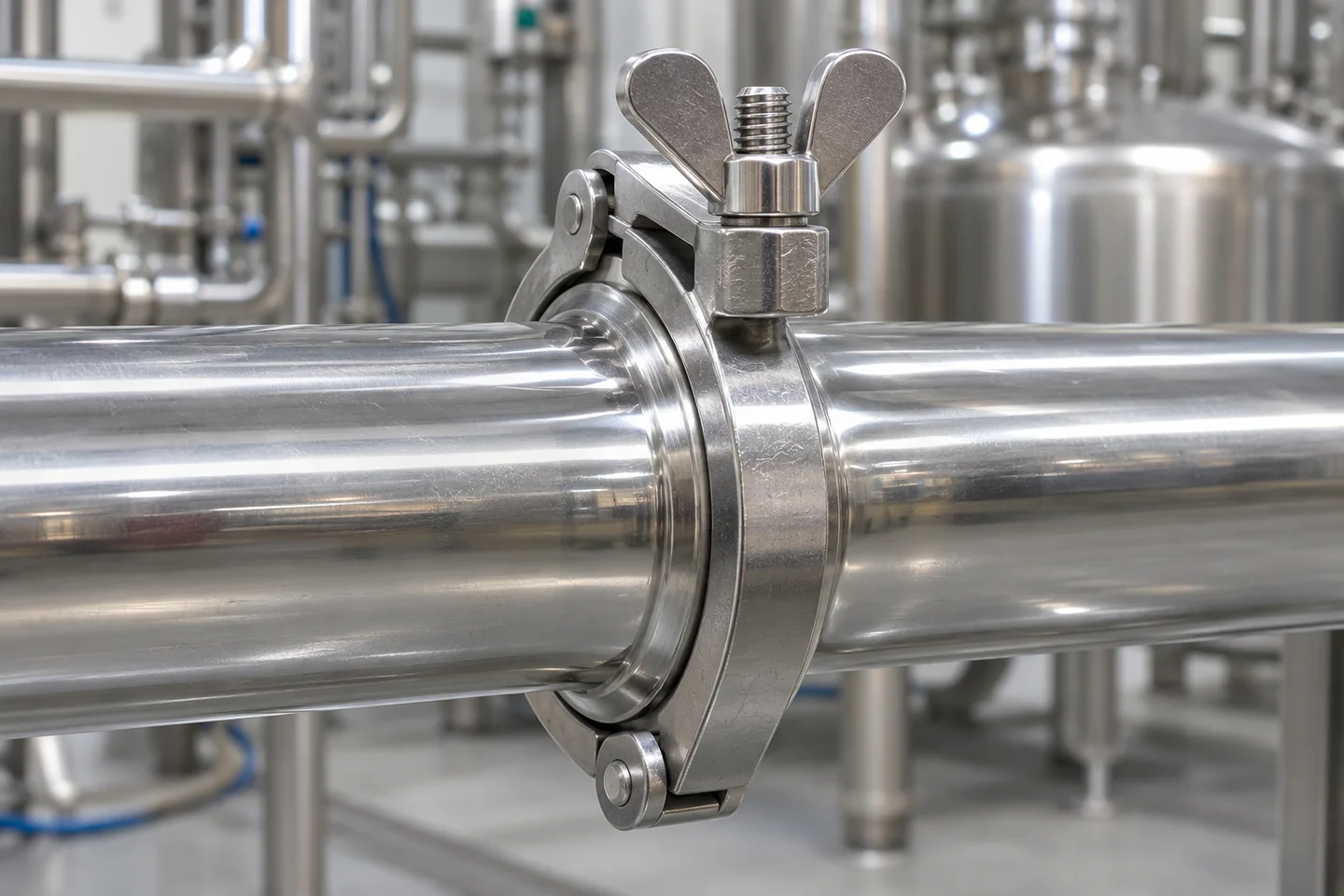
A 3/4 inch threaded fitting joins a process water line to a tank in a food plant. It is machined from 32 mm hex bar, weighs about 90 g finished and carries an NPT thread and an O-ring seat. The customer asks for it in 304 because «it is water». The right question is not what water it carries, but what the line is cleaned with and where the tank sits.
| Condition | 304 | 316 | What decides |
|---|---|---|---|
| Potable water at 25 °C, cleaning with alkaline detergent | Decades without trouble | Decades without trouble | No strong chlorides: 316 adds nothing |
| Same water, daily cleaning with sodium hypochlorite (200 ppm chlorine) | Pitting in the thread and under the seal in 1 to 3 years | No appreciable attack | Chlorides in crevices: this is where 316 pays for itself |
| Hot line at 70 °C with chlorides in the process water | Stress corrosion cracking risk in the thread | Lower risk, but present | Neither is the answer: lower the temperature, remove the crevice or move to duplex |
| Material cost in the part (90 g) | Baseline | A little more per part | Negligible against replacing the fitting |
| Machining time | Baseline | 15 to 20 % more | Minutes; decides nothing on a part this size |
What the rows say: in the first scenario 304 is the right call and asking for 316 is throwing money away. In the second, which is the real one in most food plants, 316 costs a little more per fitting and avoids replacing the part and stopping the line in two years. In the third the alloy is not the variable: the problem is design and process. That is the question to ask before choosing: will the part see chlorides, in crevices, and at what temperature?
The alloy does not fix a crevice or a badly chosen cleaning agent. Before asking for 316, find out what chlorides the part will see and where they will concentrate; with that clear, half the time 304 is enough and the other half 316 pays for itself.
Checklist for deciding
- Identify what the part will touch: potable water, food, oils and air are 304 territory; chlorides, brine, marine environments, dilute acids or chlorinated disinfectants are 316 territory.
- Ask what it is cleaned with, not just what it handles. Chlorine cleaning is the most common cause of pitting in 304 parts that «only saw water».
- Check the crevices in the design: threads, gasket seats, bolted joints. Chlorides concentrate there; remove or drain them before moving up an alloy.
- If there are chlorides, load and temperature above 60 °C at the same time, think stress corrosion cracking: neither 304 nor 316 is the full answer.
- If the part will be welded, call out the L version (304L or 316L) on the drawing.
- If the part goes near magnetic sensors or in equipment where permeability matters, it is 316, annealed after machining if the requirement is strict.
- Do not switch to 316 for strength: it takes the same load as 304. If strength is short, it is more section or a 17-4 PH.
- Size the part around a commercial size of the chosen material, especially in 316, where there is less stock and every kilogram of excess costs more.
- Quote both options on the same geometry and compare: on small parts the difference is usually smaller than expected.
Frequently asked questions about 304 and 316
What we get asked most when quoting stainless steel parts in the two alloys.
- Is 316 stronger than 304?
- No. The specification minimums are identical: 205 MPa yield and 515 MPa tensile in both, with the same 193 GPa modulus. The difference in 316 is chloride corrosion resistance, not mechanical strength.
- What is the real difference between 304 and 316?
- 316 carries 2 to 3 % molybdenum and a little more nickel. Molybdenum raises chloride pitting resistance (PREN of 23 to 28 vs 18 to 20) and improves resistance to dilute acids. Everything else is practically the same.
- When do I need 316 instead of 304?
- When the part will see chlorides: seawater, brine, coastal environments, de-icing salt, hypochlorite or chlorinated disinfectants, chemical and pharmaceutical processes. For indoors, urban weather, potable water and food without chlorinated cleaning, 304 is enough.
- What does the L in 304L and 316L mean?
- Carbon limited to 0.03 % instead of 0.08 %. It keeps chromium carbides from precipitating next to a weld and that zone from corroding. For parts that are welded and not treated afterward, call out the L; for parts that are only machined it is not needed, although much of today's material already comes dual certified.
- Which one machines better?
- 304, though the difference is moderate: 45 % machinability vs 36 to 40 % for 316. Both work-harden as they are cut and call for sharp edges, firm feed and coolant. 316 cuts 15 to 20 % slower and uses 20 to 30 % more tooling.
- How much more does a 316 part cost?
- The material costs 20 to 35 % more per kilogram and the cycle rises 15 to 20 %. On a small part with heavy machining the total difference is small; on thick plate or large bar, material dominates and 316 shows. The way to know is to quote the same geometry in both.
- Does 304 stainless attract a magnet?
- Annealed, no. After machining, threading or bending, the deformed zone partly transforms into martensite and attracts a magnet slightly; it does not mean it is a different material. 316 barely transforms and stays non-magnetic.
- Can 304 and 316 be welded?
- Yes, both, by TIG and MIG, with 308L and 316L filler respectively, without preheat. If the part will work in a corrosive environment and will not be annealed after welding, call out the L version to avoid intergranular corrosion next to the bead.
- Up to what temperature do they work?
- Both resist oxidation up to about 870 °C in continuous service. Between 425 and 860 °C they sensitize over time unless they are L grades. At low temperature, down to cryogenic, they keep their toughness because austenite has no brittle transition.
- Are the achievable tolerances different?
- No. The same milling and turning tolerances are achieved in both. What limits them is the heat of the cut and thermal expansion (17.2 vs 16.0 µm/m·K), so on tight dimensions the part is measured at temperature.
No. The specification minimums are identical: 205 MPa yield and 515 MPa tensile in both, with the same 193 GPa modulus. The difference in 316 is chloride corrosion resistance, not mechanical strength.
316 carries 2 to 3 % molybdenum and a little more nickel. Molybdenum raises chloride pitting resistance (PREN of 23 to 28 vs 18 to 20) and improves resistance to dilute acids. Everything else is practically the same.
When the part will see chlorides: seawater, brine, coastal environments, de-icing salt, hypochlorite or chlorinated disinfectants, chemical and pharmaceutical processes. For indoors, urban weather, potable water and food without chlorinated cleaning, 304 is enough.
Carbon limited to 0.03 % instead of 0.08 %. It keeps chromium carbides from precipitating next to a weld and that zone from corroding. For parts that are welded and not treated afterward, call out the L; for parts that are only machined it is not needed, although much of today's material already comes dual certified.
304, though the difference is moderate: 45 % machinability vs 36 to 40 % for 316. Both work-harden as they are cut and call for sharp edges, firm feed and coolant. 316 cuts 15 to 20 % slower and uses 20 to 30 % more tooling.
The material costs 20 to 35 % more per kilogram and the cycle rises 15 to 20 %. On a small part with heavy machining the total difference is small; on thick plate or large bar, material dominates and 316 shows. The way to know is to quote the same geometry in both.
Annealed, no. After machining, threading or bending, the deformed zone partly transforms into martensite and attracts a magnet slightly; it does not mean it is a different material. 316 barely transforms and stays non-magnetic.
Yes, both, by TIG and MIG, with 308L and 316L filler respectively, without preheat. If the part will work in a corrosive environment and will not be annealed after welding, call out the L version to avoid intergranular corrosion next to the bead.
Both resist oxidation up to about 870 °C in continuous service. Between 425 and 860 °C they sensitize over time unless they are L grades. At low temperature, down to cryogenic, they keep their toughness because austenite has no brittle transition.
No. The same milling and turning tolerances are achieved in both. What limits them is the heat of the cut and thermal expansion (17.2 vs 16.0 µm/m·K), so on tight dimensions the part is measured at temperature.
Related resources
To keep going with material selection and quoting stainless steel parts:
- Stainless steel machining: what we make in stainless, alloys, tolerances and examples.
- 304 stainless steel and 304L: data sheets.
- 316 stainless steel and 316L: data sheets.
- 303 stainless steel: the free-machining grade, when corrosion does not rule.
- Materials for CNC machining: every alloy and plastic we machine.
- 6061 vs 7075 aluminum: the sister comparison, in aluminum.
- CNC machining design guidelines: radii, wall thickness, threads and tolerances.
- Part weight calculator: mass of a geometry in each material.

Written by
Adrian Cavazos and the PREMSA Engineering Team
Adrian Cavazos, founder of PREMSA Industries, leads a team of manufacturing engineers specialized in CNC turning and milling, 3D printing and production-ready solutions. The team works closely with customers to optimize designs, improve manufacturability (DFM) and ensure reliable, scalable production from prototypes to volume.