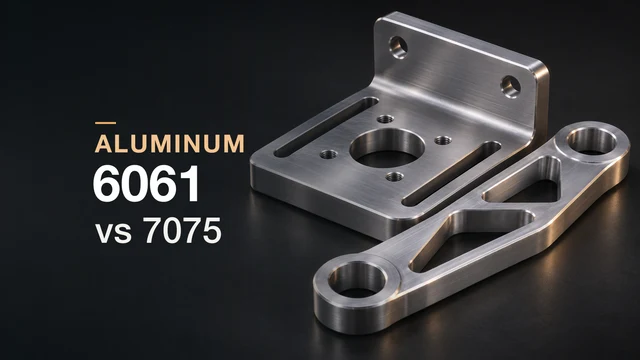

When an aluminum part comes in for a quote, the drawing almost always says 6061-T6 or 7075-T6. They are the two alloys we machine the most and the two that get mixed up most often at the design stage: we see drawings calling out 7075 for a bracket that will never see more than 50 MPa, and drawings calling out 6061 for a fitting that will run right at its limit. Both parts come out fine, but one was overpaid and the other will deform before its time.
This guide compares the two alloys using the numbers that matter for a machined part: how much load they take, how much they deflect, what they weigh, how they behave on the machine, how well they stand up to corrosion and what changes on the quote. At the end there is a worked case with a cantilever bracket calculated in both alloys, and a short checklist for deciding without guessing.
6061 vs 7075: the short answer
If you only get to decide one thing, decide based on the requirement that limits the part. Almost no part is limited by everything at once: it is short on strength, or short on stiffness, or it has to move heat, or it is going to be welded. This table summarizes where to start in each case.
| What the part needs | Start with | Why |
|---|---|---|
| Take load without permanent deformation | 7075-T6 | Yield strength of 503 MPa vs 276 MPa. Allows thinner walls or a higher safety factor with the same geometry. |
| Deflect as little as possible | Either (geometry wins) | The modulus is nearly identical. One more millimeter of thickness lowers deflection more than changing alloy. |
| Dissipate heat or carry current | 6061-T6 | 167 W/m·K and 43 % IACS vs 130 W/m·K and 33 % IACS. |
| Be welded to another part | 6061-T6 | Welds with 4043 or 5356 filler. 7075 hot-cracks and loses properties in the heat-affected zone. |
| Work in a humid or salty environment | 6061-T6 | Lower copper content. 7075 forms internal galvanic couples and is prone to stress corrosion cracking. |
| Resist fatigue in a fixed section | 7075-T6 | Fatigue strength of 159 MPa vs 97 MPa at 5 × 10⁸ cycles, with the same geometric detail. |
| Cost the least and be available today | 6061-T6 | Cheaper per kilogram, with more bar and plate sizes in stock. |
| A fixture or plate that gets handled and knocked a lot | 7075-T6 | Brinell hardness 150 vs 95: resists dents and contact wear better. |
What 6061, 7075 and T6 mean
The four digits tell you which family the alloy belongs to, and the suffix tells you which heat treatment it carries. Both matter: annealed 6061 (O temper) has less than half the strength of 6061-T6, and buying the wrong bar is a mistake that does not show until the part fails.
The 6xxx series: magnesium and silicon
6061 carries 0.8 to 1.2 % magnesium and 0.4 to 0.8 % silicon, plus some copper (0.15 to 0.40 %) and chromium. Magnesium and silicon form magnesium silicide (Mg₂Si), the precipitate that hardens the alloy during aging. The small copper content is why it behaves well against corrosion and why it welds without cracking. It is a general-purpose alloy: not the strongest and not the softest, but it does almost everything reasonably well, which is why it is the alloy with the most bar and plate in stock at any industrial distributor.
The 7xxx series: zinc and magnesium
7075 carries 5.1 to 6.1 % zinc, 2.1 to 2.9 % magnesium and 1.2 to 2.0 % copper. Hardening comes from zinc-magnesium precipitates (MgZn₂), far more effective than Mg₂Si, which is why its strength sits in the range of some structural steels. The price of that strength is the copper and zinc, which lower conductivity, make the alloy sensitive to corrosion and render it practically unweldable by arc. It was developed for aircraft structure and is still the reference when every gram has to work.
What the T6 temper is
T6 means the alloy was solution heat treated, quenched and artificially aged. In practice: it is heated until the alloying elements dissolve into the aluminum matrix (around 530 °C for 6061 and 480 °C for 7075), quenched in water so they stay in solution, and then held at a moderate temperature for hours (close to 175 °C for 6061 and 120 °C for 7075) so they precipitate in a controlled way. Those fine precipitates are what pin dislocations and give the strength.
Two practical consequences of T6. First, the treatment already comes done in the bar or plate we buy: the part is machined in T6 and stays in T6; it is not treated afterward. Second, the fast quench leaves residual stresses locked in the material, and when machining removes a thick layer from one side only, those stresses go out of balance and the part moves. In 6061 and 7075 plate this shows up on large flat parts with heavy roughing on one face; how it is controlled is covered further down.
Mechanical properties side by side
The values in the table are typical for bar and plate in T6, taken from producer data sheets. They are good for comparison and for a first estimate; for a design calculation you have to use the guaranteed minimums of the specification you buy to (ASTM B211 for bar, B209 for plate).
| Property | 6061-T6 | 7075-T6 | Difference |
|---|---|---|---|
| Yield strength (0.2 %) | 276 MPa (40 ksi) | 503 MPa (73 ksi) | +82 % |
| Ultimate tensile strength | 310 MPa (45 ksi) | 572 MPa (83 ksi) | +85 % |
| Elastic modulus | 68.9 GPa | 71.7 GPa | +4 % |
| Shear modulus | 26.0 GPa | 26.9 GPa | +3 % |
| Shear strength | 207 MPa | 331 MPa | +60 % |
| Fatigue strength (5 × 10⁸ cycles) | 97 MPa | 159 MPa | +64 % |
| Elongation in 50 mm | 12 to 17 % | 11 % | Lower in 7075 |
| Brinell hardness (500 kgf, 10 mm) | 95 HB | 150 HB | +58 % |
| Density | 2.70 g/cm³ | 2.81 g/cm³ | +4 % |
| Thermal conductivity | 167 W/m·K | 130 W/m·K | −22 % |
| Electrical conductivity | 43 % IACS | 33 % IACS | −23 % |
| Thermal expansion (20 to 100 °C) | 23.6 µm/m·K | 23.6 µm/m·K | Same |
| Melting range | 582 to 652 °C | 477 to 635 °C | 7075 melts earlier |
Strength: where 7075 wins by a wide margin
The difference that justifies 7075 is yield strength: 503 vs 276 MPa. That means a part with the same geometry takes 1.8 times the load before it starts to deform permanently. In a fitting, a pin, a clevis or any part working in tension or bending close to its limit, that difference is what lets you make it thinner or give it more safety factor without changing the envelope.
Hardness goes the same way. A 7075 fixture holds up better to the knocks of parts being loaded and unloaded, and a sliding surface marks less. In 6061 an edge that takes hits gradually mushrooms with use.
Stiffness: where there is almost no difference
This is the most common confusion. Stiffness is how much a part deflects under load, and it depends on the elastic modulus and the geometry, not on yield strength. The modulus of 7075 is only 4 % higher than that of 6061: a bracket that deflects 1 mm in 6061 will deflect 0.96 mm in 7075. If the part's problem is that it vibrates, opens up, loses alignment or flexes under the working load, switching to 7075 does not fix it. Thickness fixes it, or a rib, or a taller section, and that can be done in 6061.
The quick rule: if the part fails because it stayed bent, that is strength and 7075 helps. If the part fails because it moves too much while working and springs back when the load is removed, that is stiffness and the alloy is not the variable.
Fatigue: the difference that matters in parts that vibrate
Aluminum has no true endurance limit the way steel does: it keeps accumulating damage no matter how low the stress. That is why data sheets report strength at a number of cycles, usually 5 × 10⁸. There, 7075 gives 159 MPa and 6061 gives 97 MPa. In a part under cyclic load with the same section and the same corner radius, 7075 takes a 64 % higher alternating stress for the same life.
The caveat is that fatigue in aluminum is decided more by details than by alloy. A 0.5 mm internal radius at the root of a wall, a thread with no relief or a tool mark running across the load direction lowers life more than going from 6061 to 7075 raises it. Fix the geometry first, then pick the alloy.
Weight: the same CAD part weighs almost the same
People say 7075 is «lighter», and that is not accurate. It is 4 % denser: the same part, from the same STEP file, weighs 4 % more in 7075 than in 6061. A 100 cm³ block weighs 270 g in 6061 and 281 g in 7075.
What is true is that 7075 has a much higher strength-to-weight ratio: 179 kN·m/kg vs 102 kN·m/kg in specific yield strength. That lets you redesign the part with thinner walls and slimmer ribs, and the redesigned part does weigh less. But the savings come from the redesign, not from swapping the material on the bill of materials. If the drawing does not change, 7075 weighs more and costs more.
To quickly compare the weight of a geometry in both alloys there is the part weight calculator: it takes the CAD volume and gives the mass with each material's density.
Machinability: how each one behaves on the machine
Both alloys machine fast compared with any steel. 6061-T6 carries a C rating on the Aluminum Association machinability scale and 7075-T6 carries a B, where A is best. On the shop floor the difference shows in three things: how the chip breaks, what finish it leaves and how much it welds to the cutting edge.
Chips, surface finish and burrs
7075 is harder and less ductile, and that makes it the more forgiving one to machine. The chip breaks into short segments, the as-machined finish is more uniform and brighter, and burrs on the edges are small and come off easily. In a finishing operation with the same tool and the same parameters, 7075 usually gives a lower roughness than 6061.
6061 is more ductile and tends to form built-up edge: material welds to the cutting edge and then tears off, leaving a scored surface and an unstable dimension. It is controlled with high cutting speed, very sharp and polished edges (two- or three-flute tools with positive rake, uncoated or with an aluminum-specific coating) and plenty of coolant. Run slow, 6061 also leaves long, stringy burrs at hole exits and slot edges that cost deburring time.
Speeds and tooling
In both alloys aluminum is cut with uncoated carbide or aluminum-specific coatings (ZrN, TiB₂, DLC), at cutting speeds that for a carbide end mill run from 300 to over 600 m/min, limited in practice by spindle rpm more than by the material. Feed per tooth is high (0.05 to 0.15 mm per tooth on 6 to 12 mm end mills) and material removal rates are among the highest achievable on a machining center.
7075 wears the edge slightly more because of its hardness, but the effect is small. What does need watching in 7075 is temperature at the cutting zone: it starts melting at 477 °C, well below 6061, and a dry cut with a worn edge can smear the surface. In CNC milling and CNC turning the starting parameters for the two alloys are practically the same, with 6061 leaning toward more speed to get away from built-up edge.
Distortion from residual stress
The most expensive problem in machining T6 aluminum is not the cut, it is the part moving after it is cut. The water quench leaves the surface of the bar or plate in compression and the core in tension. While the material is whole, the stresses are in balance. When one face is roughed and the other is left alone, the balance breaks and the part bows. On a 300 mm plate machined from one side only, the bow can reach several tenths of a millimeter.
Both alloys suffer from it; 7075 a little more because its quench stresses are higher. What controls it is the machining strategy: rough both faces symmetrically leaving stock, release the part so it settles, re-clamp and finish; on critical parts, a roughing pass, a rest and a finishing pass in a second operation. For long, thin plates it is worth asking for stress-relieved stretched material when the distributor carries it; on the drawing it is enough to flag flatness as critical so the job gets planned that way.
Tolerances and dimensional stability
The tolerances achievable in 6061 and 7075 are the same: ±0.025 mm on controlled milled and turned dimensions, ±0.013 mm on diameters with dedicated finishing operations, and ISO 2768 general tolerances on everything else. The material is not what limits them; what limits them is the stiffness of the part under clamping, and temperature.
The thermal expansion coefficient is identical in both (23.6 µm/m·K), and it is high: almost double that of steel. A 200 mm part that comes off the machine at 30 °C and is measured at 20 °C measures 0.047 mm shorter. On tight tolerances, measurement is done with the part at temperature or corrected. This applies equally to both alloys.
Where 7075 helps is on thin parts that deform under clamping: its higher yield strength means the walls flex the same under cutting force (same modulus), but tolerate more vise pressure without being marked or permanently deformed. On a 1.5 mm wall, that can be the difference between holding the part in one operation and having to design a fixture.
Corrosion: why 7075 needs more protection
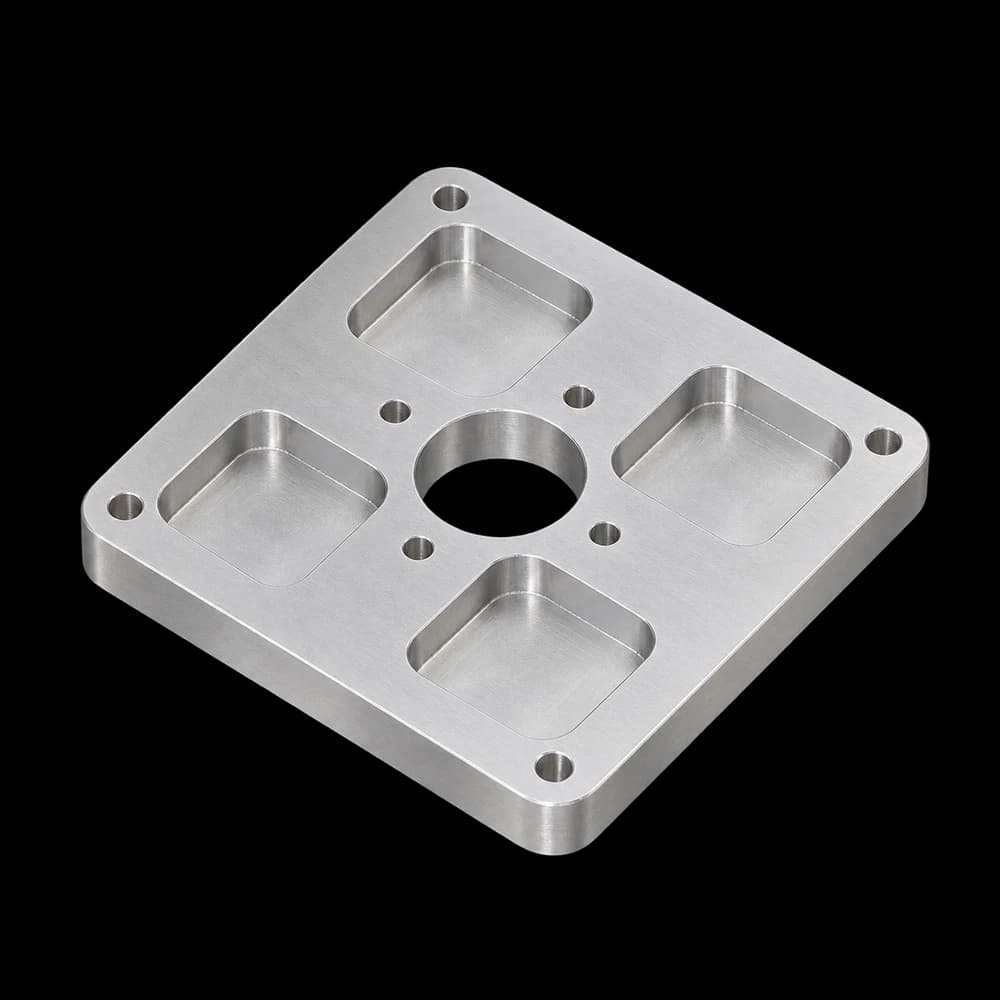
Aluminum protects itself with an oxide layer a few nanometers thick that regenerates instantly. In 6061 that layer is stable and the alloy holds up well to weather, humidity and most industrial environments with no finish at all. 7075 is a different story because of its copper and zinc content.
Copper forms precipitates that are cathodic relative to the aluminum matrix. In the presence of an electrolyte (salty water, condensation, sweat) microscopic galvanic couples form and attack proceeds by pitting and, in rolled plate, by exfoliation: corrosion runs between the layers of the elongated grain and lifts flakes of material. 7075-T6 is also susceptible to stress corrosion cracking when loaded in tension in the short-transverse direction of thick plate, which is exactly the direction many fittings machined from plate are loaded in.
In practice: a 6061 part indoors or in sheltered outdoor service can go without a finish. A 7075 part that will be exposed to humidity, in contact with stainless or carbon steel, or under sustained tensile load needs a coating, galvanic isolation at the joints, or a different alloy.
Welding: 6061 welds, 7075 does not
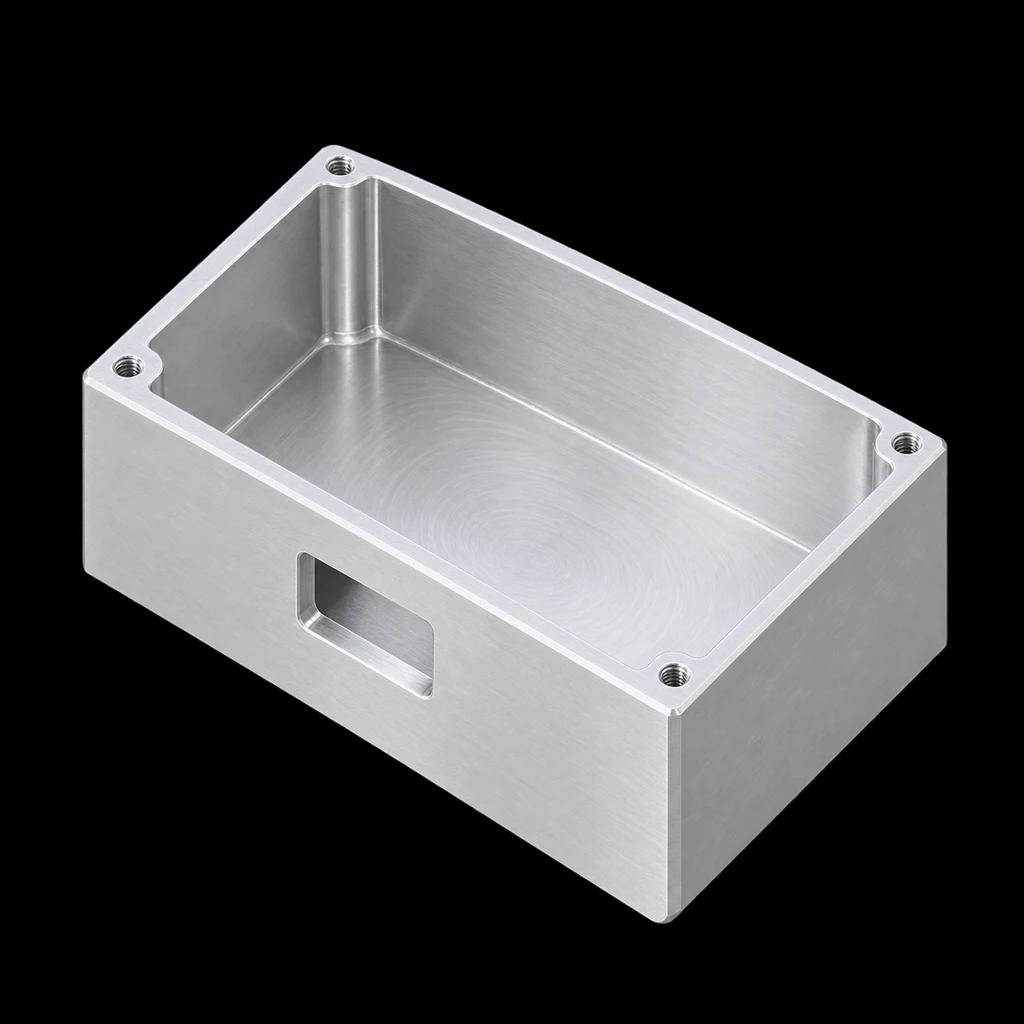
6061 welds by TIG and MIG with 4043 (aluminum-silicon) or 5356 (aluminum-magnesium) filler and is one of the most common structural alloys in welded frames, tanks and structures. Be aware that the heat-affected zone loses its temper: around the bead, tensile strength drops to 165 to 185 MPa, about half of T6. A welded 6061-T6 assembly is designed with the heat-affected-zone properties, or it is fully heat treated again after welding, which is expensive and distorts the part.
7075 is not recommended for arc welding. Its solidification range is wide and the copper and zinc make it prone to hot cracking as the bead solidifies; on top of that, the heat-affected zone ends up brittle and very sensitive to stress corrosion cracking. It can be joined by friction stir welding (FSW) and it fastens mechanically with no issues using screws or rivets, but a 7075 part that will carry a conventional weld bead is a selection error. If a machined part is going to be welded to a frame, it is 6061.
Thermal and electrical conductivity: heat sinks and housings
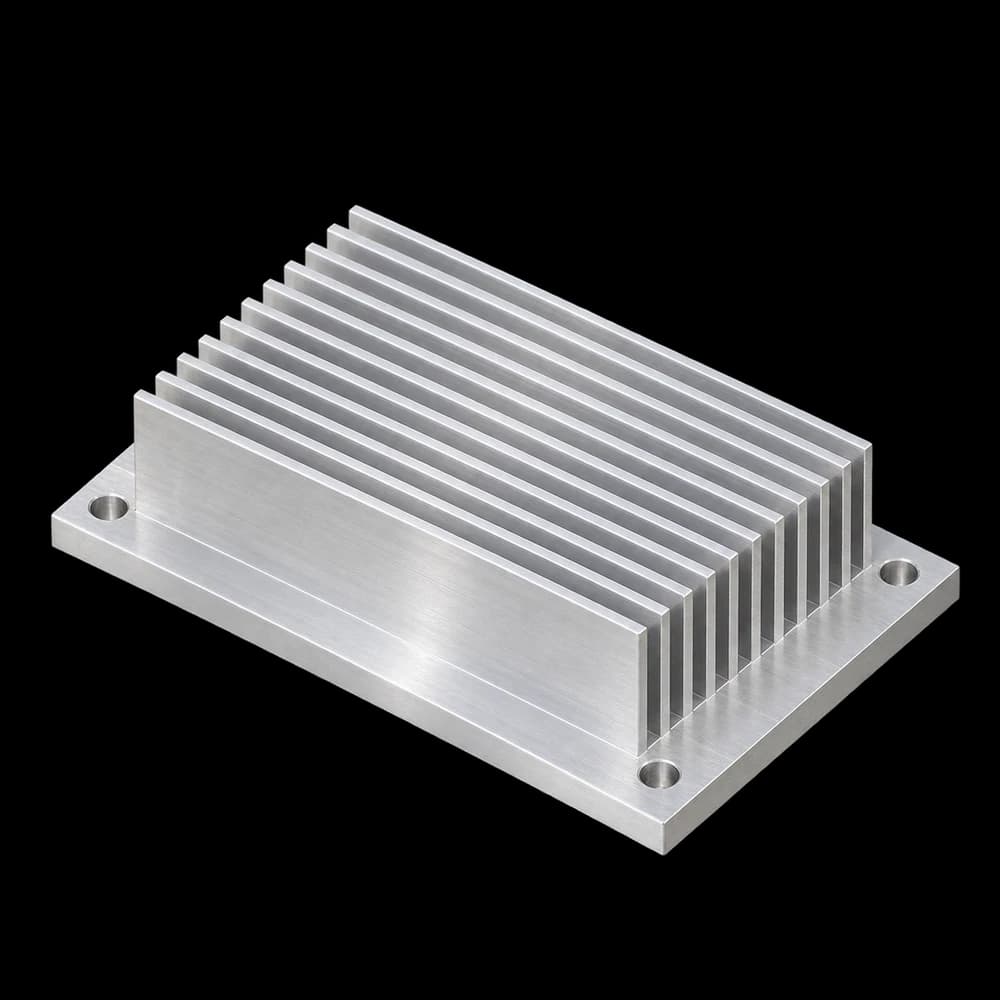
6061 conducts heat at 167 W/m·K; 7075 at 130 W/m·K. That is 22 % less, and on a machined heat sink the difference shows directly in junction temperature: for the same heat flow, 7075 fins work with a steeper gradient and the base runs hotter. Electrical conductivity goes the same way: 43 % IACS vs 33 % IACS. For a bus bar, a contact or a housing that doubles as ground, 6061 is the obvious choice; 7075 brings nothing there because those parts do not work near their mechanical limit.
Melting point also matters on parts that see temperature. 7075 starts melting at 477 °C and, well before that, from about 120 °C of sustained service, it starts to overage and lose strength. 6061 loses strength with temperature too, but the margin is wider and service up to 150 °C is common. Neither is an alloy for hot service.
Availability and stock forms: bar and plate
6061-T6 is the aluminum alloy with the most sizes in stock: round bar from 6 mm to over 300 mm, square, hex, flat bar and plate from 6 mm to over 150 mm thick, at practically any industrial distributor. That translates into almost always having a stock size that wraps the part with little excess, and material that arrives the same day or the next.
7075-T6 has fewer forms and less stock in intermediate sizes. It is common in round bar and plate, less common in square and hex, and in large sizes it may have to come from a central warehouse or be bought as a thicker plate than needed. For a quote this means two things: lead time can stretch a few days because of the material, and you may be paying for aluminum that ends up as chips. When the design allows it, sizing the part around a commercial 7075 size saves more than any tweak to the program.
Cost: what changes on the quote between 6061 and 7075
There is no single figure for how much more a 7075 part costs, because it depends on how much of the total price is material. What can be described is which lines of the quote move, and in which direction.
| Line item | 6061-T6 | 7075-T6 | How much it weighs |
|---|---|---|---|
| Raw material per kilogram | Baseline | Noticeably more expensive | A lot on thick plate and large bar; little on small parts with heavy machining |
| Stock excess | Plenty of commercial sizes | Fewer sizes, more likely waste | Depends on how well the commercial size wraps the part |
| Cycle time | Same or slightly longer due to deburring | Same or slightly shorter due to better finish | Practically neutral |
| Tool wear | Low | Slightly higher | Marginal in both |
| Deburring and hand finishing | More burr when run slow | Less burr | Minutes per part on large lots |
| Distortion risk | Present | Slightly higher | Can force an extra operation on large plates |
| Lead time | Material available | Can add days if the size is not in stock | Variable |
The practical takeaway is that on a small part with a lot of machine time (a 50 g bracket with pockets and threads) the price difference between the two alloys is small, because material is a minor share of the cost. On a 25 mm thick, 400 mm square plate, material is the big line and 7075 shows immediately. The instant quote tool prices both options on the same geometry; just switch the material and compare.
Typical applications of each alloy
Applications follow the logic of the properties. Where the part does not work near its limit, or needs to conduct heat, be welded or take the weather, it is 6061. Where the part is limited by strength, fatigue or wear and cannot be made bigger, it is 7075.
| Industry | Typical in 6061-T6 | Typical in 7075-T6 |
|---|---|---|
| Automation and machinery | Base plates, sensor brackets, housings, pneumatic manifolds, guards | Gripper jaws and fingers, cams, heavy-duty fixtures, wear plates |
| Automotive and motorsport | Accessory brackets, adapters, valve bodies, covers | Suspension clevises, links, hubs, safety-critical fittings |
| Aerospace and defense | Electronics housings, trays, ducts, panels | Structural fittings, inserts under load, actuator components |
| Electronics and energy | Heat sinks, chassis, bus bars, cold plates | Rare; only where the part is structural |
| Tooling and molds | Inspection fixtures, mounting plates, short-run mold prototypes | Injection molds for short runs, inserts, production fixtures |
| Medical and laboratory | Equipment housings, optical mounts, anodizable parts | Loaded instrument components, precision mechanisms |
| Sports and cycling | Mounts, adapters, low-stress components | Stems, cranks, pedals, carabiners and climbing hardware |
Worked case: the same bracket in 6061 and in 7075
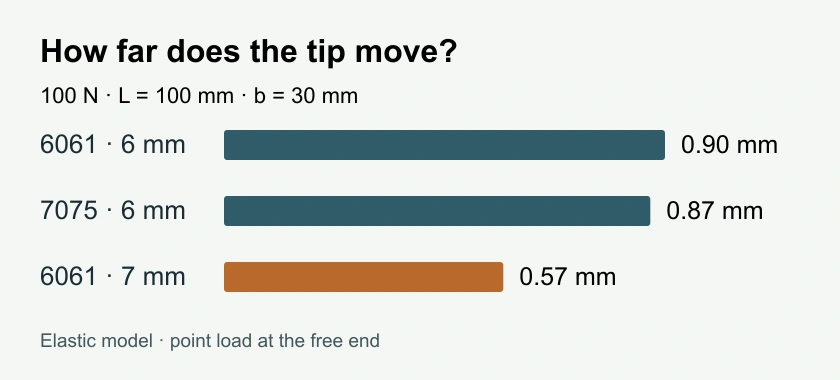
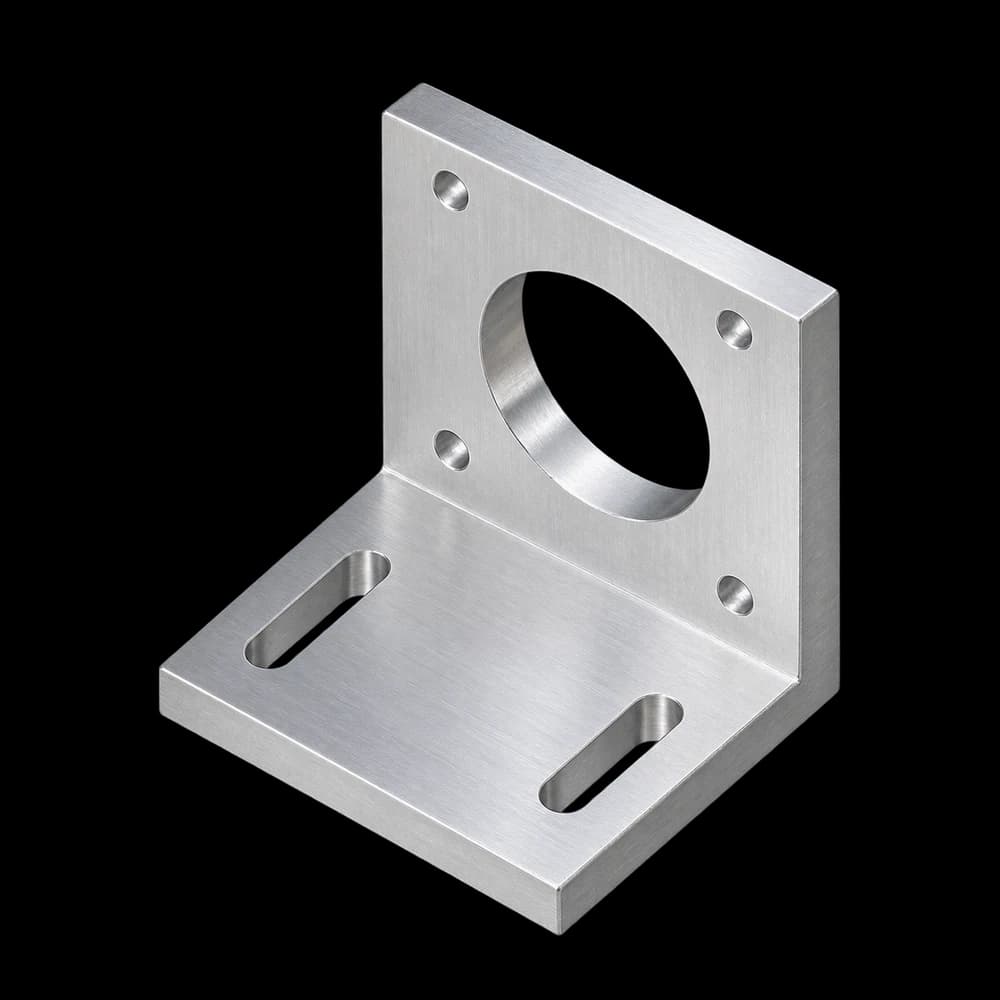
An angle bracket holds a sensor at the end of a 100 mm long, 30 mm wide arm, with a 100 N load at the tip. The customer asks that the tip not drop more than 0.6 mm and wants to know whether to make it in 7075 «so it is stiffer». The numbers with a cantilever beam model:
| Option | Thickness | Peak stress | Factor against yield | Tip deflection | Arm mass |
|---|---|---|---|---|---|
| 6061-T6 | 6 mm | 56 MPa | 4.9 | 0.90 mm | 48.6 g |
| 7075-T6 | 6 mm | 56 MPa | 9.0 | 0.87 mm | 50.6 g |
| 6061-T6 | 7 mm | 41 MPa | 6.7 | 0.57 mm | 56.7 g |
What the numbers say: peak stress is 56 MPa, far from the limit of either alloy; the part does not have a strength problem. It has a stiffness problem, and switching to 7075 improves it by 3 %, from 0.90 to 0.87 mm, without meeting the requirement. Going up one millimeter in thickness in 6061 brings deflection down to 0.57 mm, meets the requirement with margin, and costs 8 g and nothing in material. The right call is 6061-T6 at 7 mm.
The case flips if the requirement were different. If the same arm had to take an occasional 500 N impact without staying bent, stress would rise to 278 MPa: right at the limit of 6061 and with a factor of 1.8 in 7075. There 7075 does solve something 6061 does not, and the 6061 alternative would be going to 8 mm thick to match that factor, with 33 % more mass. That is the question to ask before choosing: does the part fail because it bends and springs back, or because it bends and stays?
The alloy does not fix a poorly sized geometry. Before asking for 7075, find out whether the part is limited by strength or by stiffness; in the second case, a millimeter of thickness does more than any material change.
Checklist for deciding
- Identify what limits the part: strength (it deforms and does not come back), stiffness (it moves and comes back), fatigue, heat, corrosion or cost. It is almost always just one.
- If it is stiffness, stay in 6061-T6 and change the geometry: thickness, ribs or a taller section. 7075 only gives 4 % more modulus.
- If it is strength or fatigue and the envelope cannot grow, move to 7075-T6 and check that the part will not be welded or work exposed to humidity without protection.
- If the part conducts heat or current, or will be welded, it is 6061-T6, no discussion.
- Check whether the part is loaded in tension through the thickness of a thick plate. In 7075 that is a stress corrosion cracking risk.
- Compare the real weight with the weight calculator: with the same CAD, 7075 weighs 4 % more.
- Size the part around a commercial size of the chosen material, especially in 7075, where there is less stock.
- Call out critical flatness or parallelism on the drawing if the part is flat and large, so machining gets planned in two operations.
- Quote both options on the same geometry and compare: on small parts the difference is usually smaller than expected.
Frequently asked questions about 6061 and 7075
What we get asked most when quoting aluminum parts in the two alloys.
- Is 7075 stiffer than 6061?
- Practically not. The elastic modulus is 71.7 GPa vs 68.9 GPa, 4 % more. What 7075 has is much more strength (yield of 503 vs 276 MPa), which is a different thing: it takes more load before deforming permanently, but under the same load it deflects almost the same.
- Does 7075 weigh less than 6061?
- No. It is 4 % denser: 2.81 vs 2.70 g/cm³. The same part weighs more in 7075. It weighs less only if it is redesigned with less material, taking advantage of its higher strength.
- Can 7075 be welded?
- Not recommended by arc (TIG or MIG): it hot-cracks and the heat-affected zone ends up brittle and prone to stress corrosion cracking. It is joined mechanically or by friction stir welding. If the part will be welded, it is made in 6061.
- Which one machines better?
- Both machine fast. 7075 gives a better finish and shorter chips because of its hardness; 6061 tends toward built-up edge and burrs when run slow, and calls for high speeds and very sharp edges. In cycle time the difference is small.
- How much more does a 7075 part cost?
- It depends on how much of the price is material. On a small part with heavy machining the difference is small; on thick plate or large bar, material dominates and 7075 shows. The way to know is to quote the same geometry in both alloys.
- Does 7075 hold up outdoors?
- Worse than 6061. Because of its copper and zinc it is prone to pitting, exfoliation and stress corrosion cracking, especially in thick plate loaded through the thickness. Exposed to humidity or in contact with steel it needs protection; 6061 normally does not.
- Are the achievable tolerances different?
- No. The same milling and turning tolerances are achieved in both. What limits them is the stiffness of the part when clamped and thermal expansion, which is identical in both alloys (23.6 µm/m·K).
- What does T6 mean?
- That the material was solution heat treated, water quenched and artificially aged. It is the temper the bar and plate of both alloys are bought in and the one they stay in after machining. The same material annealed (O) has less than half the strength.
- Is 7075 good for a heat sink?
- It conducts 22 % less heat than 6061 (130 vs 167 W/m·K) and a heat sink does not work near its mechanical limit, so it brings nothing. For heat sinks, cold plates and housings that carry heat, 6061.
- Up to what temperature do they work?
- Neither is for hot service. 7075 starts losing strength from overaging at about 120 °C of sustained service and melts from 477 °C. 6061 is commonly used up to 150 °C and melts from 582 °C.
Practically not. The elastic modulus is 71.7 GPa vs 68.9 GPa, 4 % more. What 7075 has is much more strength (yield of 503 vs 276 MPa), which is a different thing: it takes more load before deforming permanently, but under the same load it deflects almost the same.
No. It is 4 % denser: 2.81 vs 2.70 g/cm³. The same part weighs more in 7075. It weighs less only if it is redesigned with less material, taking advantage of its higher strength.
Not recommended by arc (TIG or MIG): it hot-cracks and the heat-affected zone ends up brittle and prone to stress corrosion cracking. It is joined mechanically or by friction stir welding. If the part will be welded, it is made in 6061.
Both machine fast. 7075 gives a better finish and shorter chips because of its hardness; 6061 tends toward built-up edge and burrs when run slow, and calls for high speeds and very sharp edges. In cycle time the difference is small.
It depends on how much of the price is material. On a small part with heavy machining the difference is small; on thick plate or large bar, material dominates and 7075 shows. The way to know is to quote the same geometry in both alloys.
Worse than 6061. Because of its copper and zinc it is prone to pitting, exfoliation and stress corrosion cracking, especially in thick plate loaded through the thickness. Exposed to humidity or in contact with steel it needs protection; 6061 normally does not.
No. The same milling and turning tolerances are achieved in both. What limits them is the stiffness of the part when clamped and thermal expansion, which is identical in both alloys (23.6 µm/m·K).
That the material was solution heat treated, water quenched and artificially aged. It is the temper the bar and plate of both alloys are bought in and the one they stay in after machining. The same material annealed (O) has less than half the strength.
It conducts 22 % less heat than 6061 (130 vs 167 W/m·K) and a heat sink does not work near its mechanical limit, so it brings nothing. For heat sinks, cold plates and housings that carry heat, 6061.
Neither is for hot service. 7075 starts losing strength from overaging at about 120 °C of sustained service and melts from 477 °C. 6061 is commonly used up to 150 °C and melts from 582 °C.
Related resources
To keep going with material selection and quoting aluminum parts:
- Aluminum machining: what we make in aluminum, alloys, tolerances and examples.
- 6061-T6 aluminum: alloy data sheet.
- 7075-T6 aluminum: alloy data sheet.
- Materials for CNC machining: every alloy and plastic we machine.
- CNC machining of aluminum: alloys, temper and cost: the general guide to aluminum in CNC.
- CNC machining design guidelines: radii, wall thickness, threads and tolerances.
- Part weight calculator: mass of a geometry in each material.

Written by
Adrian Cavazos and the PREMSA Engineering Team
Adrian Cavazos, founder of PREMSA Industries, leads a team of manufacturing engineers specialized in CNC turning and milling, 3D printing and production-ready solutions. The team works closely with customers to optimize designs, improve manufacturability (DFM) and ensure reliable, scalable production from prototypes to volume.