
Monterrey concentrates one of the largest CNC machining offerings in Mexico. From specialized shops and maquilas to integrators and suppliers serving industries such as automotive, automation, medical devices, and industrial manufacturing.
Having so many options seems like an advantage... until it is time to choose one supplier to manufacture your project.
Because in practice, the success of a part does not depend solely on whether a machine exists that can produce it. It also depends on how easy it is to quote, how clear communication is, how quickly manufacturability issues are detected, and how consistent the result is when it is time to repeat production.
The right decision directly affects lead times, dimensional quality, total project cost, and your ability to move forward without unnecessary blockers.
And mistakes rarely show up in the first quote. They appear when critical files are missing, when the MOQ does not fit your project, when nobody caught a manufacturing issue before production, or when the second run no longer matches the first.
In this guide you will learn what to define before looking for a supplier, how to evaluate a quoting process, what to review during technical evaluation, and the signals that usually indicate you found a manufacturing partner aligned with prototypes, low volume, and repeatable production.
If you are still exploring the full process from design to finished part, you can also see our CNC machining in Monterrey page, our guide to CNC machining in Monterrey, our article on CNC services for regional industry, our guide to fast CNC machining in Monterrey, and our CNC online quote in Monterrey.
Define what you need to manufacture before looking for a supplier
Before comparing prices, lead times, or manufacturing capabilities, the first step is to understand exactly what type of project you have on your hands.
Manufacturing a prototype to validate a design is not the same as an urgent spare for a stopped line. A pilot run of ten parts is also not the same as a program that could become recurring production over the next few months.
The clearer you are about the project goal, the easier it is to identify which supplier is truly aligned with your needs.
Is it a prototype, a spare part, or production?
- Functional prototypes — validate assembly, ergonomics, tolerances, or performance before investing in tooling or higher volumes.
- Industrial spare parts — urgent parts for maintenance, equipment repair, or operational continuity, where speed is usually the most important factor.
- Fixtures and tooling — nests, plates, guides, and devices for production, inspection, or automation that require rigidity and repeatability.
- Initial production — small lots for market validation, pilots, or first customer deliveries.
- Repeatable production — recurring programs where dimensional consistency, process stability, and repeatability become more important.
Defining this from the start avoids one of the most common mistakes: requesting quotes from suppliers optimized for a completely different model than your project requires.
For example, a shop focused on mass production is probably not the best option if you only need five parts to validate a design.
Not every shop is optimized for the same type of project
One of the most frequent mistakes when looking for a CNC supplier is assuming everyone works the same way.
Some shops are designed for high volume, with long setups, highly standardized processes, and programs amortized across thousands of parts. Others are more oriented toward product development, prototypes, fast iterations, and pilot runs where flexibility matters more than volume.
There are also important differences in capabilities. Some suppliers specialize only in CNC milling, while others combine CNC milling, CNC turning, inspection, and complementary processes within the same flow.
When a project requires coordinating multiple suppliers to complete a single part, lead times, communication, and risk usually increase.
That is why it helps to align expectations before requesting a quote. It is not about finding the cheapest supplier, but the one that best understands your application, the quantity you actually need to manufacture, and the stage your project is in.
Evaluate how easy it is to request a quote
Before analyzing prices, capabilities, or lead times, it is worth observing something simpler: how easy it is to start a conversation with the supplier.
The quoting process is usually the first reflection of what the experience will be like throughout the project. If there is friction to receive a quote, there will usually also be friction when there are design changes, technical questions, or production follow-up.
The quoting process reveals a lot about a supplier
The RFQ is not just an administrative step. It is the first test of organization, communication, and responsiveness.
A supplier that manages information correctly from the start usually reduces errors, accelerates technical reviews, and makes project execution easier when it is time to manufacture.
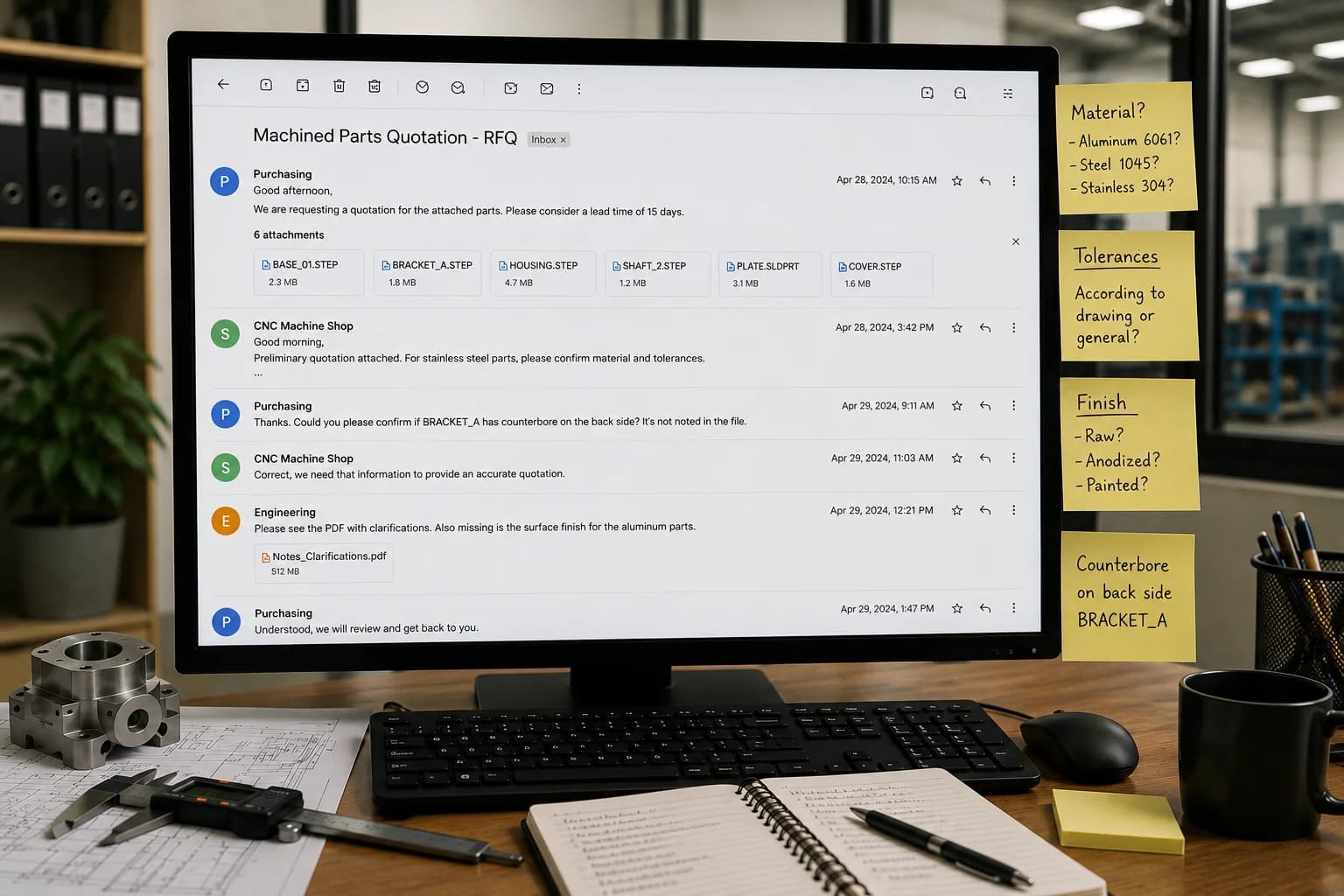
- Endless emails — every change in quantity, material, or finish generates new message threads that are hard to follow.
- Scattered information — files in different versions, specifications inside emails, and drawings that do not match the CAD model.
- Lack of follow-up — days pass without knowing whether the RFQ was received, reviewed, or if there is a technical issue.
- Slow processes — a simple quote ends up taking weeks when it could be resolved in one or two business days with complete information.
- Low visibility — no clarity on what information is missing, who is reviewing the project, or what the next step is.
The reality is that many manufacturing delays happen before the first tool touches material. They happen during information gathering, technical clarifications, and manual reviews that could be avoided with a better structured process.
What to look for in a modern RFQ process
An efficient quoting process should make communication with the shop easier—not turn it into another bottleneck.
The less time your team spends chasing information, resending files, or clarifying basic specifications, the faster the project can move toward manufacturing.
- CAD file upload — STEP per part, with a flow that does not depend on email attachments.
- Centralized information — material, quantity, finish, and notes in one place.
- Structured follow-up — visibility into RFQ status without chasing updates.
- Less friction — fewer loops between design and manufacturing to start production.
- Early technical review — identify possible manufacturing risks before generating the quote.
- Consistent information — avoid multiple file versions and scattered specifications.
The reality is that many manufacturing delays do not happen at the machine. They happen before manufacturing, when information is incomplete, files do not match, or the quoting process forces multiple clarification cycles.
That is why the way a supplier receives and organizes an RFQ is often a good indicator of how they will manage the project once the order enters production.
How PREMSA's CNC quote tool works
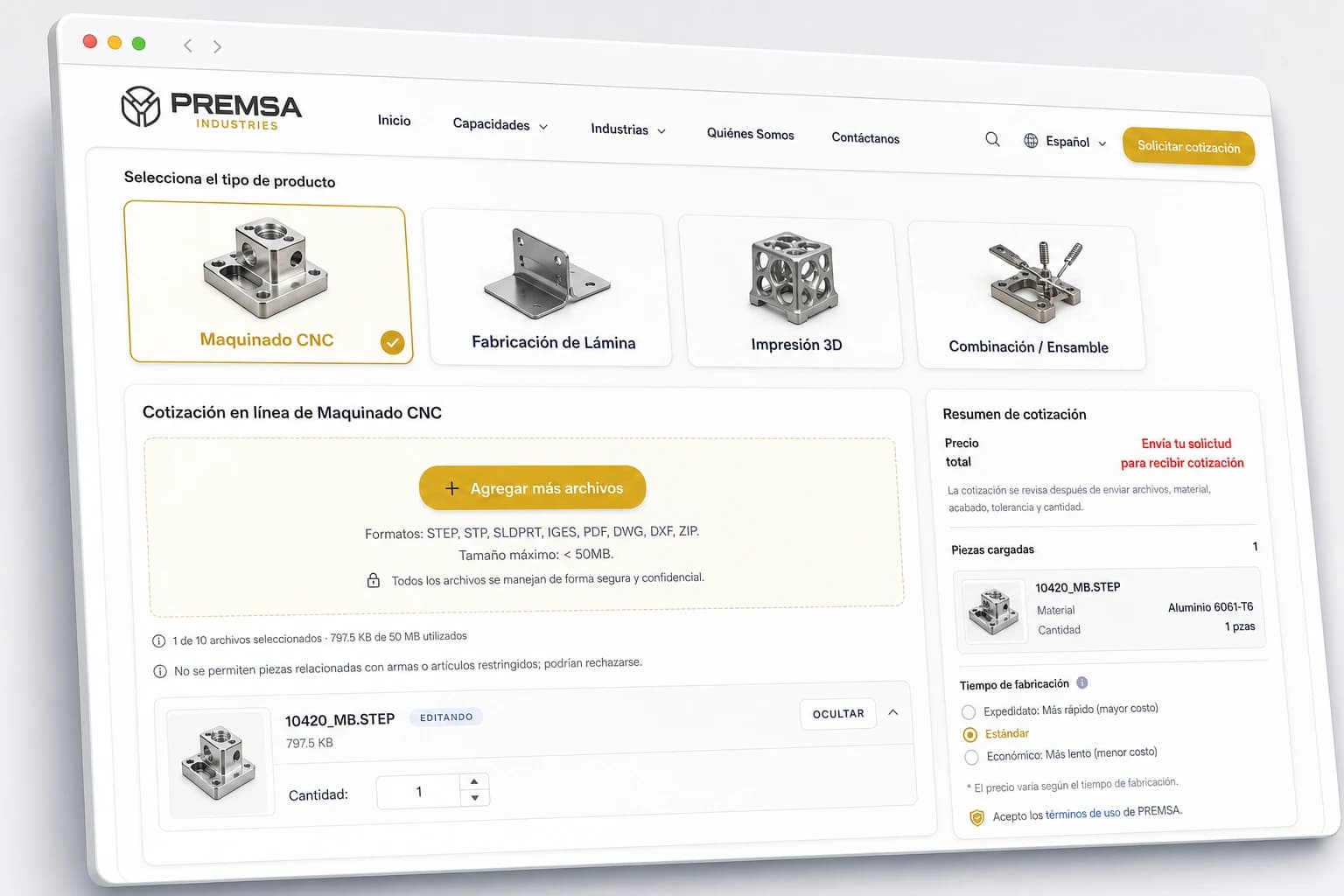
At PREMSA Industries we built an online CNC quote tool precisely to reduce that friction from first contact.
The goal is for you to send a complete technical package within a structured flow, avoiding endless email chains and reducing the risk that important information is left out of the review.
In practice, the process usually looks like this:
1. Upload a STEP file (or STP) per part with solid geometry and clear units.
2. Select material and process according to the project's real requirements.
3. Define quantities from a single part to pilot runs or repeatable production.
4. Submit the RFQ for technical review and manufacturability evaluation.
If you want to learn more about low-volume manufacturing and digital quoting, you can also read our article on the CNC online quote in Monterrey and our CAD file for CNC machining guide.
Review how they handle CAD files and technical documentation
One of the most important differences between an average supplier and a true manufacturing partner appears long before the first part is manufactured: the way they receive, interpret, and validate technical information.
A well-documented project reduces questions, speeds up quotes, and lowers the risk of manufacturing an incorrect part. But even when the technical package is complete, the supplier must be able to understand the intent behind the design and not simply machine exactly what appears on screen.
A CNC supplier must understand more than geometries
A STEP file describes the shape of a part, but it does not always communicate how it should be manufactured, inspected, or used.
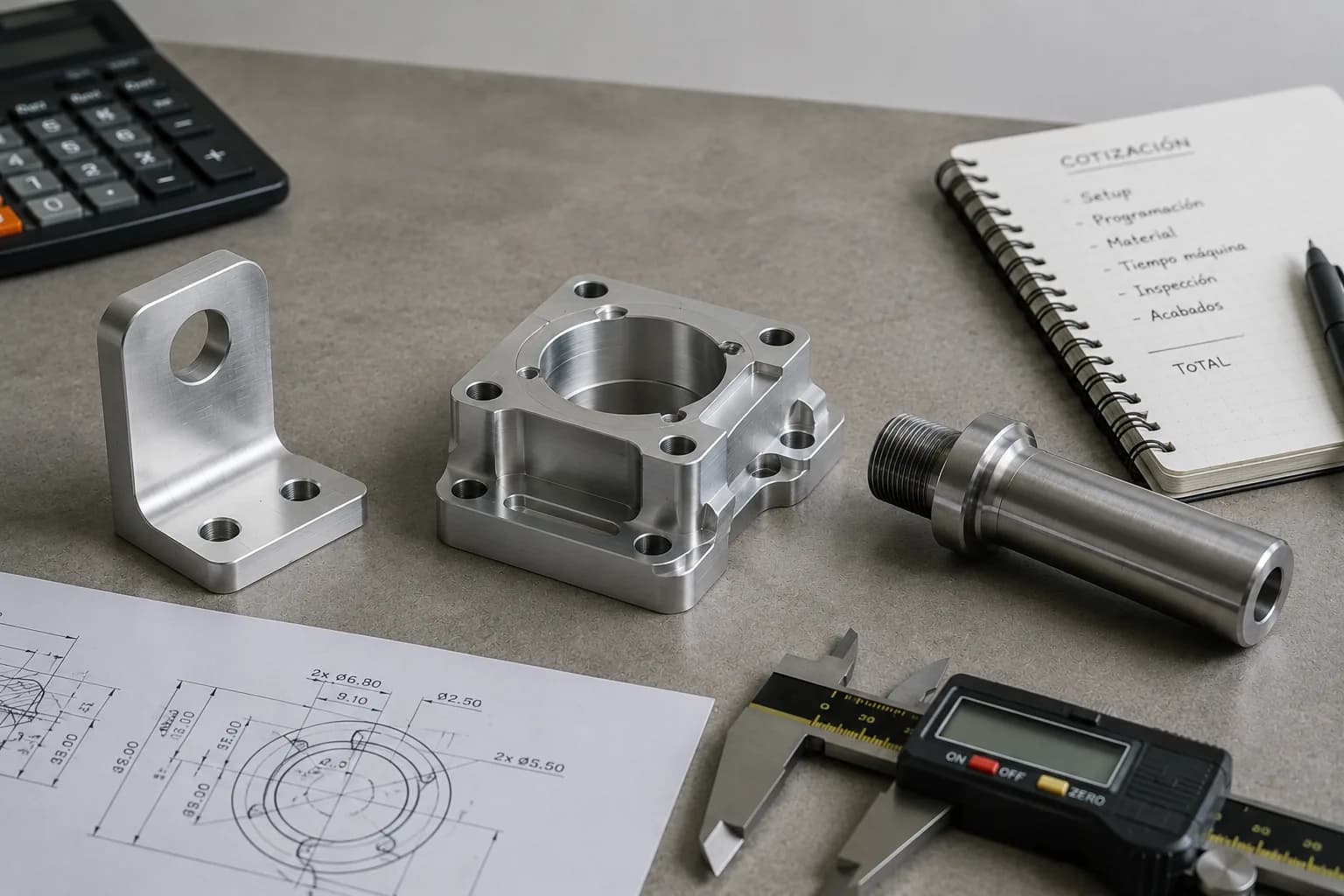
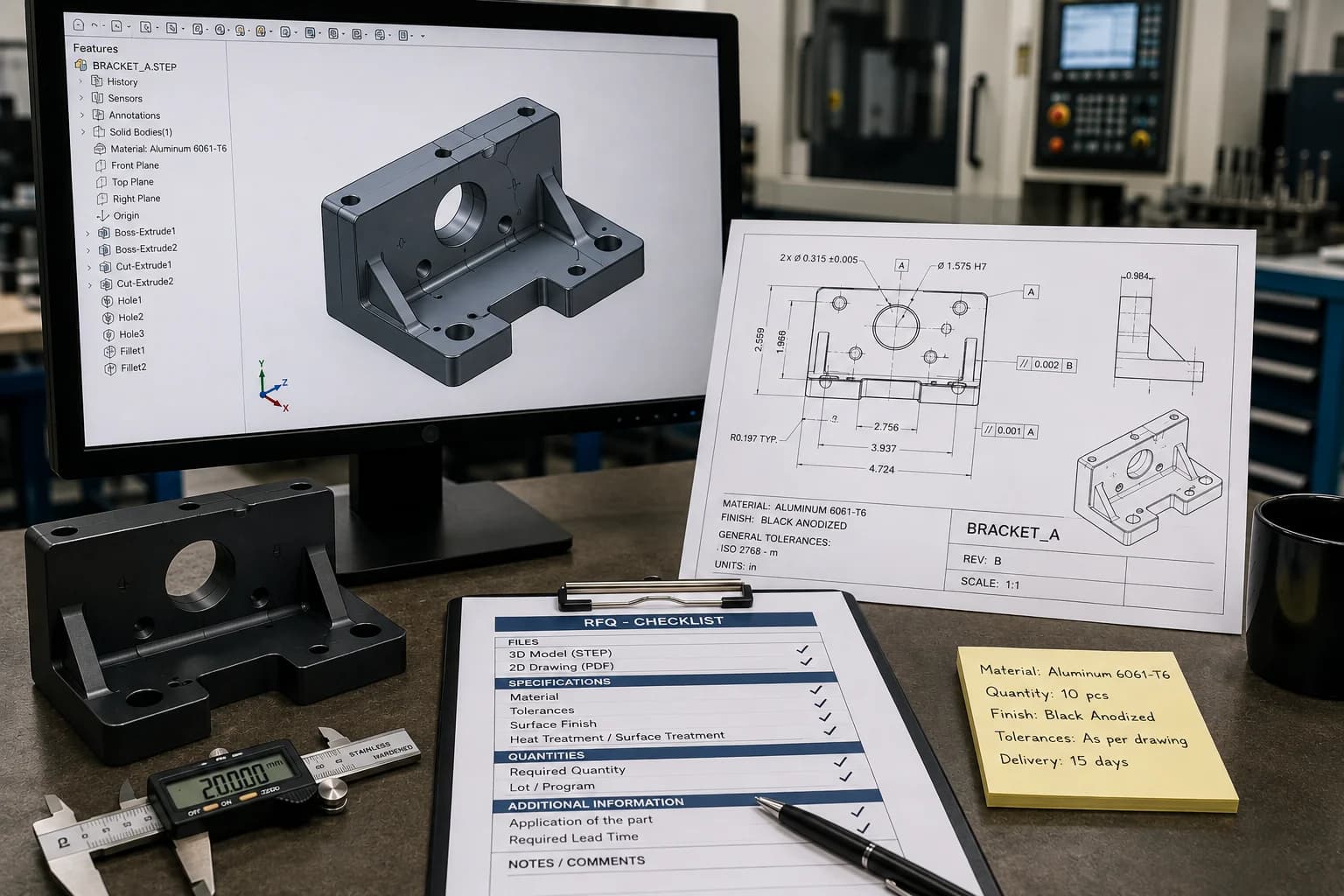
A serious supplier should be able to work with a complete technical package that includes, when applicable, PDF drawings, tolerances, surface finishes, inspection notes, and functional requirements. The goal is not to interpret the model blindly, but to understand which features are truly critical to project success.
- STEP / STP — 3D geometry per part, closed solid with no export errors.
- PDF — critical tolerances, threads, finishes, special notes, and datums when the project requires them.
- Tolerances — general for standard features and strict requirements only where they add functional value.
- Finishes — defined on specific functional or cosmetic surfaces, avoiding unnecessary requirements across the entire part.
- Revisions — consistent revision number between CAD, drawing, and RFQ to avoid manufacturing obsolete versions.
In many projects, problems do not appear during machining. They appear when there is a discrepancy between the CAD model, the drawing, or the version approved for manufacturing.
That is why the ability to review and validate technical documentation is often as important as manufacturing capability itself.
Manufacturability review can save time and money
DFM (design for manufacturability) review is not an optional step or a simple technical comment. It is one of the most effective tools to reduce cost, avoid delays, and improve the probability that a part is manufactured correctly from the first run.
Features such as internal radii that are too small, deep cavities, unnecessarily strict tolerances, or materials with limited availability can significantly increase manufacturing time without adding real value to the part's function.
Detecting these risks before programming CAM or releasing production is usually much more economical than correcting them afterward.
If your team develops CNC parts frequently, it is worth establishing consistent design criteria before requesting quotes. Our CNC machining design guide can help you reduce iterations, accelerate technical reviews, and improve manufacturability from the earliest project stages.
What PREMSA reviews before manufacturing a part
Before releasing a project to production, the engineering team at PREMSA Industries performs a technical review focused on identifying factors that could affect cost, lead time, or manufacturing feasibility.
The goal is not to modify the customer's design, but to detect possible risks early enough for decisions to be made before committing material, programming, and delivery dates.
- Difficult geometries — deep cavities, thin walls, limited access, or features that may require multiple setups.
- Critical tolerances — identifying which dimensions are truly functional and which can be optimized without affecting performance.
- Materials — availability, machinability, and compatibility with processes such as CNC milling or CNC turning.
- Finishes — validation of functional, cosmetic, or assembly surfaces to avoid unnecessary requirements.
- Technical documentation — consistency between CAD files, drawings, revisions, and RFQ specifications.
When there is an optimization opportunity that can reduce cost or accelerate manufacturing without affecting the part's function, it is communicated during the technical review. It is much easier to resolve a problem at the quoting stage than to discover it when material is already on the machine.
Make sure they can manufacture prototypes and low volume
Many CNC projects do not start with thousands of parts. They start with an idea, a validation, an urgent spare, or a first run to confirm everything works as expected.
That is why it is important to make sure the supplier can comfortably work with prototypes, iterations, and small lots without turning every change into a slow or costly process.
Flexibility is key during product development
During product development, it is normal for the design to evolve. A radius changes, a new assembly version appears, or the need arises to test another material before releasing production.
A supplier that understands this stage can help accelerate the team's learning. One structured only for high volumes can turn every iteration into additional weeks of waiting.
- Fast iterations — ability to manufacture new revisions without completely restarting the commercial process.
- Physical validations — access to real parts for assembly, performance, or manufacturability testing.
- Design changes — clear communication about differences between revisions and possible impacts on cost or lead time.
- Faster learning cycles — shorter cycles between design, manufacturing, and validation.
High MOQs can stall projects
MOQs (minimum order quantities) can make sense in certain production models, but they can also become a barrier when the goal is to validate a design or manufacture a limited quantity of parts.
Buying more components than you actually need increases inventory, financial risk, and logistics complexity, especially when there is a possibility the design will change after the first validation.
In early development stages, the priority is usually to learn fast and make decisions with real information—not fill shelves with parts that could become obsolete weeks later.
How PREMSA handles low-volume projects
At PREMSA Industries we work on projects from a single part when geometry, material, and process allow it responsibly. This includes functional prototypes, spare parts, design validations, fixtures, and pilot runs before a possible transition to repeatable production.
The goal is not to force high MOQs or make you buy unnecessary inventory, but to help you move forward with quantities aligned to the project's real stage.
We combine low-volume CNC machining with a quoting flow designed for real quantities, allowing the project to evolve from prototype to production with less administrative and technical friction.
If you want to go deeper on this topic, see our guide to low-volume CNC machining without high MOQs and our article on the CNC online quote in Monterrey.
Evaluate communication and responsiveness
Technical capability is important, but it is not the only factor that determines project success.
Even with good machines, available materials, and a competitive quote, delays usually appear when communication fails. Unanswered questions, poorly documented design changes, or lack of follow-up can quickly turn into lost weeks.
Communication often becomes a bottleneck
In prototypes, spare parts, and low-volume production, communication is as important as the manufacturing process itself.
When a clarification or an update is needed, or a design revision arises, the speed at which information flows can determine whether the project moves forward or stops.
That is why, before selecting a supplier, it is worth evaluating not only their manufacturing capability, but also how they respond, document changes, and keep the people involved in the project informed.
Red flags to watch for
- Slow responses — days pass without feedback on the RFQ, material availability, or scheduling.
- Unclear dates — general promises without committed dates or visible milestones.
- Ambiguous quotes — scope, finishes, inspection, or deliverables insufficiently defined.
- Lack of follow-up — no clear contact to resolve technical questions during the project.
- Changes without documentation — design or scope modifications that are not formally recorded.
What to expect from a professional manufacturing partner
A reliable supplier should provide much more than a number on a quote.
Communication should be clear, technical information should stay organized, and project status should stay visible throughout the process.
At PREMSA Industries we prioritize technical communication, project follow-up, and visibility on materials, manufacturing, inspection, and delivery. Especially in prototypes, spare parts, and low-volume projects, where every day of delay can affect validations, maintenance, or launch dates.
Ask how they handle quality and inspection
Quality does not begin when a part reaches the inspection area. It begins much earlier, during technical review, process planning, and defining the requirements that truly matter for how the part functions.
Quality begins before the first CNC operation
Final inspection cannot fix a poorly defined manufacturing strategy. That is why the best results usually come when quality is considered from the start of the project.
Drawing review, identification of critical features, proper tool selection, and operation planning help reduce variation and minimize risk before the first cut.
Questions you should ask about inspection
Quality can mean different things for each project. For some parts, verifying general dimensions is enough; for others, a single feature out of tolerance can affect assembly, performance, or service life.
That is why it helps to understand from the start how the supplier validates parts and what level of documentation they can offer when the project requires it.
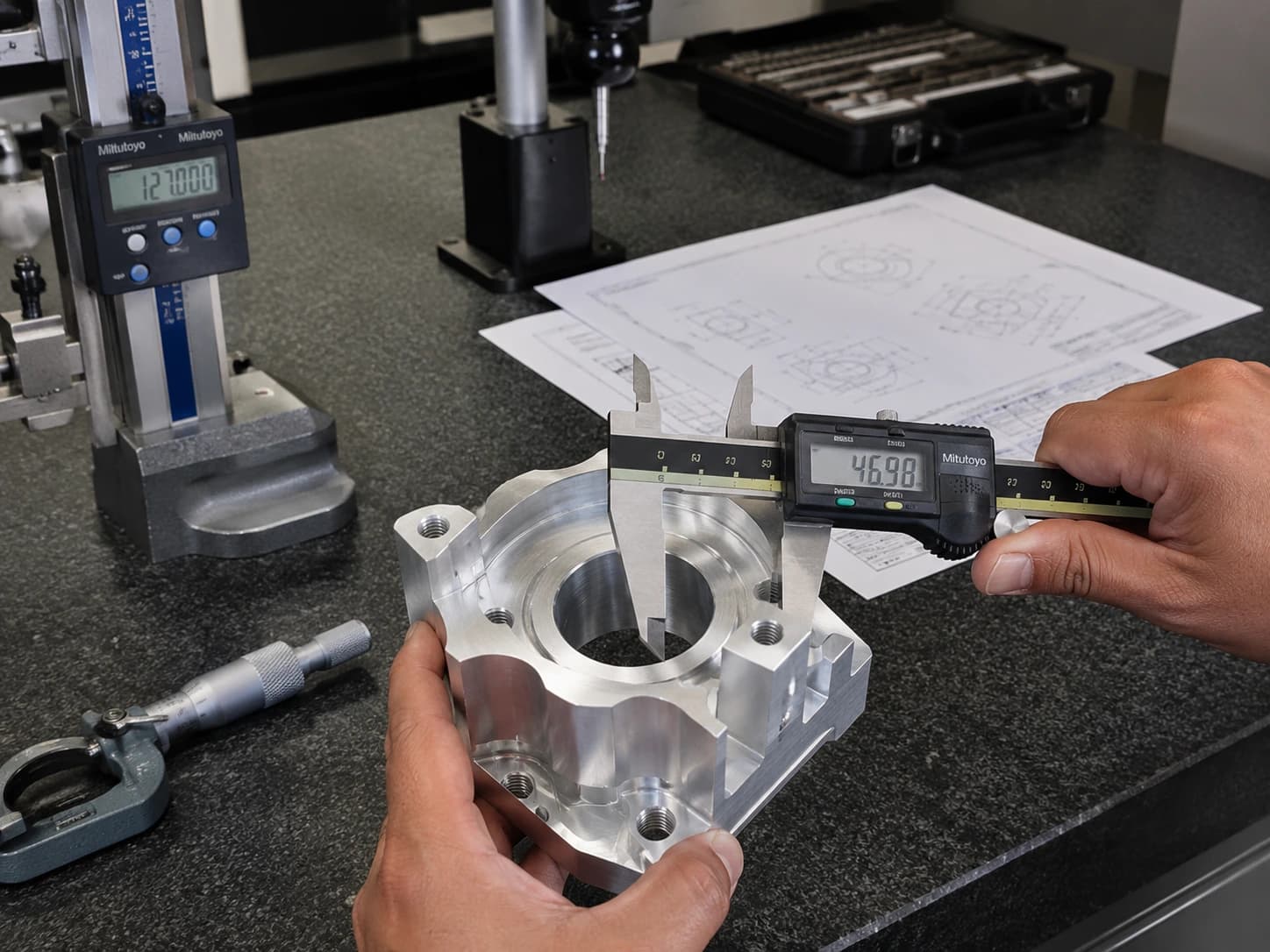
- Do they provide dimensional reports when the project requires them?
- How do they identify and document critical characteristics (CTQs)?
- How do they validate tolerances — calipers, micrometers, CMM, or other methods?
- What happens when a feature does not meet specification?
- How do they communicate deviations or changes that could affect quality?
The answers to these questions usually reveal much more about process maturity than a simple list of inspection equipment.
How PREMSA approaches inspection and quality
At PREMSA Industries quality begins before the part reaches inspection.
The flow includes requirement review during quoting, technical documentation validation, manufacturing planning, and *dimensional inspection* according to the scope and criticality of each project.
When there are critical tolerances, functional surfaces, or sensitive assembly requirements, we recommend defining CTQs (Critical To Quality) and the inspection method from the RFQ.
Making these decisions before manufacturing helps avoid different interpretations, reduces rework, and improves consistency between production runs.
The ultimate goal is not simply to verify dimensions, but to ensure the delivered part fulfills the function for which it was designed.
Think long term, not just about the first order
One of the most common mistakes when selecting a CNC supplier is evaluating only the first purchase order.
The reality is that many industrial projects evolve. What today is a validation part can become a pilot run, a recurring spare, or a production program over the next few years.
Many projects start with a prototype
It is normal for a manufacturing relationship to begin with a single part, a functional prototype, or a small validation lot.
However, it is worth asking from the start whether the supplier has the capacity to support the next project stages or whether you will need to restart the process with another company when it is time to grow.
Changing suppliers means transferring knowledge again, reviewing documentation, validating processes, and rebuilding technical context. All of that consumes time and adds risk.
The right supplier can support growth
Scalability goes far beyond installed capacity.
It also means preserving project knowledge, reusing validated programs, maintaining consistent inspection criteria, and building a relationship where you do not have to explain every detail again on every order.
When there is continuity, new runs are usually executed with greater speed, lower risk, and a better understanding of customer requirements.
From prototype to production with PREMSA
Many projects at PREMSA Industries begin with prototypes, spare parts, or low-volume manufacturing and later evolve toward recurring runs.
Keeping the same quoting flow, the same technical documentation, and the same revision history helps reduce friction between stages and avoids restarting project learning every time volume increases.
The result is a smoother transition between development, validation, and production, allowing knowledge accumulated during early stages to keep generating value as the project grows.
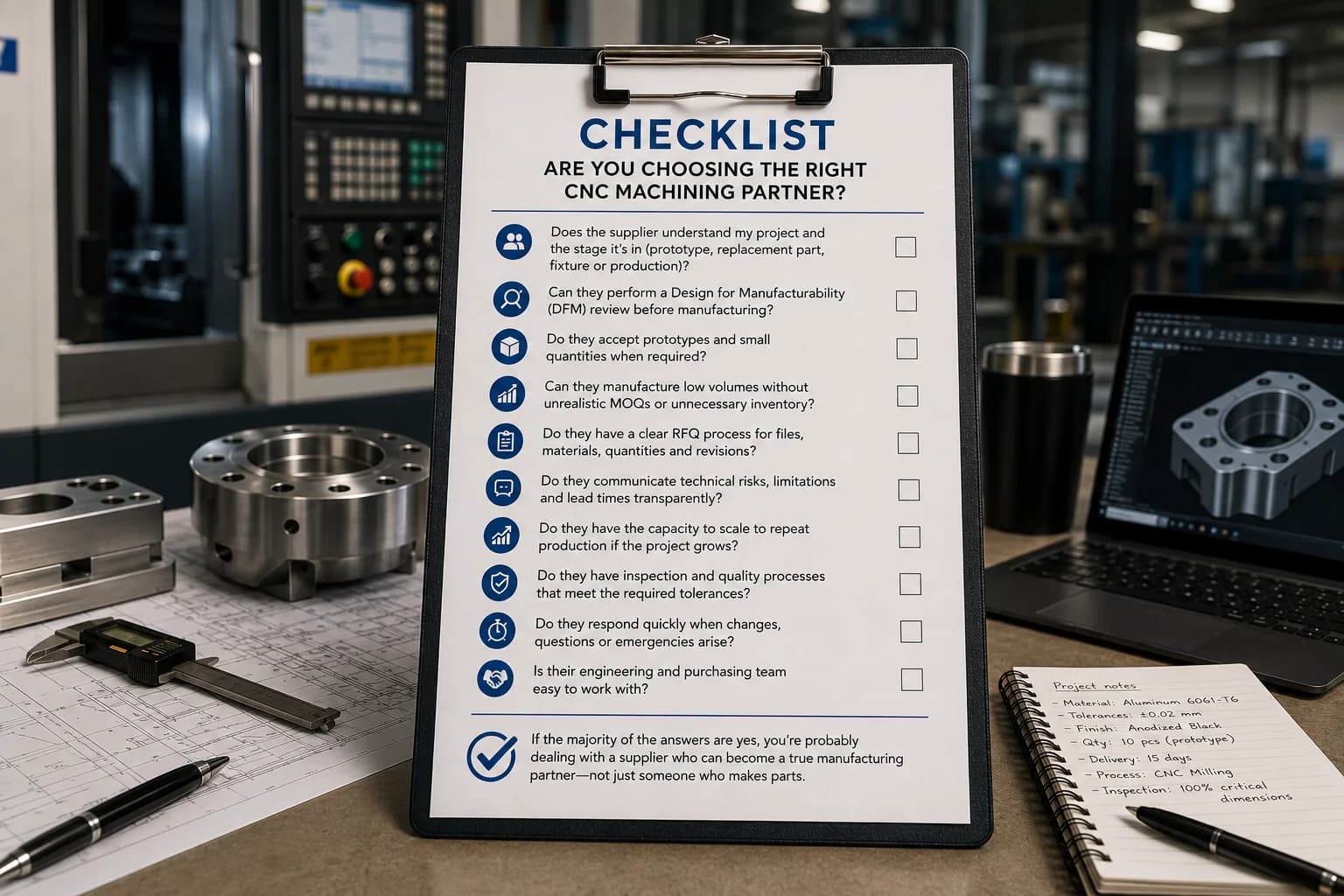
Checklist: signs you found a good CNC machining partner
After reviewing capabilities, quoting processes, technical documentation, communication, and inspection, one important question remains: did you really find a supplier you would want to work with long term?
A good manufacturing relationship is not built solely on price. It is built on trust, technical capability, consistency, and how easily both parties can solve problems when they appear.
Before sending your first order—or before changing suppliers—it is worth doing one final evaluation.
Questions you should be able to answer before sending an order
If most answers are yes, you are probably facing a supplier that can become a true manufacturing partner—not just someone who machines parts.
- Do they understand my project and the stage it is in (prototype, spare, fixture, or production)?
- Can they perform a manufacturability review (DFM) before manufacturing?
- Do they accept prototypes and small quantities when the project requires it?
- Can they manufacture low volume without unrealistic MOQs or unnecessary inventory?
- Do they have a clear RFQ process for files, materials, quantities, and revisions?
- Do they communicate risks transparently—technical limitations, constraints, and timelines?
- Do they have the capacity to scale toward repeatable production if the project grows?
- Do they have inspection and quality processes aligned with required tolerances?
- Do they respond quickly when changes, questions, or urgencies appear?
- Is their team easy to work with?
No supplier will be perfect for every project. However, the more boxes you can check on this list, the lower the probability of facing delays, rework, communication problems, or unexpected changes during manufacturing.
In many cases, the difference between a successful project and a problematic one is not the machine used, but the quality of the process around it.
Conclusion: the best CNC partner is the one that makes it easier to manufacture correctly
Choosing a CNC machining supplier in Monterrey goes far beyond comparing prices or estimated times on a quote.
The best partner for your project is one that understands your goals, identifies risks before manufacturing, and can support you from prototypes and pilot runs to repeatable production.
When there are clear quoting, technical review, communication, and inspection processes, you can spend less time solving problems and more time advancing the project.
At PREMSA Industries we combine CNC machining, manufacturability review, and an online CNC quote tool designed to simplify the process from the first RFQ.
If you are evaluating suppliers in the region, send us your STEP files, specifications, and quantities for technical review oriented to real manufacturing. You can also see our CNC machining in Monterrey page, our guide to CNC machining in Monterrey, and our articles on CNC services for regional industry and fast CNC machining in Monterrey.
If you are preparing or optimizing designs, see our CNC machining design guide.

Written by
Adrian Cavazos and the PREMSA Engineering Team
Adrian Cavazos, founder of PREMSA Industries, leads a manufacturing engineering team specialized in CNC turning and milling, 3D printing, and production-ready solutions. The team works closely with customers to optimize designs, improve manufacturability (DFM), and ensure reliable, scalable production from prototypes to volume manufacturing.