
Comparing CNC machining quotes seems straightforward: you receive three or four prices, line them up in a spreadsheet, and choose the most economical option. In industrial manufacturing, however, that logic often becomes one of the most expensive mistakes you can make when getting parts made.
Two suppliers can quote the exact same drawing and deliver prices that differ by 20%, 50%, or even more. The reason is rarely that one supplier simply wants to earn more than another. In most cases, each supplier is interpreting the project differently: material, tolerances, finishes, inspection, manufacturing strategy, lead time, documentation, or even the level of risk they are willing to accept.
For example, one supplier may assume general tolerances and commercial material available in stock, while another considers dimensional inspection, material certificates, special tooling, and reserved capacity to meet an aggressive delivery date. Both are quoting the same part, but not necessarily the same scope.
That is why a low quote does not always represent a good purchase. Sometimes it is a signal that a finish was omitted, inspection was not considered, a different material was assumed, or a critical design feature was simply not identified. When that happens, the initial savings usually disappears quickly in the form of rework, rejections, engineering changes, logistics delays, or even production stoppages.
The best quote is not always the cheapest. The best quote is the one that offers the right balance of cost, quality, technical compliance, delivery reliability, and project risk reduction.
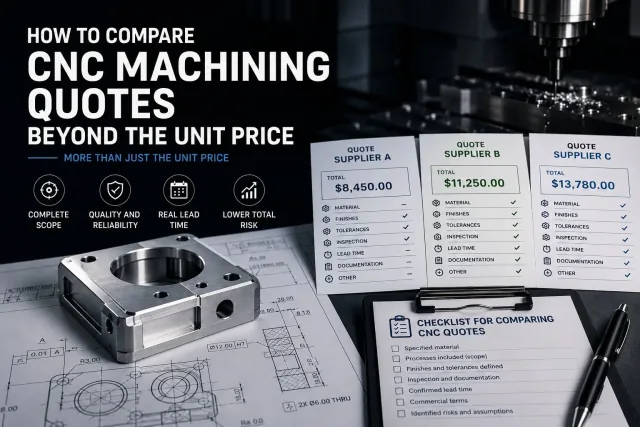
Six criteria to compare CNC quotes fairly
- Material — same grade, condition, and certification requirements across suppliers.
- Tolerances and inspection — general vs critical limits and metrology scope.
- Finishes and secondary processes — anodizing, coating, heat treatment, and deburring.
- Manufacturing complexity — setups, tooling, and real machine-time assumptions.
- Lead time and validity — committed delivery date and quote expiration.
- Total scope — confirm every supplier is pricing the same part and requirements.
In CNC, comparing prices without comparing scope means comparing numbers that do not represent the same part.
Why CNC quotes can vary so much
When several quotes for the same part arrive with significant price differences, the natural reaction is to assume that one of them must be wrong. In reality, the most common explanation is that each supplier is valuing the project under different assumptions.
A CNC quote is not just the cost of cutting material. It also incorporates decisions related to manufacturing, inspection, programming, tooling, material availability, production capacity, technical risk, and delivery commitment. Even small changes in any of these factors can significantly alter the final price.
Before rejecting a high quote or approving a low one, it is worth identifying exactly what each supplier is considering. Only then can you determine whether you are truly comparing equivalent alternatives.
Specified material
The first point to verify is that all suppliers are quoting exactly the same material. This seems obvious, but it is one of the most common differences between CNC quotes.
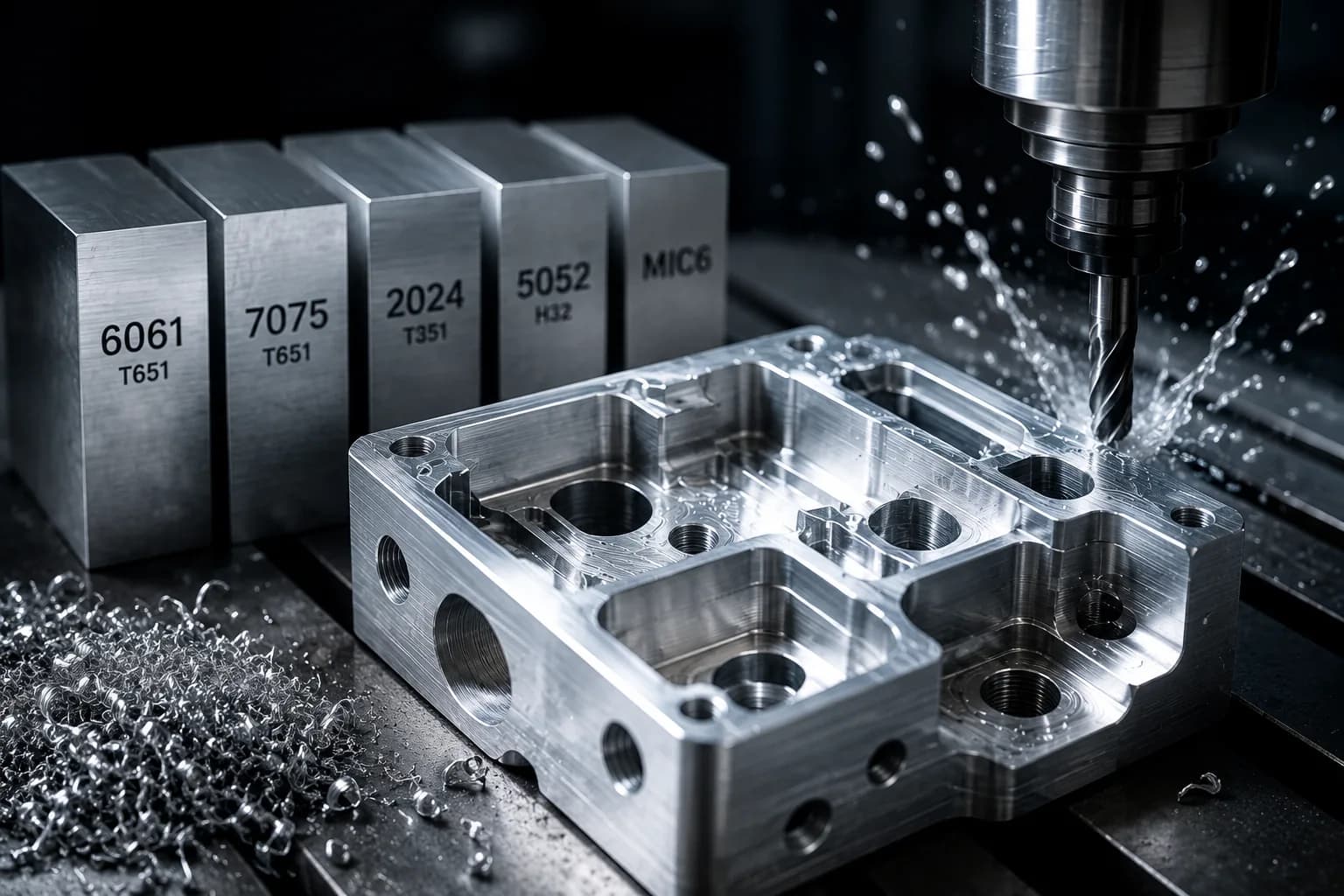
Simply saying "aluminum," "steel," or "stainless" does not fully define a raw material. Grade, standard, supply condition, and traceability requirements can materially change both cost and manufacturing difficulty. In addition, some materials may be immediately available in inventory while others require special purchases that affect price and lead time.
When two suppliers use different materials, even if the difference seems minor on paper, they are no longer quoting the same product.
- Aluminum 6061 vs 7075 — 7075 usually offers higher mechanical strength but also comes at a significantly higher cost.
- Steel 1018 vs 4140 — 4140 typically implies higher material cost, tooling, and machining difficulty.
- Stainless 304 vs 316 — 316 provides better corrosion resistance but is generally more expensive and harder to machine.
- Annealed vs heat-treated material — material condition can change machining time, tool wear, and dimensional stability.
- Commercial vs certified material — material certificates, traceability, and documentation add value but also cost and supply time.
A frequent mistake is comparing a quote based on commercial stock material against another that includes certificates, traceability, or customer-specific requirements. Even if both indicate the same material grade, the real scope can be very different.
Before comparing prices, always confirm that the material, supply condition, and documentation requirements are exactly the same. Otherwise, any economic comparison will be misleading.
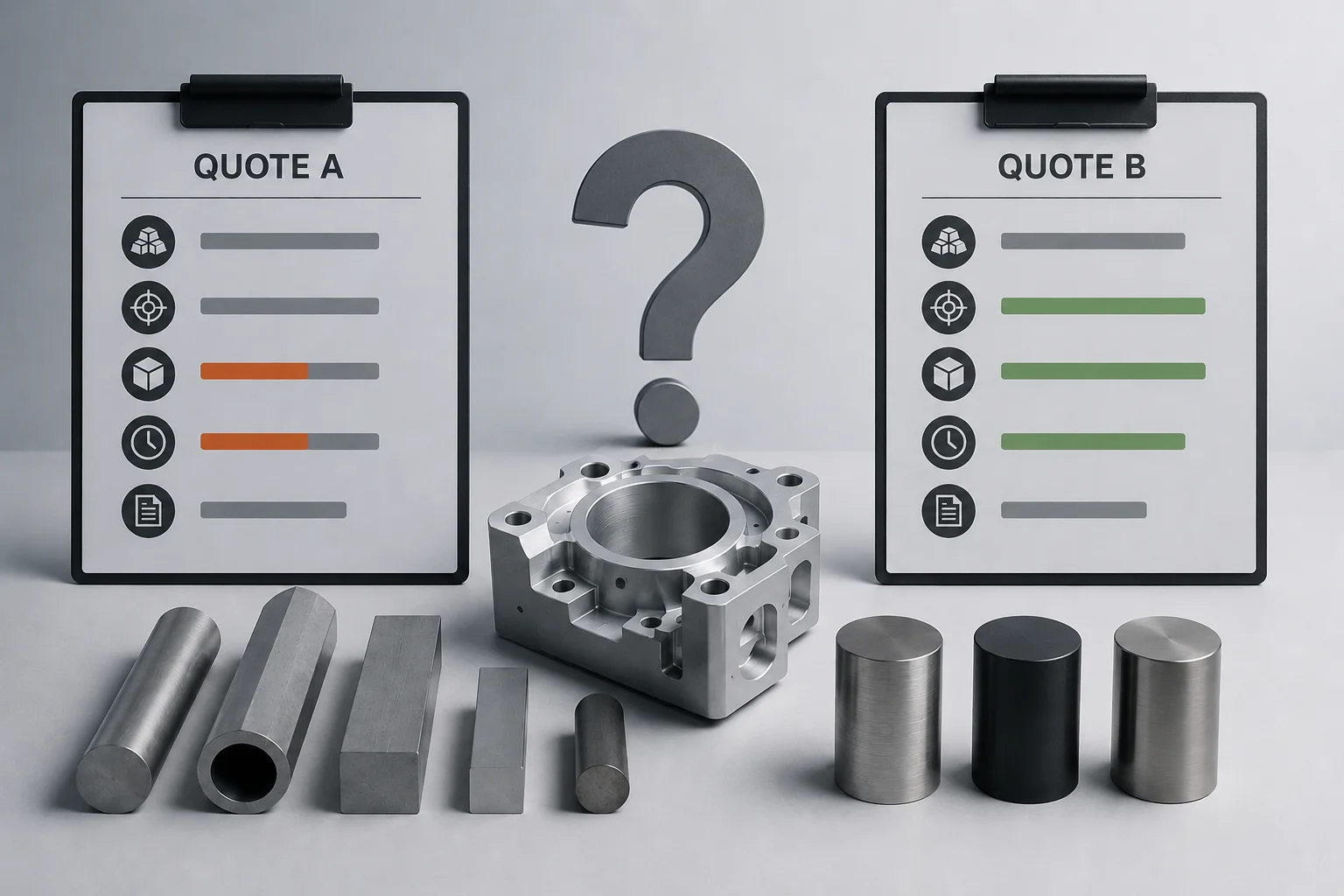
Manufacturing complexity
Two parts can look practically identical in a CAD model and still have completely different manufacturing costs. The reason is that CNC part price depends not only on dimensions or material, but on how much effort is required to produce the part repeatably, precisely, and reliably.
Geometric complexity directly affects CAM programming time, the number of tools required, the number of setups, fixturing difficulty, inspection requirements, and the risk of producing out-of-spec parts. That is why when one quote is significantly higher than another, the difference is often not in the supplier margin, but in how they interpret and plan to manufacture the part.
- Number of setups — each additional orientation means re-clamping the part, recalibrating references, and increasing preparation time.
- Pocket depth — deep pockets usually require long tools, more conservative cutting strategies, and slower machining cycles.
- Small internal radii — force the use of smaller-diameter tools, increasing cycle time and tool wear.
- Tight tolerances — require additional finishing operations, measurement, and inspection.
- Critical or deep threads — may require special tools, additional cycles, or dimensional verification.
- Thin walls — increase vibration, deformation, and rejection risk during machining.
- Difficult-to-hold geometries — may require special vises, dedicated fixtures, or multiple operations to complete the part.
An important difference between suppliers is that not everyone evaluates complexity with the same level of detail. Some shops quote mainly based on general dimensions and material volume, while others analyze manufacturing strategy, production risk, and real machine time. As a result, two quotes can look very different even though both are based on the same drawing.
For that reason, when comparing prices, do not only ask how much it costs to make the part. Also ask how they plan to manufacture it.
Tolerances and inspection
Tolerances are one of the factors that create the largest differences between CNC quotes because not all suppliers interpret dimensional requirements the same way.
One supplier may assume general manufacturing tolerances while another considers critical inspection, dimensional reports, 100% verification, special gauges, or even dedicated metrology equipment. In most cases, those activities are not visible when you simply compare prices in a spreadsheet.
The reality is that producing a dimension within ±0.10 mm does not cost the same as holding ±0.01 mm repeatably. As tolerances become tighter, machining time, inspection frequency, scrap probability, and the risk the manufacturer accepts all increase.
Tolerances do not only define how precise a part must be. They also determine how much time, inspection, and risk are required to manufacture it.
Before comparing two quotes, verify that both suppliers are considering exactly the same critical tolerances and the same level of inspection. Otherwise, the comparison will be misleading from the start.
For specification criteria and tolerance selection, see the CNC machining tolerances guide.
Finishes and post-processes
Another frequent source of quote differences is everything that happens after machining. A part fresh off the machine rarely represents the final product the customer receives.
Surface finishes, heat treatments, coatings, marking, cleaning, assembly, and documentation can add days of lead time and significantly change total cost. However, these items often go unnoticed when only the unit price is compared.
- Anodizing — improves corrosion resistance and appearance on aluminum components.
- Zinc plating — common surface protection for steel components.
- Black oxide — finish used for protection and aesthetic appearance.
- Passivation — frequent process on stainless steels to improve corrosion resistance.
- Powder coating — durable finish with multiple color and texture options.
- Heat treatment — changes mechanical properties and dimensional stability.
- Marking — part identification, traceability, or regulatory requirements.
- Hardware insertion — nuts, studs, helicoils, or other assembled elements.
When a quote includes finishes or external processes, it is important to verify whether those costs are integrated or will be billed separately. Two suppliers can offer very different prices simply because one includes all required processes and the other is only considering machining.
Lead time and urgency
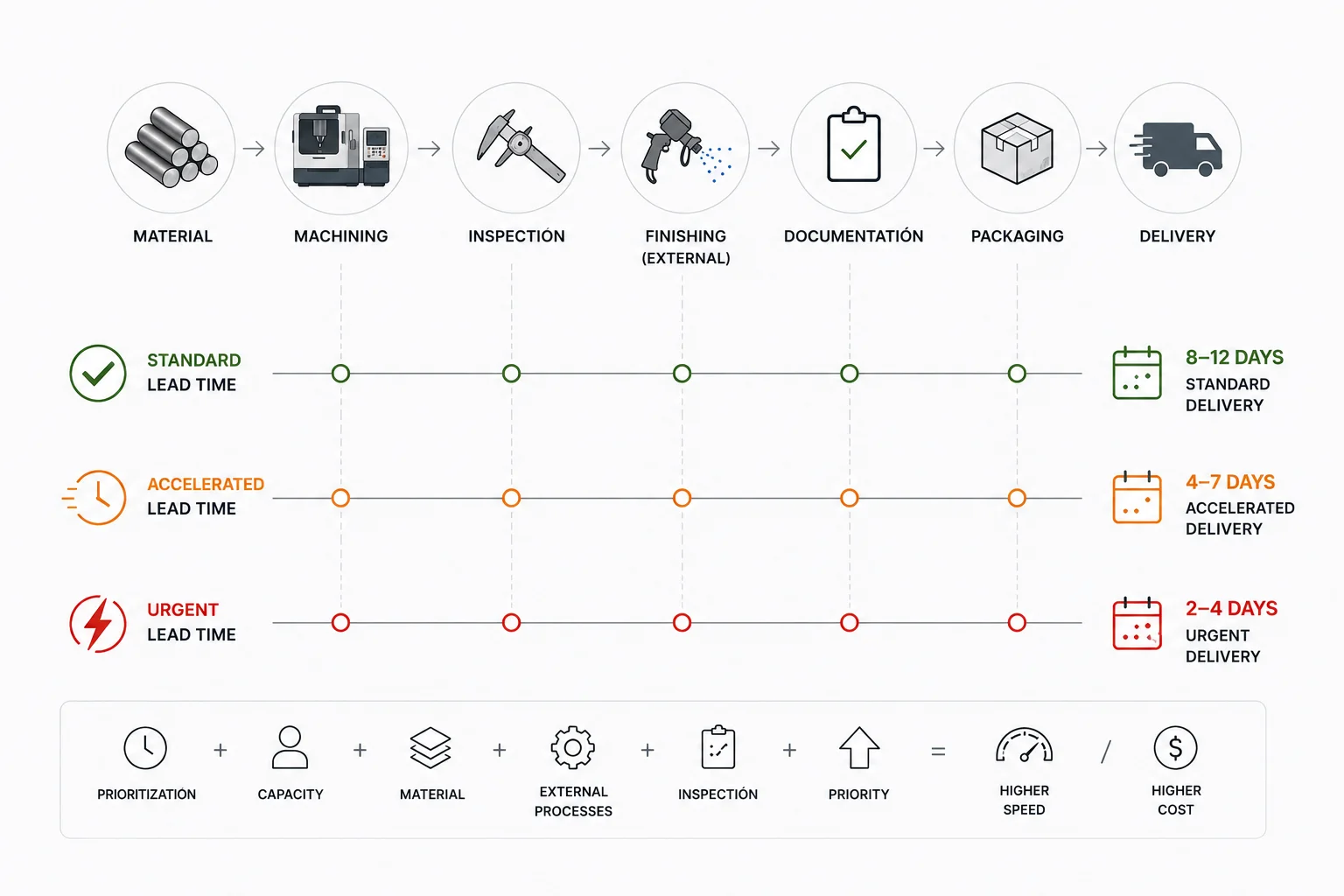
Price and delivery time are usually closely related. In CNC manufacturing, accelerating a project normally requires reorganizing production scheduling, prioritizing materials, reserving machine capacity, or coordinating external processes with greater urgency.
For that reason, an economical quote with an uncertain delivery date can end up costing much more than a slightly more expensive option capable of meeting a critical date.
Real lead time depends on multiple factors:
- Material availability
- Current production load
- Part geometric complexity
- Requested quantity
- Required external processes
- Inspection and documentation
- Project priority assigned
When comparing quotes, do not evaluate only how much it costs to manufacture a part. Also evaluate how likely each supplier is to deliver on the committed date. In many industrial projects, a one-week delay can cost much more than any initial price difference.
To better understand how delivery times are built in manufacturing, see fast CNC machining and lead times.
The most common mistake: comparing only unit price
Unit price vs total cost
One of the most frequent mistakes in industrial procurement is assuming that the best quote is the one with the lowest unit price. Although price per part is important data, it rarely represents the real cost of a CNC purchase.
The reality is that buyers are not purchasing parts alone. They are buying specification compliance, delivery reliability, repeatability, technical support, and risk reduction. When any of those elements fails, the economic impact is usually much greater than any savings obtained during initial negotiation.
For that reason, people with more experience buying parts usually evaluate total project cost of ownership rather than unit price alone. A difference of a few dollars per part may look important in a spreadsheet, but it becomes insignificant compared with the cost of a rejected lot, a production delay, or a missed delivery.
- Rework — out-of-tolerance parts that must be reprocessed, adjusted, or remanufactured.
- Rejections — wasted material, machine time, and logistics from nonconforming parts.
- Delays — impact on validations, engineering releases, assemblies, or production programs.
- Logistics costs — expedited shipments, returns, replacements, and extraordinary movements.
- Line stoppages — a single critical part can stop an entire operation.
- Poor communication — unclarified assumptions that create late changes and corrective orders.
- Lack of traceability — especially problematic in repetitive, regulated, or high-responsibility projects.
Unit price appears on the quote. Real cost appears when something goes wrong.
When cheap becomes expensive
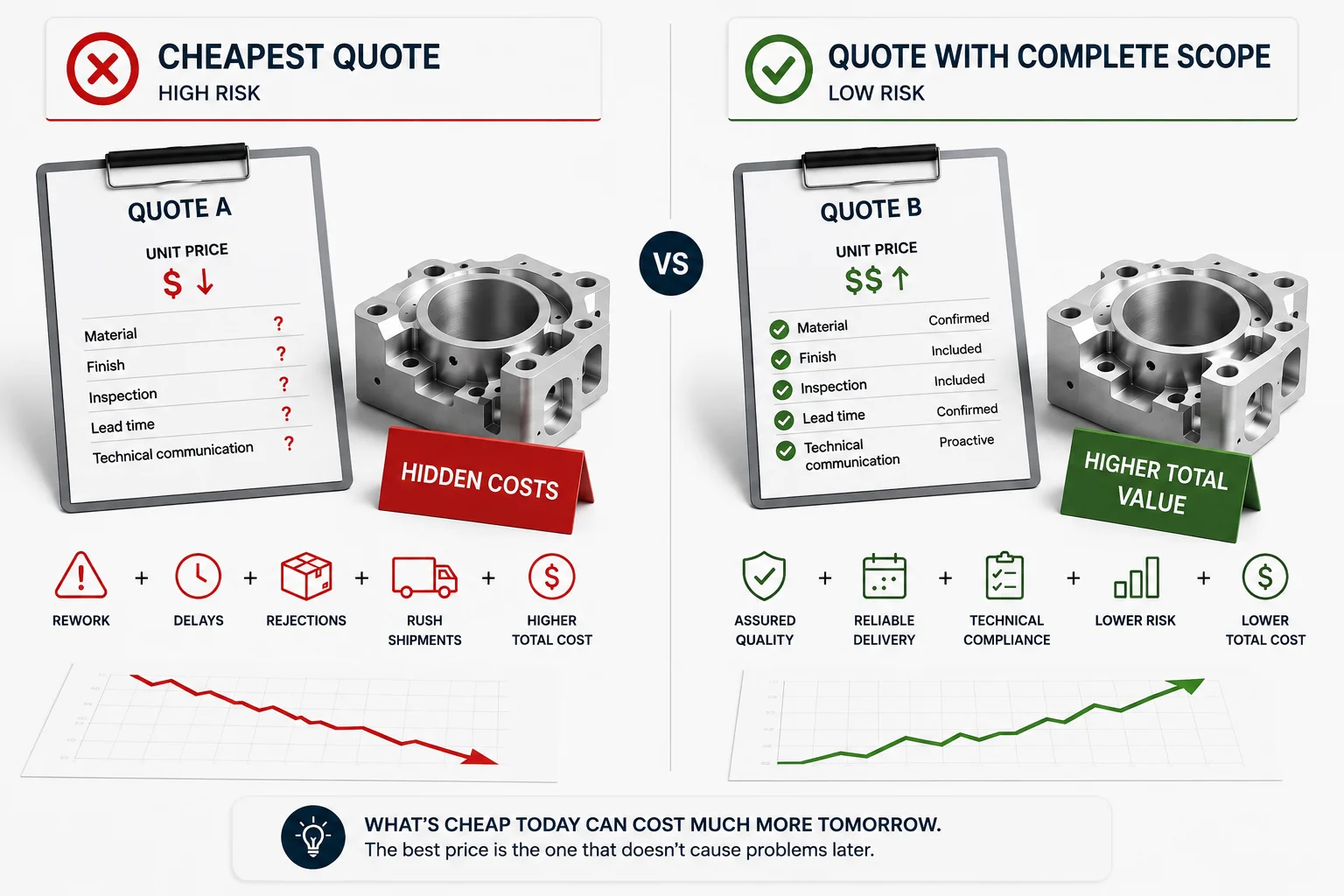
Imagine you need 50 parts for a critical assembly with a committed delivery date. You receive two quotes.
Supplier A offers the lowest price. However, it does not clearly specify material, does not include dimensional inspection, does not confirm finishes, and does not provide a firm delivery date.
Supplier B presents a higher price but documents the exact material, includes inspection, defines the required finish, validates the drawing, and provides a specific lead time.
At first glance, the most economical option seems like the logical decision. However, if even one part in the lot arrives out of specification and forces you to delay an assembly, request replacements, or perform rework, the initial savings disappear quickly.
In many industrial cases, one week of delay or an urgent replacement order costs more than the entire price difference between both quotes.
That is why experienced buyers usually ask a different question. Instead of asking "which quote is cheapest?", they ask "which quote has the lowest probability of creating problems after the purchase order is issued?".
| Criterion | Supplier A | Supplier B |
|---|---|---|
| Unit price | Lower | Higher |
| Specified material | Ambiguous | Confirmed |
| Finish included | No | Yes |
| Inspection included | No | Yes |
| Lead time | Uncertainty | Committed date |
| Technical communication | Limited | Proactive |
| Total risk | High | Low |
| Overall value | Hard to determine | More predictable |
The goal of a CNC quote should not simply be to minimize purchase price. The goal is to minimize total project cost while considering quality, technical compliance, delivery reliability, and operational risk.
What a professional CNC quote should include
A professional CNC quote should remove uncertainty, not create it. When a buyer receives a proposal, they should be able to understand exactly what will be manufactured, under which specifications, with what quality level, and under which commercial conditions.
If a quote forces you to assume important information or leaves questions unanswered, it is not yet ready to be compared against other alternatives. The clearer the assumptions from the start, the lower the risk of price changes, technical disputes, or production problems.
A good quote does not only communicate a price. It communicates exactly what the customer will receive.
Technical information
The technical section defines which product is being quoted. If this information is ambiguous, two suppliers may be proposing completely different solutions without it being obvious to the buyer.
- Part number — exact identification of the quoted component.
- Drawing revision — prevents manufacturing an obsolete design version.
- Material — grade, standard, condition, and special traceability requirements.
- Quantity — volume considered to calculate price and manufacturing strategy.
- Critical tolerances — features requiring additional dimensional control.
- Required finish — surface, cosmetic, or functional per specification.
- Files used to quote — STEP, PDF, DXF, or other relevant documents.
A recommended practice is to verify that all suppliers are quoting exactly the same drawing revision and the same file package. Seemingly minor differences can create significant changes in price, lead time, and quality.
Commercial information
Commercial information defines the economic conditions under which the purchase will take place. A quote may have an attractive price but still be difficult to compare if it does not clearly specify financial terms and validity.
- Unit price — cost per part under the stated conditions.
- Total price — full value of the quoted lot.
- Quote validity — period during which the price remains valid.
- Payment terms — deposit, credit, wire transfer, or other agreed conditions.
- Currency — USD, MXN, or other applicable currency.
- Taxes — clear specification of included or additional taxes.
When material has high volatility or external processes are involved, quote validity becomes especially important. A price valid for seven days does not represent the same commercial commitment as one valid for thirty or sixty days.
Delivery information
Many quotes show price in detail but leave delivery in vague terms. From a procurement perspective, a reliable date can be as important as the price itself.
- Lead time — estimated manufacturing time.
- Estimated delivery date — concrete commitment for planning.
- Shipping conditions — logistics responsibilities and associated costs.
- Delivery location — destination considered within the quote.
When a part is part of a launch, validation, or production program, it is worth confirming whether lead time starts when the purchase order is issued, when the deposit is received, or after technical documentation is approved.
Quality information
Quality is rarely reflected only in price. That is why a professional quote should clearly specify which controls, documents, and evidence will accompany the finished product.
- Inspection included — sampling, dimensional inspection, or 100% verification.
- Material certificates — evidence of conformity with the required specification.
- Dimensional report — measurement results for critical features.
- COC (Certificate of Conformance) — formal declaration of compliance.
- Customer special requirements — PPAP, FAI, traceability, specific packaging, or other requirements.
In industrial, aerospace, automotive, or medical projects, quality documentation can be as important as the part itself. Before comparing prices, verify that all suppliers are considering exactly the same level of inspection and documentation.
If a quote does not clearly specify material, quality, delivery, and scope, the price alone has little value for making a decision.
If you are still assembling the information package to request prices, the guide to how to get CNC parts made and CAD files for CNC machining will help you receive more complete, accurate, and comparable quotes from the start.
Red flags in a CNC quote
Not all weak quotes are easy to identify. Some look professional at first glance, have an attractive price, and arrive quickly. However, when analyzed in detail, omissions, assumptions, or ambiguities often appear that can become expensive problems during production.
Detecting these red flags before issuing a purchase order helps reduce technical, financial, and operational risk. If you find several of the following situations in the same quote, it is worth digging deeper before making a decision.
Ambiguous material
If the quote only mentions generic terms such as "aluminum," "steel," "stainless," or "nylon" without specifying grade, standard, or supply condition, there is significant interpretation risk.
The supplier may be assuming a different material than required, a more economical variant, or simply the option available in inventory. In critical applications, that difference can affect mechanical strength, performance, machinability, traceability, or specification compliance.
If the material is not defined precisely, the product you will receive is not defined either.
No mention of tolerances
A professional quote should demonstrate that the supplier reviewed the drawing and understood the functional requirements of the part. When there is no reference to critical tolerances, threads, finishes, special notes, or relevant dimensional features, the technical review may have been superficial.
This does not necessarily mean the supplier cannot manufacture the part, but it may indicate that the real project scope has not been fully evaluated.
No clear lead time
Expressions such as "as soon as possible," "fast delivery," or "subject to availability" do not represent a delivery commitment. Without a clear date, it is difficult to coordinate validations, assemblies, downstream purchases, or production activities.
A reliable quote should indicate when delivery is expected and under which conditions the committed time begins to run.
Price significantly lower than other options
When a quote is well below the rest, the right question is not "why is it so cheap?" but "what is being considered differently?".
In some cases there may be a legitimate advantage in capacity, processes, or efficiency. However, it can also indicate that operations were omitted, drawing requirements were not understood, more open tolerances were assumed, or manufacturing risks were simply not identified.
A moderate price difference between suppliers is normal. An extreme difference deserves much deeper review before approving the purchase.
No technical questions asked
One of the most underestimated signals is when a supplier delivers a complex quote without asking a single question.
Industrial parts rarely arrive with all the information needed to manufacture without doubts. Material, annual quantity, finish, end use, dimensional requirements, assembly, documentation, or delivery priority usually require clarification.
The best suppliers usually ask questions before quoting because they are trying to remove uncertainty. Paradoxically, a quote obtained after several technical questions is usually more reliable than one generated in minutes without any information exchange.
Good quotes usually come from good questions.
Does not specify what is included
Scope must be clearly defined. If you do not know exactly what the price includes, you also cannot compare suppliers fairly.
Finishes, inspection, packaging, material certificates, dimensional reports, heat treatments, quality documentation, or logistics costs should appear explicitly when they are part of the project.
One of the most common procurement mistakes is comparing a quote that includes finish, inspection, and documentation against another that only considers machining. Even if both look similar in price, they are actually quoting different products.
Does not identify manufacturing risks
When a part contains aggressive tolerances, deep pockets, thin walls, complex radii, or difficult-to-machine materials, manufacturing risks are normal.
If a supplier reviews a complex design and mentions no observations, DFM recommendations, or possible areas of concern, it is worth asking how they evaluated the project. A total absence of comments does not always mean the design is perfect; sometimes it means no one analyzed it in depth.
The best quotes do not only indicate how much it will cost to manufacture a part. They also help identify problems before they reach production.
How to compare CNC suppliers beyond price
A quote is only a partial snapshot of a supplier. Price can help you understand the cost of a part, but it rarely reveals the full manufacturing experience.
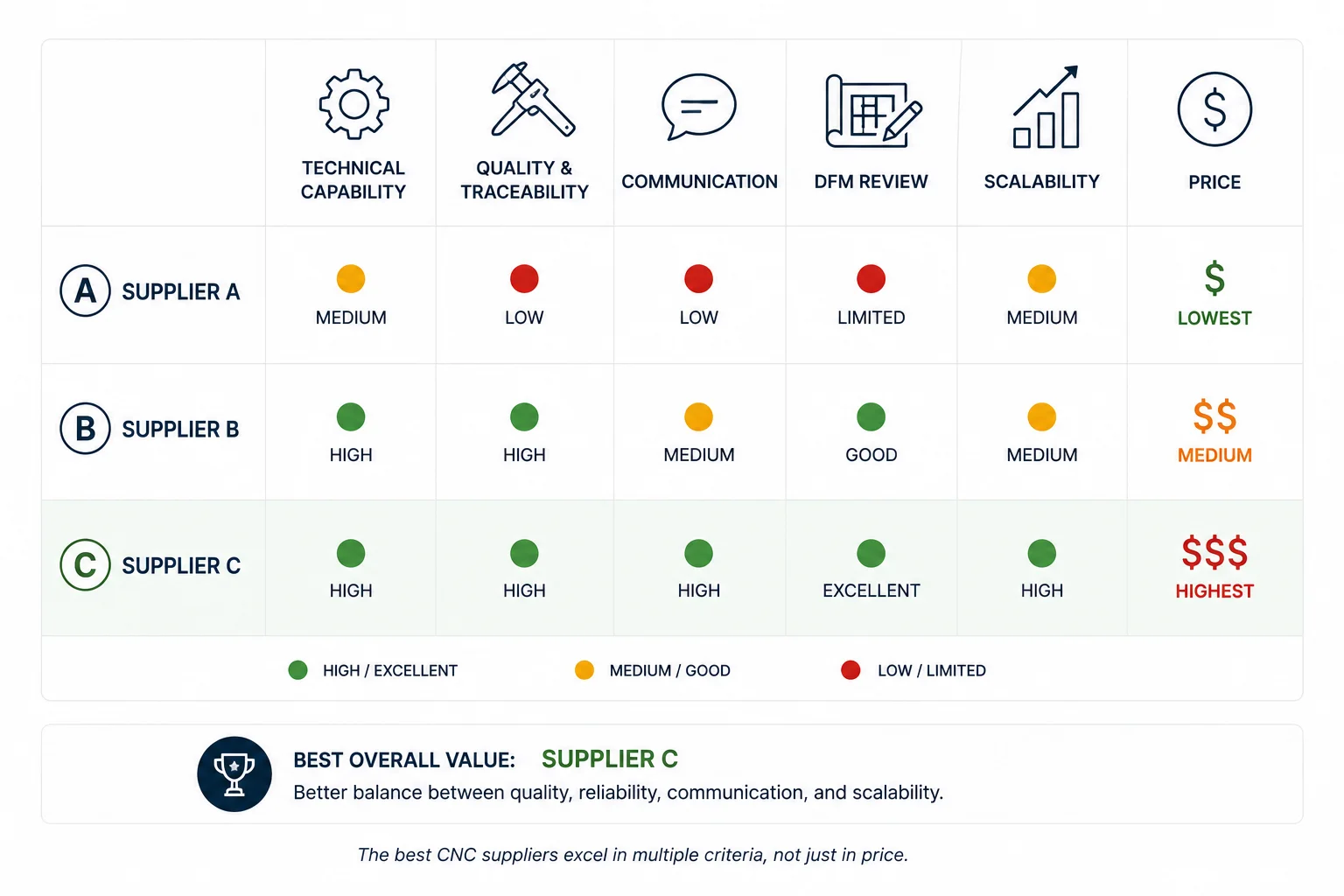
The most effective buyers do not select suppliers only by who offers the lowest price. They evaluate technical capability, reliability, communication, quality, growth capacity, and risk level. After all, a purchase order is not an isolated transaction; it is the start of a relationship that can impact production, quality, and compliance for months or years.
Technical capability
The first question should not be how much it costs to manufacture a part. It should be whether the supplier can actually manufacture it consistently.
Not all manufacturers have the same experience with complex materials, tight tolerances, high-precision parts, or difficult geometries. A competitive quote quickly loses value if the supplier discovers technical limitations once production has started.
Evaluate relevant experience in processes such as CNC milling, CNC turning, complex parts, difficult-to-machine materials, critical components, and inspection requirements.
Communication
Communication quality is usually one of the best indicators of a supplier's future performance. Companies that respond quickly, ask relevant questions, and document agreements correctly usually create fewer problems during production.
Conversely, when communication is slow, ambiguous, or reactive during the quoting stage, those same problems usually amplify after the purchase order is issued.
The way a supplier quotes usually anticipates the way they will execute the project.
DFM review
The best quotes do not only deliver a price. They also help identify risks before manufacturing.
A DFM (Design for Manufacturability) review can detect unnecessarily tight tolerances, additional setups, difficult-to-machine pockets, problematic radii, or features that raise cost without adding functional value.
When a supplier proposes manufacturing improvements before receiving the purchase order, they are usually thinking about project success and not only about selling machine hours. To go deeper on this topic, see the CNC machining design guide.
Quality and traceability
In industrial projects, quality should not be assumed. It must be defined and documented.
Before selecting a supplier, it is worth understanding what type of inspection will be performed, what evidence will be delivered, and how product conformity will be documented. Depending on the application, this may include material certificates, dimensional reports, lot traceability, or certificates of conformance.
The difference between two seemingly similar quotes may be precisely the level of quality control each supplier is willing to provide.
Scalability
Many projects start with a prototype or a small lot but do not end there. If the part works correctly, the next step is usually repetitive production.
That is why it is worth evaluating whether the supplier can support project growth. A supplier capable of making one part today but unable to sustain 500 or 5,000 units tomorrow may force you to repeat validations, approvals, and procurement processes with another manufacturer later.
The best option is usually the one that can support the full product lifecycle, from prototypes to stable production.
Questions to ask before approving a CNC quote
Before issuing a purchase order, it is worth clarifying a few points that rarely appear complete in a quote. These questions help detect risk, align expectations, and avoid surprises during manufacturing.
Technical questions
- What exact material are you quoting?
- Which drawing revision did you use to generate the quote?
- Which tolerances do you consider critical?
- Is there any difficult or risky feature to manufacture?
- Do you recommend any DFM changes to reduce cost or risk?
- Is there any dimension that requires special inspection?
- Would the price change if certain tolerances or finishes are modified?
Commercial questions
- What exactly does the quoted price include?
- Does the quote include surface finishes?
- Is inspection included or quoted separately?
- Does quality documentation have an additional cost?
- How long is the quote valid?
- Are there programming, tooling, or setup charges?
- Are there conditions that could change the price later?
Delivery questions
- Is the material currently available?
- What is the expected real lead time?
- What factors could delay delivery?
- Does the clock start at purchase order or at deposit receipt?
- Are there external processes that could affect the committed date?
- How would delays or changes be communicated during production?
A question asked before issuing the purchase order usually costs less than a problem discovered afterward.
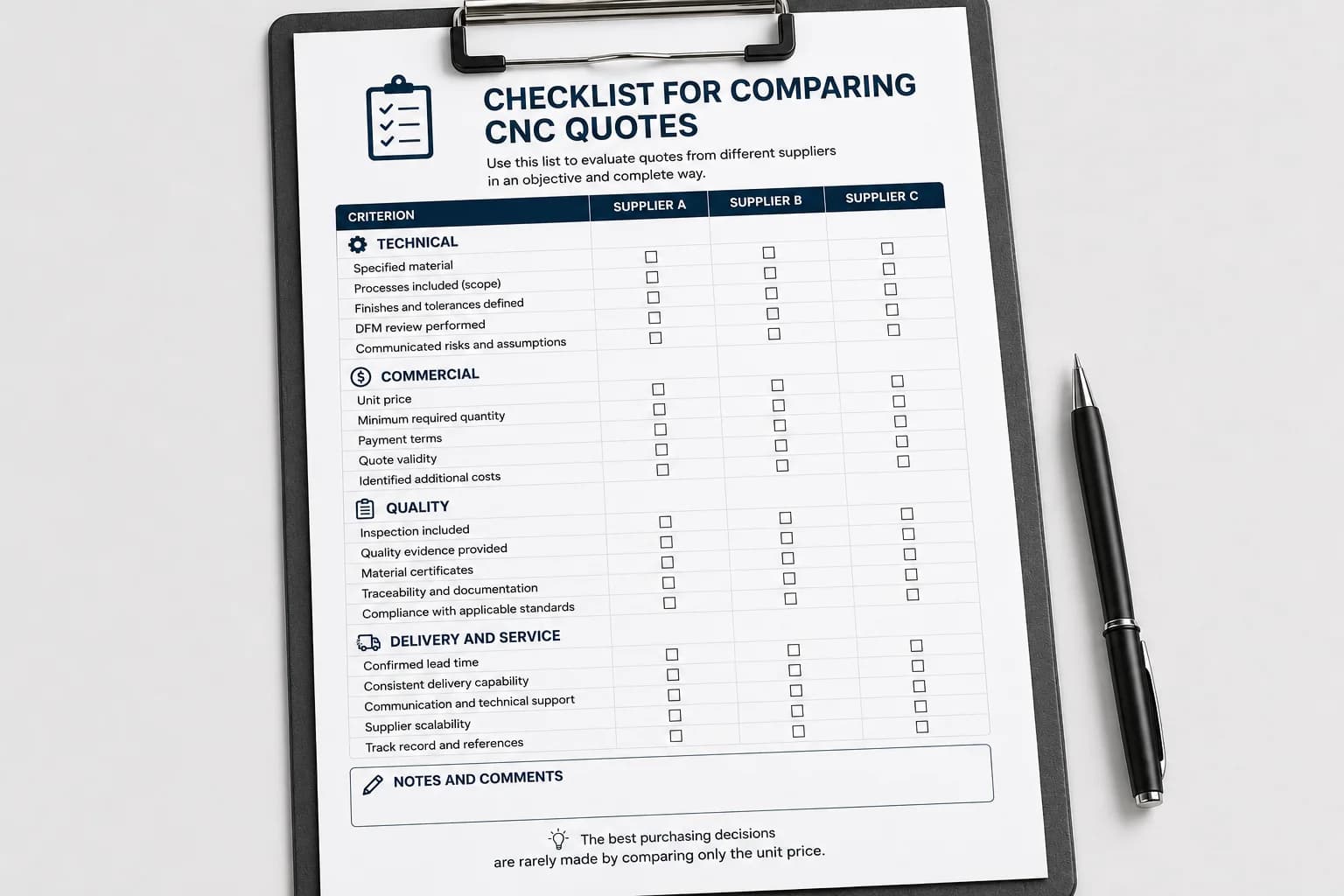
Checklist for comparing CNC quotes
One of the best practices in industrial procurement is to evaluate all quotes using exactly the same criteria. This prevents price from becoming the only decision factor and helps visualize which supplier truly offers the best total value.
Use the following matrix as a starting point to compare options objectively and consistently.
| Criterion | Supplier A | Supplier B | Supplier C |
|---|---|---|---|
| Unit price | |||
| Total price | |||
| Specified material | |||
| Tolerances considered | |||
| Finish included | |||
| Inspection included | |||
| Certificates and traceability | |||
| Clear lead time | |||
| Quote validity | |||
| DFM review | |||
| Technical communication | |||
| Growth capacity | |||
| Perceived risk | |||
| Best total value |
Common mistakes when requesting CNC quotes
Many comparison problems begin even before the first quote arrives. When the RFQ is incomplete or lacks critical information, each supplier ends up making different assumptions and the proposals stop being comparable.
- Sending incomplete files — insufficient models or drawings force the supplier to assume critical information.
- Not indicating real quantity — volume directly affects manufacturing strategy and price.
- Not specifying material — different materials generate very different costs and lead times.
- Not defining finish — surface treatments can represent a significant portion of total cost.
- Requesting tighter tolerances than necessary — increases machine time, inspection, and scrap risk.
- Omitting quality or documentation requirements — can create important differences between quotes.
- Comparing proposals with different scope — one of the most common mistakes in technical procurement.
The best way to receive comparable quotes is to send clear information from the start. If you want to optimize your RFQs, also review how to reduce CNC machining costs without sacrificing functionality and the CNC machining cost guide.
Frequently asked questions about comparing CNC quotes
Quick answers for comparing CNC part quotes.
- Why can one CNC quote be much more expensive than another?
- Because each supplier may be considering different assumptions about material, tolerances, inspection, finishes, lead time, documentation, or manufacturing risk. If the scope is not exactly the same, the price should not be either.
- Is the cheapest quote always a bad option?
- Not necessarily. However, when a quote is significantly below the rest, it is worth verifying what it includes and what it may be omitting. A low price can result from greater efficiency, but also from an incomplete project review.
- What should I review first when comparing CNC quotes?
- Before reviewing price, confirm that all suppliers are quoting the same material, quantity, drawing revision, tolerances, finish, inspection, and delivery date. Comparing prices without validating scope usually leads to wrong conclusions.
- What files should I send to receive a more accurate quote?
- Ideally send a STEP 3D file, 2D PDF drawing, required quantity, material, finish, critical tolerances, and target date. The more complete the technical package, the more comparable and accurate the quote will be.
- Why does lead time change between suppliers?
- Because it depends on factors such as material availability, current production load, part complexity, installed capacity, required inspection, and external processes such as anodizing, heat treatment, or coatings.
- What does it mean when a quote includes DFM review?
- It means the supplier analyzed the part from a manufacturing perspective and identified opportunities to reduce cost, improve manufacturability, or minimize risk before starting production.
- When should I request a dimensional report?
- When the part has critical tolerances, assembly requirements, dimensional validations, or quality specifications that must be formally documented.
- How do I know if a CNC supplier understood my part correctly?
- The most reliable suppliers usually ask technical questions, confirm materials and finishes, discuss critical tolerances, and point out possible manufacturing risks before issuing a final quote.
- Can I quote a part if I only have a STEP file?
- Yes. Many parts can be quoted using only the 3D model. However, if there are critical tolerances, special finishes, threads, or inspection requirements, it is recommended to supplement the information with a 2D drawing.
- What is the difference between commercial and certified material?
- Certified material includes documentation demonstrating composition, mechanical properties, and traceability. Depending on the industry or application, these certificates may be mandatory and affect both cost and lead time.
- Is it normal for suppliers to ask questions before quoting?
- Yes. In fact, it is usually a good sign. Technical questions help remove assumptions, clarify requirements, and generate more accurate and comparable quotes.
- How can I reduce cost before approving a CNC quote?
- The most effective strategies usually include simplifying geometries, relaxing unnecessary tolerances, using commercial materials, consolidating quantities, reducing setups, and applying DFM principles before manufacturing.
Because each supplier may be considering different assumptions about material, tolerances, inspection, finishes, lead time, documentation, or manufacturing risk. If the scope is not exactly the same, the price should not be either.
Not necessarily. However, when a quote is significantly below the rest, it is worth verifying what it includes and what it may be omitting. A low price can result from greater efficiency, but also from an incomplete project review.
Before reviewing price, confirm that all suppliers are quoting the same material, quantity, drawing revision, tolerances, finish, inspection, and delivery date. Comparing prices without validating scope usually leads to wrong conclusions.
Ideally send a STEP 3D file, 2D PDF drawing, required quantity, material, finish, critical tolerances, and target date. The more complete the technical package, the more comparable and accurate the quote will be.
Because it depends on factors such as material availability, current production load, part complexity, installed capacity, required inspection, and external processes such as anodizing, heat treatment, or coatings.
It means the supplier analyzed the part from a manufacturing perspective and identified opportunities to reduce cost, improve manufacturability, or minimize risk before starting production.
When the part has critical tolerances, assembly requirements, dimensional validations, or quality specifications that must be formally documented.
The most reliable suppliers usually ask technical questions, confirm materials and finishes, discuss critical tolerances, and point out possible manufacturing risks before issuing a final quote.
Yes. Many parts can be quoted using only the 3D model. However, if there are critical tolerances, special finishes, threads, or inspection requirements, it is recommended to supplement the information with a 2D drawing.
Certified material includes documentation demonstrating composition, mechanical properties, and traceability. Depending on the industry or application, these certificates may be mandatory and affect both cost and lead time.
Yes. In fact, it is usually a good sign. Technical questions help remove assumptions, clarify requirements, and generate more accurate and comparable quotes.
The most effective strategies usually include simplifying geometries, relaxing unnecessary tolerances, using commercial materials, consolidating quantities, reducing setups, and applying DFM principles before manufacturing.
Conclusion
Comparing CNC machining quotes should not come down to choosing the lowest price. A solid decision considers material, tolerances, finishes, inspection, lead time, documentation, technical capability, and total project risk.
The reality is that two quotes can look similar on paper and yet represent completely different levels of quality, support, and reliability. That is why more experienced buyers evaluate scope first and price second.
The best quote is not necessarily the most economical. It is the one that offers the best balance of cost, quality, technical compliance, and probability of success. When a part matters to your operation, reducing risk usually creates more value than saving a few percentage points on the initial price.
The best CNC quote is not the one that costs less upfront. It is the one that costs less in the end, considering quality, time, compliance, and risk.
If you want to go deeper on costs, design for manufacturability, and RFQ preparation, these resources complement this guide and help you make more informed purchasing decisions:
- CNC machining cost guide — how CNC part pricing is built.
- What affects CNC machined part cost the most — technical factors that drive price differences.
- How to reduce CNC machining costs — optimization before issuing an RFQ.
- CNC machining design guide — DFM principles to reduce cost and risk.
- How to get CNC parts made — recommended information for requesting quotes.
- CNC machining tolerances — when and how to specify them.
- CNC milling — capabilities for prismatic components.
- CNC turning — capabilities for rotational components.

Written by
Adrian Cavazos and the PREMSA Engineering Team
Adrian Cavazos, founder of PREMSA Industries, leads a manufacturing engineering team specialized in CNC turning and milling, 3D printing, and production-ready solutions. The team works closely with each customer to deliver clear quotes, DFM review, and reliable manufacturing from prototypes to volume production.