Home/Materials/3003 H14 Aluminum
General Purpose

3003 H14 Aluminum forHigh-Formability Components

3003-H14 aluminum is the most widely used general-purpose alloy, offering excellent workability, high corrosion resistance, and a cost-effective solution for diverse industrial needs.

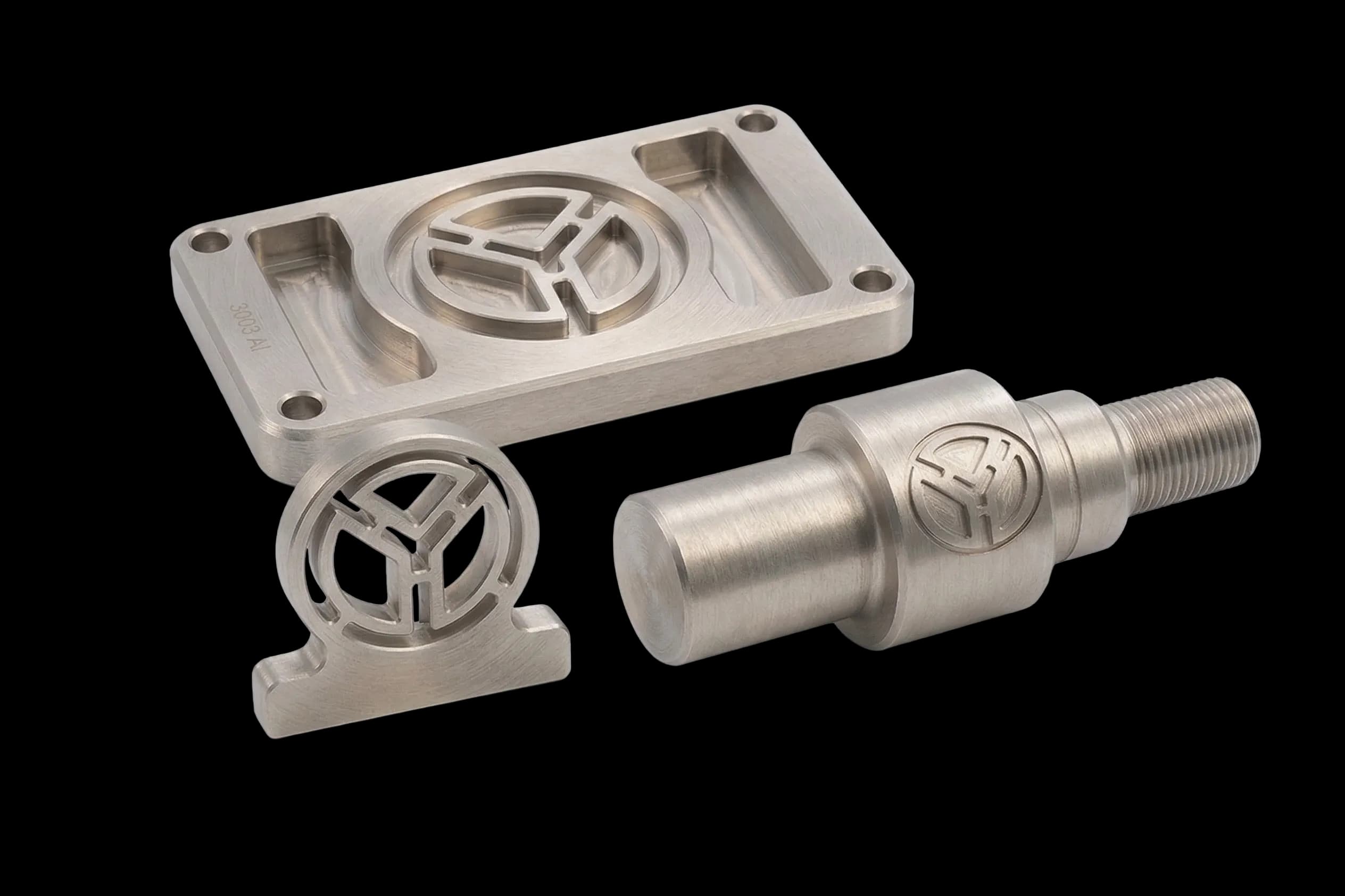
3003 H14 Aluminum sheets and formed industrial components
Material Overview

What is 3003-H14 Aluminum?

3003-H14 aluminum is an alloy of aluminum and manganese, providing about 20% more strength than pure aluminum while maintaining excellent workability. The H14 temper indicates the material is strain-hardened to a 1/2 hard state. It is highly regarded for its superior resistance to atmospheric corrosion and chemical attack. While it is less commonly chosen for complex CNC machining compared to 6061, it is the industry standard for chemical equipment, pressure vessels, and any application requiring excellent welding and brazing capabilities.

Industrial 3003 H14 aluminum parts with clean surface finish
Specifications

3003 H14 Aluminum Specifications

Key technical data for 3003-H14 aluminum. This alloy excels in applications where ductility and chemical stability are more critical than high structural strength.

3003-H14 Engineering Properties

Alloy Series

3000 series (Al-Mn alloy)

Temper

H14 (strain-hardened, 1/2 hard)

Primary Characteristics

Excellent corrosion resistance, superior workability, excellent weldability, low cost

Tensile Strength (Ultimate)

22 ksi (152 MPa)

Tensile Strength (Yield)

21 ksi (145 MPa)

Shear Strength

14 ksi (97 MPa)

Fatigue Strength

9 ksi (62 MPa)

Elongation at Break

8–20%

Brinell Hardness

40 HB

Density

2.73 g/cm³ (0.0986 lb/in³)

Elastic Modulus

10,000 ksi (68.9 GPa)

Poisson’s Ratio

0.33

Thermal Conductivity

193 W/m·K

Coefficient of Thermal Expansion

23.2 µm/m·°C

Melting Range

643–654 °C (1190–1210 °F)

Electrical Conductivity

40% IACS

Machinability

Fair (Best with high speeds and light cuts; can be gummy)

Weldability

Excellent (Highly compatible with all standard welding methods)

Corrosion Resistance

Excellent (Very high resistance to atmospheric and chemical corrosion)

Anodizing Response

Good (Primarily used for protection; decorative results are modest)

Common Forms

Sheet, plate, tube, foil

Typical Applications

Chemical equipment, heat exchangers, fuel tanks, kitchenware, decorative trim, pressure vessels

Material Composition

Aluminum (Al): 96.8–99%, Manganese (Mn): 1.0–1.5%, Copper (Cu): 0.05–0.20%, Iron (Fe): ≤0.7%

ASTM Standard

ASTM B209

Performance

3003-H14 Performance Overview

Comparative assessment for general manufacturing and fabrication.

Strength

Weight

Machinability

Weldability

Formability

Corrosion Resistance

Thermal Resistance

Cost Efficiency

Ready to fabricate 3003 H14 Aluminum parts?

Cost-effective 3003 aluminum manufacturing. Submit your CAD designs for an engineering review and a fast quote today.

Where 3003 H14 Aluminum is Commonly Used

The go-to alloy for everyday industrial products where cost and corrosion resistance outweigh the need for extreme strength.

Chemical processing and storage equipment

HVAC components and heat exchangers

Fuel tanks and oil lines

Pressure vessels and piping

Residential siding and roofing

Cooking utensils and food prep equipment

Decorative architectural panels

Truck and trailer components

General sheet metal fabrication

Material FAQs

3003-H14 Aluminum FAQs for General Fabrication and Stamping

Technical insights for engineers utilizing 3003-H14 aluminum for high-formability sheet metal parts, industrial hardware, and high-volume production.

Ready for your Project

Material Guide

3003 H14 Aluminum: The Versatile Standard for Forming and Stamping

3003 H14 aluminum is the most widely used general-purpose aluminum alloy, prized for its excellent workability and moderate strength. Alloyed with manganese, it offers approximately 20% more strength than pure aluminum while maintaining exceptional ductility. This makes it the primary choice for Metal Stamping and high-volume fabrication of everyday consumer and industrial goods.

For engineering teams, 3003-H14 provides a highly reliable, cost-effective material that bridges the gap between decorative use and structural performance, especially in HVAC and chemical equipment components.

Key manufacturing characteristics of 3003 H14 aluminum

  • Superior Formability: Excellent for deep drawing, spinning, and intricate Sheet Bending without the risk of material fracture.
  • High Corrosion Resistance: Like the 5000 series, it performs exceptionally well in atmospheric conditions and chemical environments.
  • The H14 Temper: Strain-hardened and stabilized to a half-hard state, providing the perfect balance of stiffness and bendability.
  • Excellent Weldability: Highly compatible with TIG, MIG, and resistance welding, ensuring strong and clean joints for tanks and housings.
  • Uniform Surface Quality: Offers a consistently smooth finish that is ideal for high-visibility decorative panels and kitchenware.
  • Non-Heat Treatable: Gains its mechanical properties through cold-working, ensuring stable performance that won't change during secondary heating processes.

Mechanical and physical properties of 3003-H14 aluminum

3003-H14 is a manganese-alloyed aluminum that excels in applications where extreme strength is less important than ease of fabrication. It is significantly more formable than 6061 aluminum, making it the preferred alloy for complex geometries produced via Sheet Metal Fabrication.

Typical performance profile

  • Moderate mechanical strength with very high ductility
  • Outstanding resistance to pitting and chemical degradation
  • Highly predictable behavior during high-speed production runs
  • Excellent thermal and electrical conductivity

Why engineers choose it

  • Ideal for large-scale production of complex stamped parts
  • Provides long-lasting durability for heat exchangers and cooling fins
  • The most economical choice for general-purpose aluminum fabrication
  • Works perfectly for containers, tanks, and chemical piping systems

Strengths and advantages of 3003 H14 aluminum

  1. Deep Drawing Capability: The best alloy for creating seamless cups, cans, and deep enclosures.
  2. Process Compatibility: Seamlessly transitions between CNC Machining for hardware and stamping for main bodies.
  3. Corrosion Defense: Reliable performance in humid or mildly acidic environments.
  4. Thermal Management: Excellent for cooling applications due to its efficient heat transfer properties.
  5. Surface Finishing: Responds beautifully to painting, laminating, and light anodizing.
  6. Cost-Efficiency: One of the most competitively priced alloys for high-volume manufacturing.

Trade-offs and limitations of 3003 H14 aluminum

  1. Lower Tensile Strength: Not suitable for high-load structural frames or aerospace tension members.
  2. Softness during Machining: Can be prone to 'burring' during high-speed CNC Milling; requires sharp tools and specific speeds.
  3. Lower Hardness: More susceptible to surface denting or deformation under physical impact compared to the 5xxx or 6xxx series.
  4. Minimal Heat Response: Strength cannot be increased through heat treatment once the part is finished.
  5. Limited Wear Resistance: Not recommended for parts subject to constant friction or abrasive contact.

Fabrication and manufacturing considerations for 3003

Metal Stamping & Forming

This is where 3003 H14 truly shines. Its manganese content allows for aggressive deformation without cracking, making it the standard for Metal Stamping.

  • Excellent for high-volume progressive die operations
  • Supports very tight radius bends and complex architectural shapes
  • Ideal for stamped lids, covers, and decorative trims

Welding and Assembly

  • Consistent results in automated welding cells for tanks and pressure vessels
  • High joint efficiency when paired with compatible 1xxx or 4xxx filler metals
  • Easily integrated with standard Drilling & Threading for assembly

Prototyping & Hybrid Approaches

Before moving to mass production stamping, clients often use Prototype 3D Printing to test assembly fit. For low-volume metal prototypes, SLS can simulate complex metal geometries.

  • Fast iteration for HVAC and appliance components
  • Scalable from small-batch prototypes to millions of units

Finishing and Aesthetics

  • Standard for high-end powder-coated appliances and enclosures
  • Can be embossed or textured for architectural panels
  • Maintains a bright, uniform appearance for food-grade applications

Common applications for 3003 H14 aluminum

From the kitchen to the industrial plant, 3003 H14 aluminum is foundational for high-performance CNC machined components and stamped products.

  • HVAC components, evaporators, and condenser fins
  • Chemical handling equipment and storage tanks
  • Kitchenware, cooking utensils, and food containers
  • Architectural siding, roofing, and decorative trim
  • Pressure vessels and piping for fluid transport
  • Automotive heat shields and fuel lines
  • Electronic shielding and small stamped enclosures
  • Signage and commercial display hardware

When 3003 H14 aluminum is a strong material choice

3003 is the right choice when your project requires maximum formability, high-volume production, and reliable corrosion resistance without the need for extreme structural strength.

  • When parts require deep drawing or complex Metal Stamping
  • When manufacturing heat exchangers or thermal management components
  • When the application involves food contact or chemical exposure
  • When seeking the most cost-effective aluminum for high-volume runs
  • When a balance of moderate strength and extreme ductility is required