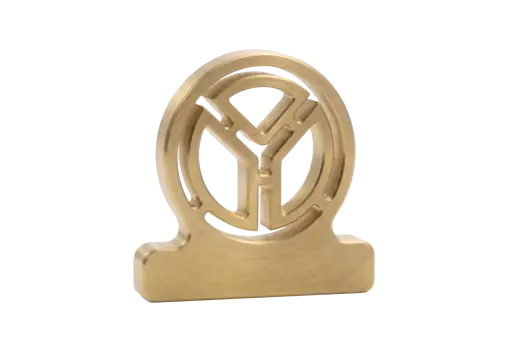
High Ductility & Corrosion ResistanceBrass C260: The Gold Standard for Precision Forming and Deep Drawing
Brass C260, universally known as Cartridge Brass, is defined by its exceptional ductility and superior cold-working properties. With a 70% copper and 30% zinc composition, it offers the best combination of strength and plasticity in the yellow brass family.
At PREMSA Industries, we utilize C260 for components that require high-integrity seals, complex forming, or high-end aesthetic finishes. It is the premier choice for CNC machining when the final part must undergo secondary bending, flaring, or high-pressure fluid service.
Key manufacturing characteristics of C260 Brass
- Extreme Formability: Capable of severe deep drawing and cold-heading without fracturing, unlike more brittle free-machining alloys.
- Superior Corrosion Resistance: Excellent resilience in fresh water and many industrial chemicals; generally more resistant to dezincification than C360.
- Lead-Free Profile: Contains virtually no lead, making it highly compatible with modern environmental regulations and health-sensitive applications.
- High Surface Quality: Achieves a mirror-like luster when polished, making it a favorite for architectural and decorative hardware.
- Excellent Cold-Workability: Ideally suited for secondary operations such as crimping, riveting, or thread rolling after primary machining.
- Non-Magnetic & Non-Sparking: A critical safety feature for electronic housings and aerospace components used in volatile environments.
Mechanical and physical properties of C260 Brass
C260 is selected when a part requires structural toughness and the ability to be deformed without failure. While its machinability is lower than the benchmark Brass C360, its superior tensile strength and elongation make it the industrial standard for 'heavy-use' brass components.
Typical performance profile
- Highest tensile strength and elongation in the common yellow brass category
- Excellent thermal conductivity for heat management components
- Maintainable mechanical properties across a wide temperature range
- High impact strength compared to leaded brasses
- Exceptional plating adhesion for nickel, chrome, and gold finishes
Why engineers choose it
- Required for parts that will be 'flared' or 'swaged' during final assembly
- Better suited for TIG and MIG welding compared to leaded copper alloys
- Ideal for high-pressure fluid connectors and plumbing manifolds
- Commonly specified for high-reliability electrical sockets and springs
Strengths and advantages of C260 Cartridge Brass
- Superior Ductility: Can be processed into intricate shapes that would snap other brass grades.
- Atmospheric Resilience: Naturally resists 'season cracking' and tarnishing in industrial environments.
- Reliable Electrical Performance: Provides low contact resistance for power transmission components.
- Robust Joining Potential: Responds exceptionally well to silver brazing and soft soldering.
- Versatility: A 'workhorse' alloy used in everything from ammunition cases to musical instruments.
- Clean Material Chemistry: Easier to document for REACH and RoHS compliance due to lack of lead.
Trade-offs and limitations of C260 Brass
- Lower Machinability: Rated at 30% compared to C360; requires slower feeds and more robust chip management during CNC milling.
- Stringy Chip Formation: Does not break chips naturally; requires skilled programming and high-pressure coolant to prevent 'bird-nesting'.
- Work Hardening: Increases in hardness rapidly during forming, which may require intermediate annealing for extreme shapes.
- Cost Stability: Higher copper content can make it more susceptible to market commodity price fluctuations.
- Tool Sensitivity: Requires specific rake angles and sharp carbide tools to prevent material 'smearing' on the cutting edge.
Fabrication and machining considerations for C260
Machining behavior
C260 is a 'tougher' cut than free-machining grades. Our CNC turning experts use high-lubricity fluids and specialized chip-breakers to maintain production speed.
- Excellent for high-precision components where forming is the primary design driver
- Achieves exceptional surface finishes (sub 32 Ra) with the right tooling
- Stable dimensional repeatability after initial process dial-in
Joining and Finishing
Unlike leaded brasses, C260 is the preferred choice for welded or brazed assemblies.
- High compatibility with resistance welding and brazing
- Supports durable powder coating and epoxy paint systems
- Responds well to chemical patinas for architectural color matching
Advanced Prototyping
For complex C260 designs, we often use Prototype 3D Printing to verify assembly fitment before starting the brass machining process.
- Fitment testing with SLS models
- Functional clearance verification for moving brass assemblies
Common applications for Cartridge Brass C260
C260 is the backbone of high-ductility, corrosion-resistant hardware in CNC machined components.
- High-pressure radiator cores and heat exchanger tubes
- Electrical socket connectors and spring terminals
- Ammunition components and shell casings
- Marine hinges, fasteners, and underwater hardware
- Automotive thermostat housings and fluid connectors
- Musical instrument valves and brass-wind components
- Architectural trim, luxury plumbing fixtures, and locks
- Precision rivets, eyelets, and fasteners
When C260 Brass is the right material choice
Select C260 when your design requires a metal that can flex, form, and survive in environments where standard brass might fail.
- When the part requires deep drawing, flaring, or heavy cold-forming
- When parts must be lead-free to comply with industry or safety standards
- When superior brazing or welding performance is a technical requirement
- When a premium aesthetic finish is required for high-visibility hardware
- When structural reliability in fresh-water environments is a priority