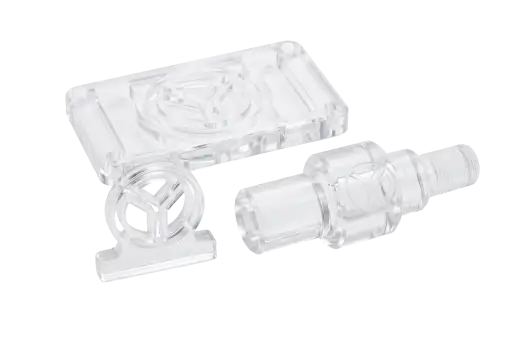
Acrylic (PMMA) is a transparent thermoplastic widely used for panels, covers, and visual components, offering excellent optical clarity, surface quality, and dimensional stability.
Material Overview
What is Acrylic (PMMA)?
Acrylic (PMMA, Polymethyl Methacrylate) is a transparent engineering thermoplastic known for its excellent optical clarity, UV resistance, and high-quality surface finish. It is widely used for panels, covers, lenses, and visual components produced through sheet cutting and sheet metal fabrication workflows adapted for plastics. For more complex geometries or tight tolerances, acrylic can also be processed through CNC machining, while high-detail visual prototypes and presentation models are often produced using SLA / DLP to achieve smooth surfaces and fine feature resolution.

Specifications
Acrylic (PMMA) Specifications
Engineering-grade properties of acrylic (PMMA), including optical, mechanical, and thermal characteristics relevant to transparent components, fabricated panels, and precision parts. This data supports material selection for applications where clarity, surface quality, and dimensional stability are critical.
Acrylic (PMMA) Engineering Properties
Material Type
Amorphous thermoplastic (PMMA)
Primary Characteristics
High optical clarity, rigid, smooth surface finish, brittle compared to engineering plastics
Tensile Strength (Ultimate)
8,000–10,000 psi (55–70 MPa)
Flexural Strength
11,000–17,000 psi (75–117 MPa)
Elongation at Break
3–6%
Impact Resistance
Low to moderate (lower than polycarbonate)
Hardness
Rockwell M90–M105
Density
1.18 g/cm³ (0.043 lb/in³)
Elastic Modulus
400,000 psi (2.7 GPa)
Light Transmission
≈92% (higher than most plastics)
Refractive Index
1.49
Heat Deflection Temperature
90–105 °C (194–221 °F)
Glass Transition Temperature
~105 °C (221 °F)
Thermal Conductivity
0.19 W/m·K
Machinability
Good (requires proper feeds, speeds, and tooling to avoid melting or chipping)
Formability
Good (thermoforming compatible)
Chemical Resistance
Moderate (sensitive to alcohols, solvents, and stress cracking agents)
Standardized comparison across key engineering and manufacturing criteria.
Strength
Weight
Machinability
Optical Clarity
Impact Resistance
Formability
UV Resistance
Cost Efficiency
Ready to produce acrylic components?
Upload your CAD files and get a fast, engineering-reviewed quote. From prototypes to production, we help you move faster.
Where Acrylic (PMMA) is Commonly Used
Acrylic is widely used in applications where transparency, appearance, and surface quality are critical. It is especially common in fabricated panels, display systems, and visual components rather than high-load structural parts.
Transparent panels and machine covers
Display cases and retail fixtures
Signage and illuminated components
Protective barriers and shields
Lighting lenses and diffusers
Consumer product housings
Architectural glazing and features
Automotive interior trim components
Custom visual prototypes and presentation models
Material FAQs
Acrylic (PMMA) FAQs for Manufacturing and Production
Common questions from engineering, sourcing, and product development teams working with acrylic (PMMA) across machining, forming, and production applications.
Ready for your Project
Material Guide
Acrylic (PMMA): Properties, Processing, and Applications
Acrylic (PMMA) is a transparent thermoplastic widely used in manufacturing for applications requiring optical clarity, weather resistance, and visual performance. It is commonly processed through sheet cutting, CNC machining services, and SLA / DLP rather than high-volume molding.
For engineering and sourcing teams, acrylic is often selected when glass-like transparency is required without the weight and fragility of glass, especially in applications where machining, cutting, or custom fabrication is needed.
Key manufacturing characteristics of acrylic
Excellent optical clarity: Offers high light transmission, making it suitable for transparent and light-guiding components.
Good weather resistance: Performs well in outdoor environments without yellowing as quickly as many plastics.
Brittle compared to other plastics: More prone to cracking under impact than materials like polycarbonate.
Strong aesthetic properties: Supports polished, frosted, or textured finishes for visual applications.
Thermoformable: Can be heated and formed into curved shapes with proper process control.
Mechanical and physical properties of acrylic
Acrylic is typically selected for its optical and environmental performance rather than mechanical strength. Compared to impact-resistant plastics like polycarbonate or ABS, acrylic offers superior clarity but lower toughness.
Typical performance profile
High optical transparency with excellent light transmission
Good UV and weather resistance
Moderate stiffness with low impact resistance
Lower toughness compared to engineering thermoplastics
Stable performance in indoor and outdoor environments
Why engineers choose it
Glass-like appearance with lower weight
Suitable for visual and display-driven applications
Easy to machine, cut, and polish
Available in sheets, rods, and custom forms
Strengths and advantages of acrylic
High transparency: One of the clearest thermoplastics available for optical applications.
Excellent UV stability: Maintains clarity and color over time in outdoor use.
Good surface finish potential: Can be polished to near-glass quality.
Lightweight alternative to glass: Reduces weight in assemblies while maintaining visibility.
Versatile fabrication options: Compatible with cutting, routing, laser processing, and forming.
Trade-offs and limitations of acrylic
Low impact resistance: Can crack or shatter under sudden loads compared to polycarbonate.
Scratch sensitivity: Surface can scratch more easily without coatings.
Limited structural strength: Not ideal for load-bearing applications.
Thermal sensitivity: Can deform under elevated temperatures.
Crack propagation risk: Stress concentrations can lead to fracture if not properly designed.
Fabrication and processing considerations for acrylic
Cutting and sheet processing
Acrylic is widely used in sheet form and is commonly processed through sheet cutting and routing operations for panels, covers, and display components.
Clean cuts achievable with proper tooling
Laser cutting enables high precision and polished edges
Heat buildup must be controlled to avoid melting or edge defects
Machining behavior
Acrylic can be machined using CNC milling and drilling operations, but requires careful parameter control to prevent cracking or melting.
Sharp tooling and proper feeds are critical
Coolant or air blast helps manage heat
Avoid aggressive cuts that induce stress fractures
Additive manufacturing
Acrylic-like resins are commonly used in SLA / DLP processes for high-detail prototypes and visual models.
Excellent for visual prototypes and concept validation
High surface detail and smooth finishes
Mechanical properties differ from bulk PMMA
Finishing
Can be flame polished for optical clarity
Can be bonded using solvent or adhesive methods
Surface coatings can improve scratch resistance
Edges can be machined or polished for improved aesthetics
Common applications for acrylic
Acrylic is widely used in applications where clarity, aesthetics, and environmental resistance are key requirements.
Transparent covers and protective panels
Lighting components and diffusers
Display cases and signage
Medical and laboratory enclosures
Consumer product housings
Optical and visual components
Architectural panels and features
When acrylic is a strong material choice
Acrylic is often the right choice when visual performance, clarity, and environmental resistance are more important than impact strength or structural load capacity.
When optical clarity is a primary requirement
When a lightweight alternative to glass is needed
When parts are primarily visual or protective rather than structural
When outdoor durability and UV resistance are important
When polished or high-quality surface finish is required