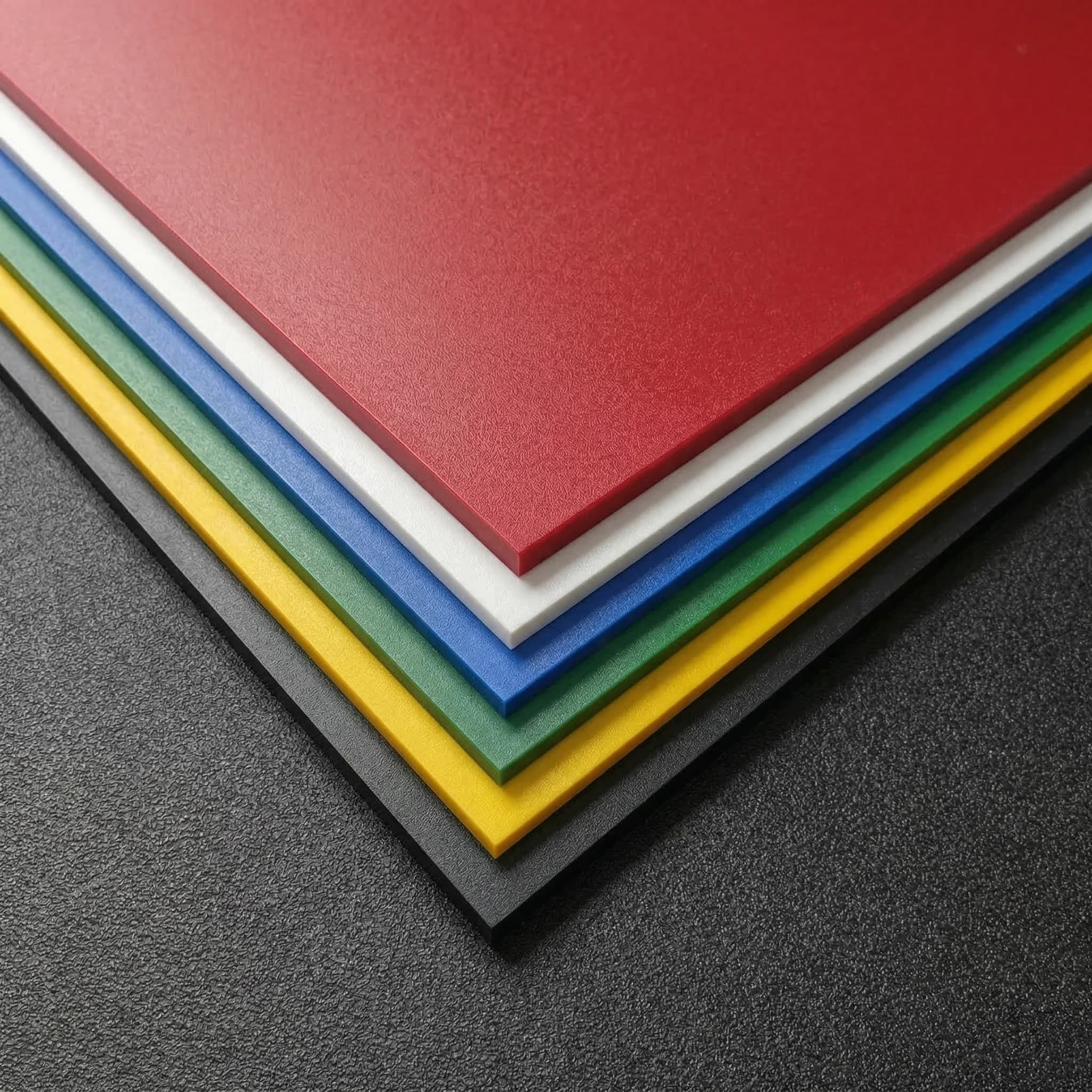
ABS (Acrylonitrile Butadiene Styrene) is a widely used thermoplastic for CNC machined components, offering excellent machinability, impact resistance, and cost-effective performance across industrial applications.
Material Overview
What is ABS Plastic?
ABS (Acrylonitrile Butadiene Styrene) is a widely used engineering thermoplastic known for its strong balance of impact resistance, toughness, machinability, and cost efficiency. It is commonly used in CNC machining, CNC milling, and CNC turning for functional prototypes and low-to-medium volume production parts. In addition to machining, ABS is also widely used in injection molding and FDM for scalable production and rapid prototyping workflows across industrial and commercial environments.
Specifications
ABS Plastic Specifications
Engineering-grade properties of ABS plastic, including mechanical, thermal, and processing characteristics relevant to design, CNC machining, molding, and additive manufacturing. This data supports material selection, performance evaluation, and manufacturability decisions across plastic component production.
ABS Engineering Properties
Material Type
Amorphous thermoplastic polymer
Primary Characteristics
Good impact resistance, tough, easy to machine, cost-effective, moderate strength
Tensile Strength (Ultimate)
5,000–6,500 psi (34–45 MPa)
Tensile Strength (Yield)
4,000–6,000 psi (28–41 MPa)
Flexural Strength
6,000–9,000 psi (41–62 MPa)
Elongation at Break
10–50%
Izod Impact Strength
High (notched: ~2–7 ft-lb/in)
Hardness
Rockwell R90–R110
Density
1.04 g/cm³ (0.0376 lb/in³)
Elastic Modulus
300,000 psi (2.1 GPa)
Heat Deflection Temperature
85–105 °C (185–221 °F)
Glass Transition Temperature
~105 °C (221 °F)
Thermal Conductivity
0.17–0.20 W/m·K
Machinability
Excellent (stable cutting, low tool wear, good surface finish)
Formability
Good (thermoforming and molding compatible)
Chemical Resistance
Moderate (resistant to many acids and alkalis, not suitable for strong solvents)
Moisture Absorption
Low
Common Forms
Sheet, rod, plate, pellets (for molding), filament (for 3D printing)
Standardized comparison across key engineering and manufacturing criteria.
Strength
Weight
Machinability
Impact Resistance
Formability
Chemical Resistance
Thermal Resistance
Cost Efficiency
Ready to machine ABS plastic parts?
Upload your CAD files and get a fast, engineering-reviewed quote. From prototypes to production, we help you move faster.
Where ABS Plastic is Commonly Used
ABS is widely used across industries that require durable, impact-resistant, and cost-effective plastic components. It is especially common in machined parts, molded products, and rapid prototyping applications.
CNC machined housings and enclosures
Consumer product components
Automotive interior parts and trims
Industrial fixtures and jigs
Electronic device casings
Prototypes and functional test parts
Protective covers and guards
Assembly components and brackets
Custom plastic parts for production and development
Material FAQs
ABS FAQs for Manufacturing and Production
Common questions from engineering, sourcing, and product development teams working with ABS plastic across injection molding, machining, and multi-process manufacturing environments.
Ready for your Project
Material Guide
ABS: Properties, Processing, and Applications
ABS (acrylonitrile butadiene styrene) is one of the most widely used thermoplastics in modern manufacturing. It is valued for its impact resistance, processability, and cost efficiency, making it a core material across plastic part production, injection molding, and 3D printing services.
For engineering and sourcing teams, ABS offers a practical balance between performance and manufacturability, especially in programs that move from prototyping into scaled production while maintaining cost control and design flexibility.
Key manufacturing characteristics of ABS
High impact resistance: ABS maintains toughness under shock and repeated use, making it suitable for enclosures, housings, and consumer-facing components.
Excellent moldability: It flows well in injection molding, allowing for complex geometries, thin walls, and integrated features.
Good dimensional stability: ABS holds tolerances well in molded parts when process conditions are controlled.
Surface finish flexibility: It supports textured, glossy, or painted finishes depending on tooling and post-processing.
Cost-effective material: Lower cost compared to many engineering thermoplastics while still delivering reliable mechanical performance.
Mechanical and physical properties of ABS
ABS is typically selected when impact resistance, ease of processing, and cost efficiency are more important than high temperature performance or chemical resistance. Compared to higher-performance plastics like polycarbonate or nylon, ABS offers a more balanced and economical solution for general-purpose applications.
Typical performance profile
High impact strength compared to many commodity plastics
Moderate stiffness with good toughness
Lower heat resistance than engineering-grade thermoplastics
Stable performance in indoor and controlled environments
Good balance between rigidity and ductility
Why engineers choose it
Supports complex molded geometries with consistent results
Works well for cosmetic and functional parts
Widely available across global supply chains
Compatible with both prototyping and production workflows
Strengths and advantages of ABS
Impact durability: Performs well in applications exposed to drops, handling, or mechanical stress.
Cost efficiency: Offers a strong balance between performance and material cost.
Good cosmetic properties: Accepts paint, texture, and secondary finishing processes.
Prototyping flexibility: Frequently used in 3D printing services for early-stage validation.
Reliable production scaling: Transitions well from prototype to full production programs.
Trade-offs and limitations of ABS
Limited heat resistance: Not suitable for high-temperature environments compared to materials like ULTEM (PEI).
Moderate chemical resistance: Can degrade when exposed to certain solvents and aggressive chemicals.
UV sensitivity: May require stabilization or coating for outdoor use.
Lower strength than reinforced polymers: Not ideal for high-load structural applications.
Creep under load: Can deform over time under continuous stress conditions.
Fabrication and processing considerations for ABS
Injection molding behavior
ABS is one of the most commonly molded plastics due to its predictable flow characteristics and ability to replicate detailed features. It performs well in both prototype molding and production molding.
Supports thin-wall designs with proper mold design
Good surface replication for cosmetic parts
Stable shrink behavior when tooling and process are controlled
Additive manufacturing
ABS is widely used in FDM and other additive processes for functional prototyping and low-volume production.
Good for early-stage design validation
Allows quick iteration before tooling investment
Lower strength than molded ABS but useful for functional testing
Machining considerations
While ABS can be processed through CNC machining services, it is typically not the primary method for production parts. Machining is more common for prototypes, fixtures, or low-volume components.
Easy to machine with standard tooling
May require careful control to avoid melting or poor surface finish
Less efficient than molding for production volumes
Finishing
Can be painted for improved appearance or UV protection
Supports textured mold finishes for cosmetic parts
Can be bonded or assembled using adhesives or mechanical fastening
Common applications for ABS
ABS is widely used across multiple industries where impact resistance, manufacturability, and cost control are important.
Consumer product housings and enclosures
Automotive interior components
Electronic device casings
Appliance parts and covers
Industrial equipment panels
Prototyped parts for design validation
Custom molded plastic components
When ABS is a strong material choice
ABS is often the right choice when a project requires a balance of durability, manufacturability, and cost efficiency without the need for extreme temperature or chemical performance.
When impact resistance and toughness are required
When transitioning from prototyping to injection-molded production
When cosmetic finish and surface quality matter
When cost efficiency is a key constraint
When complex geometries are needed in molded parts