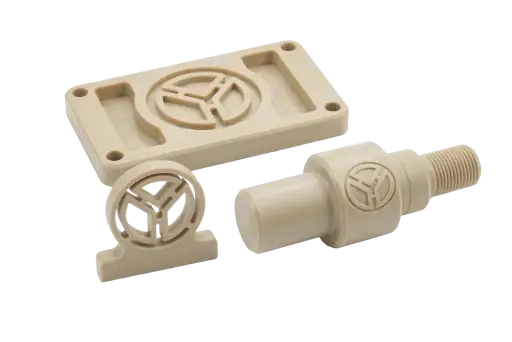
PEEK (Polyether Ether Ketone) is a high-performance thermoplastic used in demanding environments requiring heat resistance, chemical stability, and precision-machined performance.
PEEK (Polyether Ether Ketone) is a high-performance engineering thermoplastic known for its exceptional thermal stability, chemical resistance, and mechanical strength. It is widely used in CNC machining, CNC milling, and CNC turning for precision components operating in demanding environments where metals may be too heavy or susceptible to corrosion. While PEEK can also be used in injection molding for high-volume production, it is most commonly selected for machined parts that require tight tolerances, stability, and high-performance material behavior.
Specifications
PEEK Specifications
Engineering-grade properties of PEEK, including mechanical, thermal, and chemical characteristics relevant to high-performance applications. This data supports material selection for components requiring durability, stability, and reliability under extreme conditions.
PEEK Engineering Properties
Material Type
Semi-crystalline high-performance thermoplastic
Primary Characteristics
High temperature resistance, excellent chemical resistance, high strength, dimensional stability
Tensile Strength (Ultimate)
14,000–16,000 psi (96–110 MPa)
Flexural Strength
20,000–24,000 psi (138–165 MPa)
Compressive Strength
16,000–20,000 psi (110–138 MPa)
Elongation at Break
20–50%
Hardness
Rockwell M95–M105
Density
1.30 g/cm³
Elastic Modulus
500,000–600,000 psi (3.5–4.1 GPa)
Continuous Service Temperature
~250 °C (482 °F)
Melting Point
~343 °C (649 °F)
Glass Transition Temperature
~143 °C (289 °F)
Thermal Conductivity
~0.25 W/m·K
Machinability
Good (requires rigid setups and proper tooling due to material toughness)
Chemical Resistance
Excellent (resistant to most chemicals, fuels, and aggressive environments)
Wear Resistance
Excellent (especially in filled grades)
Electrical Insulation
Excellent
Moisture Absorption
Very low
Common Forms
Rod, plate, tube
Typical Applications
Aerospace components, medical parts, seals, bearings, electrical connectors, high-temperature fixtures
Performance
Material Performance Overview
Standardized comparison across key engineering and manufacturing criteria.
Strength
Weight
Machinability
Thermal Resistance
Chemical Resistance
Dimensional Stability
Wear Resistance
Cost Efficiency
Ready to machine PEEK parts?
Upload your CAD files and get a fast, engineering-reviewed quote. From prototypes to production, we help you move faster.
Where PEEK is Commonly Used
PEEK is widely used in applications where performance under extreme conditions is required. It is especially common in industries where temperature, chemical exposure, and reliability are critical.
Aerospace structural and interior components
Medical implants and surgical instruments
High-temperature seals and gaskets
Bearings and wear components
Electrical connectors and insulation parts
Oil & gas components
Semiconductor manufacturing equipment
Industrial fixtures exposed to heat
Precision machined high-performance components
Material FAQs
PEEK FAQs for High-Performance Manufacturing
Common questions about working with PEEK across precision machining, high-performance components, and demanding industrial environments.
Material Guide
PEEK: Properties, Machining, and High-Performance Applications
PEEK (polyether ether ketone) is a high-performance thermoplastic used in demanding engineering applications requiring exceptional mechanical strength, thermal stability, and chemical resistance. It is commonly processed through CNC machining services, particularly CNC milling and CNC turning, as well as high-performance plastic part production for critical components.
In practice, PEEK is often selected when standard engineering plastics such as nylon, acetal, or polycarbonate cannot meet temperature, chemical, or mechanical performance requirements.
Key manufacturing characteristics of PEEK
High-temperature performance: Maintains mechanical properties at elevated temperatures far beyond standard thermoplastics.
Exceptional chemical resistance: Withstands aggressive chemicals, fuels, and solvents.
High strength and stiffness: Suitable for load-bearing and structural applications.
Excellent wear resistance: Performs well in friction-driven and dynamic applications.
Dimensional stability: Maintains tight tolerances even in demanding environments.
Machining-focused material: Commonly used in CNC machining services for precision components.
Mechanical and physical properties of PEEK
PEEK is typically selected for extreme performance environments. Compared to acetal or nylon, it offers significantly higher temperature resistance, chemical stability, and long-term mechanical reliability. Compared to metals, it can reduce weight while maintaining strong structural performance.
Typical performance profile
High strength and stiffness across a wide temperature range
Excellent fatigue resistance under cyclic loading
Outstanding chemical and environmental resistance
Low creep under long-term load compared to most plastics
Stable performance in extreme industrial conditions
Why engineers choose it
Performs in environments where standard plastics fail
Metal replacement capability: Reduces weight and eliminates corrosion in some applications.
Trade-offs and limitations of PEEK
High material cost: Significantly more expensive than standard engineering plastics.
Machining cost: Longer cycle times and tooling considerations increase processing cost.
Limited availability compared to commodity plastics: May need to be ordered in advance.
Not always necessary: Over-specified for applications that do not require its performance level.
Thermal expansion considerations: Must be managed in precision assemblies.
Fabrication and machining considerations for PEEK
Machining behavior
PEEK is frequently processed using CNC milling and CNC turning for high-precision components. While it machines predictably, process control is important due to material cost and performance requirements.
Produces consistent chips with proper tooling
Supports tight tolerances in precision components
Tool wear is manageable compared to filled composites
Thermal and dimensional control
Thermal expansion must be considered in design
Stable performance under sustained load and temperature
Minimal moisture absorption compared to materials like nylon
Wear and motion applications
Performs well in bearings, bushings, and seals
Handles high-load and high-speed conditions
Suitable for dry-running or low-lubrication environments
Production considerations
PEEK is also used in high-performance plastic part production, particularly for critical applications where repeatability and reliability are required.
Used in aerospace, medical, and semiconductor industries
Requires controlled processing environments
Often specified in regulated or high-reliability applications
Common applications for PEEK
PEEK is widely used in industries where performance, reliability, and environmental resistance are critical.
Aerospace components and structural parts
Medical implants and surgical devices
Semiconductor equipment components
High-performance bearings and seals
Oil and gas components
Electrical insulation in extreme environments
Precision machined industrial parts
When PEEK is a strong material choice
PEEK is often the right choice when extreme performance requirements justify higher material and manufacturing cost.
When operating temperatures exceed standard plastic limits
When chemical resistance is critical
When long-term dimensional stability is required
When replacing metal to reduce weight or corrosion