Production Material

Nylon forWear-Resistant Industrial Components

Nylon is a widely used engineering thermoplastic known for its strength, wear resistance, and low friction, making it ideal for machined and functional components in industrial environments.

Nylon material stock and machined industrial plastic components
Material Overview

What is Nylon?

Nylon (polyamide) is a high-performance engineering thermoplastic known for its strong balance of mechanical strength, wear resistance, and low friction. It is widely used in CNC machining, CNC milling, and CNC turning for functional components such as bushings, gears, rollers, and wear parts. In addition to machining, nylon is also commonly used in SLS and MJF for complex geometries and production-grade additive manufacturing, especially when fast iteration and lightweight structures are required.

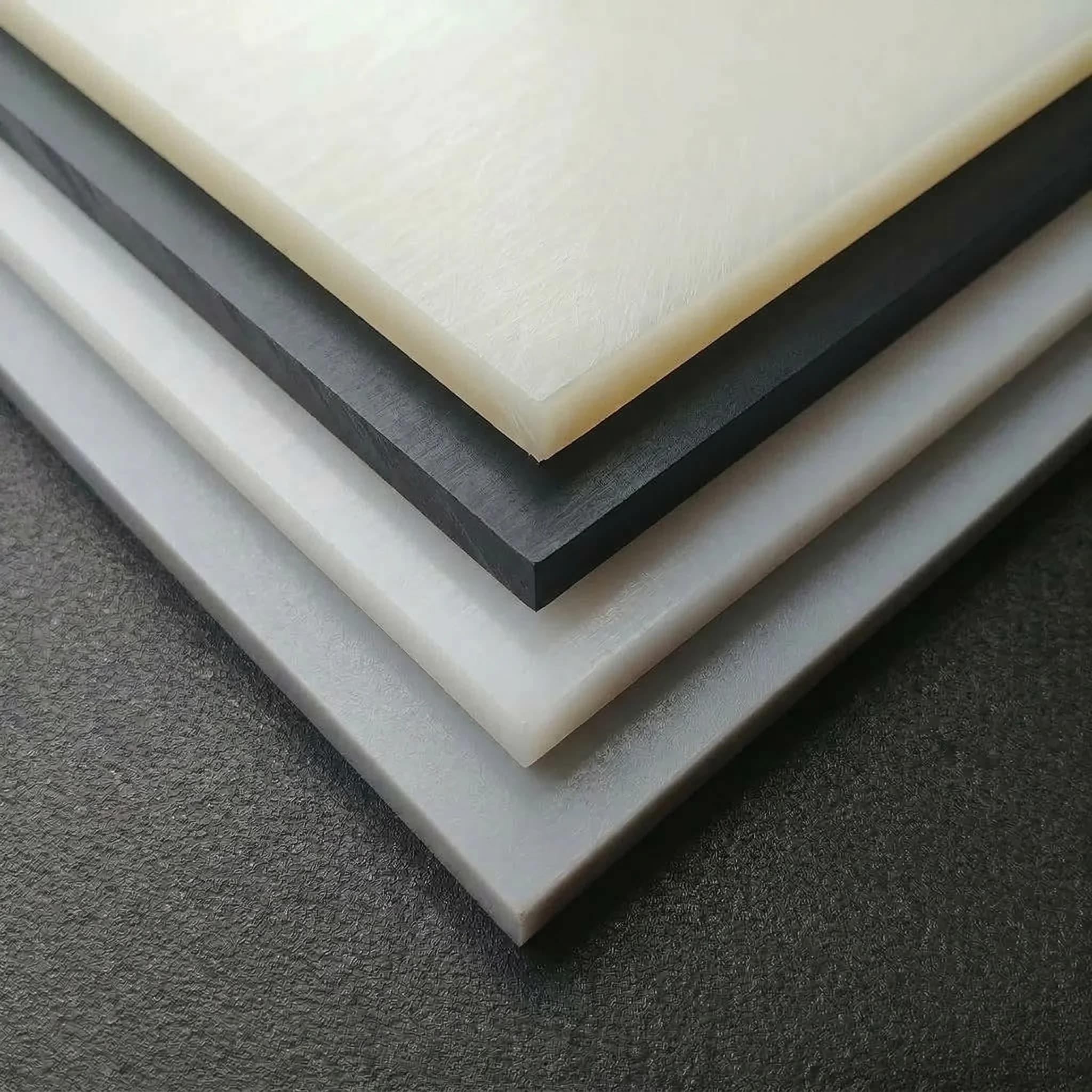
Machined nylon parts and additive manufactured components
Specifications

Nylon Specifications

Engineering-grade properties of nylon (polyamide), including mechanical, thermal, and moisture-related characteristics relevant to machining, wear applications, and production environments. This data supports material selection for parts requiring strength, durability, and friction performance.

Nylon Engineering Properties

Material Type

Semi-crystalline engineering thermoplastic (polyamide)

Common Grades

Nylon 6, Nylon 6/6, Nylon 12

Primary Characteristics

High strength, excellent wear resistance, low friction, good impact resistance

Tensile Strength (Ultimate)

8,000–12,000 psi (55–83 MPa)

Flexural Strength

12,000–18,000 psi (83–124 MPa)

Elongation at Break

50–300%

Impact Resistance

Good to excellent

Hardness

Rockwell R100–R120

Density

1.13–1.15 g/cm³

Elastic Modulus

400,000–500,000 psi (2.8–3.5 GPa)

Coefficient of Friction

Low (self-lubricating behavior)

Water Absorption

Moderate to high (can affect dimensions and properties)

Moisture Sensitivity

High (dimensional changes must be considered in design)

Continuous Service Temperature

~90–120 °C (194–248 °F)

Melting Point

~190–265 °C (depending on grade)

Thermal Conductivity

~0.25 W/m·K

Machinability

Good (requires control for heat and moisture stability)

Wear Resistance

Excellent

Chemical Resistance

Good resistance to oils, fuels, and many chemicals

Electrical Insulation

Good

Common Forms

Rod, sheet, plate, powder (for additive manufacturing)

Typical Applications

Gears, bushings, rollers, wear pads, bearings, structural plastic components

Performance

Material Performance Overview

Standardized comparison across key engineering and manufacturing criteria.

Strength

Weight

Machinability

Wear Resistance

Friction Performance

Dimensional Stability

Chemical Resistance

Cost Efficiency

Ready to produce nylon parts?

Upload your CAD files and get a fast, engineering-reviewed quote. From prototypes to production, we help you move faster.

Where Nylon is Commonly Used

Nylon is widely used in applications that require strength, wear resistance, and low friction. It is especially common in moving assemblies and components exposed to repeated mechanical contact.

Gears and sprockets

Bushings and bearings

Rollers and conveyor components

Wear pads and sliding elements

Mechanical housings and structural parts

Industrial fixtures and tooling components

Automotive functional components

Additive manufactured functional prototypes

Custom machined plastic parts for motion systems

Material FAQs

Nylon (PA6 / PA66) FAQs for Manufacturing and Production

Common questions from engineering, sourcing, and product development teams working with nylon across machining, molded components, and wear-resistant industrial applications.

Ready for your Project

Material Guide

Nylon (Polyamide): Properties, Machining, and Applications

Nylon (polyamide) is a versatile engineering thermoplastic widely used for applications requiring strength, toughness, and wear resistance. It is commonly processed through CNC machining services, as well as plastic part production for higher-volume applications.

For engineering and sourcing teams, nylon is often selected for components that must handle mechanical loads, friction, and repeated motion, but its moisture absorption and dimensional variability must be carefully considered during design and production.

Key manufacturing characteristics of nylon

  • High strength and toughness: Stronger and more impact-resistant than many commodity plastics.
  • Good wear resistance: Performs well in sliding and friction-based applications.
  • Moisture absorption: Absorbs water from the environment, affecting dimensions and mechanical properties.
  • Versatile processing: Suitable for CNC machining services and injection molding.
  • Low friction properties: Often used in moving assemblies without additional lubrication.
  • Multiple grades available: Variants such as filled or reinforced nylon provide tailored performance.

Mechanical and physical properties of nylon

Nylon is typically selected for mechanical performance and durability. Compared to acetal, nylon offers higher toughness and impact resistance but less dimensional stability due to moisture absorption. Compared to HDPE, it provides significantly higher strength and stiffness.

Typical performance profile

  • High strength and toughness for a thermoplastic
  • Good fatigue resistance under repeated loading
  • Moderate-to-high friction resistance depending on grade
  • Moisture-sensitive dimensional behavior
  • Wide operating range for mechanical applications

Why engineers choose it

  • Handles impact and dynamic loading better than many plastics
  • Performs well in gears, bushings, and moving parts
  • Available in multiple grades for specific performance needs
  • Works for both machined and molded components

Strengths and advantages of nylon

  1. High mechanical strength: Suitable for load-bearing plastic components.
  2. Excellent wear resistance: Performs well in friction-driven applications.
  3. Impact durability: More resistant to shock compared to materials like acrylic.
  4. Versatile manufacturing: Compatible with CNC machining services and molding processes.
  5. Good fatigue performance: Ideal for repetitive motion and cyclic loading.
  6. Material customization: Filled grades improve stiffness, wear, or thermal resistance.

Trade-offs and limitations of nylon

  1. Moisture absorption: Can cause dimensional changes and reduced stiffness.
  2. Lower dimensional stability than acetal: Not ideal for tight tolerance precision parts in humid environments.
  3. Creep under sustained load: Can deform over time in static load conditions.
  4. Surface variability: May not provide consistent cosmetic finish without secondary processing.
  5. Chemical sensitivity: Less resistant to certain chemicals compared to HDPE.

Fabrication and machining considerations for nylon

Machining behavior

Nylon can be machined using CNC milling and CNC turning, but its flexibility and moisture sensitivity require careful process control.

  • Material can deform under clamping pressure
  • Sharp tooling improves finish and dimensional accuracy
  • Moisture content can affect machining consistency

Moisture and dimensional control

  • Parts may absorb moisture after machining and change size
  • Critical tolerances may require conditioning or compensation
  • Design must account for environmental exposure

Wear and motion applications

  • Commonly used for gears, bushings, and sliding components
  • Performs well in dynamic loading environments
  • May require lubrication depending on load and speed

Molding considerations

Nylon is widely used in injection molding for high-volume production of mechanical components.

  • Supports complex geometries in molded parts
  • Reinforced grades improve structural performance
  • Moisture conditioning is often required after molding

Common applications for nylon

Nylon is widely used in industrial applications requiring strength, durability, and wear resistance.

  • Gears and mechanical drive components
  • Bushings and bearings
  • Structural plastic parts
  • Automotive components
  • Industrial wear parts
  • Electrical and mechanical housings
  • Custom machined and molded components

When nylon is a strong material choice

Nylon is often the right choice when mechanical strength, impact resistance, and wear performance are required, and some dimensional variation can be managed.

  • When parts experience dynamic loading or impact
  • When wear resistance is required in moving components
  • When higher strength is needed compared to commodity plastics
  • When molded or machined production is viable
  • When moisture effects can be accounted for in design