Home/Materials/Acetal (POM)
Production Material

Acetal (POM) forMachined Precision Components

Acetal (POM) is a high-performance engineering plastic widely used for CNC machined parts that require tight tolerances, low friction, dimensional stability, and reliable wear performance.

Acetal POM material stock and machined precision plastic components for industrial manufacturing
Material Overview

What is Acetal (POM)?

Acetal (POM, Polyoxymethylene) is a high-performance engineering thermoplastic known for its excellent dimensional stability, low moisture absorption, low friction, and strong machinability. It is widely used in CNC machining, CNC milling, CNC turning, and drilling & threading for precision plastic parts that require repeatable tolerances, smooth motion, and reliable wear performance. Because of these properties, acetal is a preferred material for bushings, spacers, gears, rollers, fixtures, valve components, and other functional parts used across industrial and commercial applications.

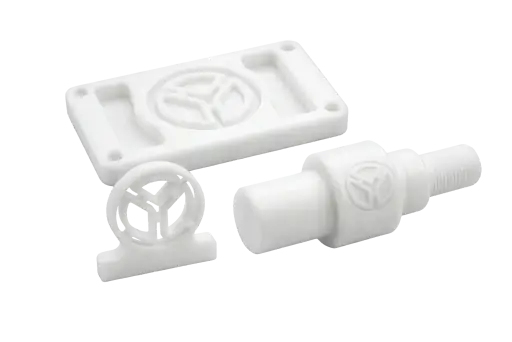
Machined acetal POM plastic parts with precision finishing
Specifications

Acetal (POM) Specifications

Engineering-grade properties of acetal (POM), including mechanical, physical, thermal, and wear-related characteristics relevant to design, CNC machining, and production applications. This data supports material selection, performance evaluation, and manufacturability decisions across precision-engineered plastic components.

Acetal (POM) Engineering Properties

Material Type

Semi-crystalline engineering thermoplastic

Primary Characteristics

Excellent machinability, high stiffness, low friction, low moisture absorption, strong dimensional stability

Common Names

Acetal, POM, Polyoxymethylene, Delrin® (acetal homopolymer)

Tensile Strength (Ultimate)

8,000–10,000 psi (55–69 MPa)

Tensile Strength (Yield)

8,000–9,500 psi (55–66 MPa)

Flexural Strength

11,000–15,000 psi (76–103 MPa)

Compressive Strength

12,000–16,000 psi (83–110 MPa)

Elongation at Break

20–40%

Hardness

Rockwell M80–M95

Density

1.41 g/cm³ (0.051 lb/in³)

Elastic Modulus

400,000–500,000 psi (2.8–3.5 GPa)

Coefficient of Friction

Low

Water Absorption

Very low

Moisture Sensitivity

Low (maintains dimensional stability better than many nylons)

Continuous Service Temperature

~85–105 °C (185–221 °F)

Melting Point

~165–175 °C (329–347 °F)

Thermal Conductivity

~0.30 W/m·K

Coefficient of Thermal Expansion

~90–120 µm/m·°C

Machinability

Excellent (one of the best engineering plastics for precision machining)

Wear Resistance

Excellent for sliding and moving components

Chemical Resistance

Good resistance to fuels, solvents, and many industrial chemicals

Electrical Insulation

Good

Common Forms

Rod, sheet, plate, tube

Typical Applications

Bushings, gears, wear pads, rollers, spacers, valve components, insulators, fixtures, conveyor parts

Performance

Material Performance Overview

Standardized comparison across key engineering and manufacturing criteria.

Strength

Weight

Machinability

Dimensional Stability

Wear Resistance

Chemical Resistance

Thermal Resistance

Cost Efficiency

Ready to machine acetal (POM) parts?

Upload your CAD files and get a fast, engineering-reviewed quote. From prototypes to production, we help you move faster.

Where Acetal (POM) is Commonly Used

Acetal is widely used across industries that require tight tolerances, smooth motion, low friction, and dependable wear performance. Its combination of machinability and dimensional stability makes it especially suitable for functional precision plastic components.

Bushings and sleeve bearings

Precision gears and sprockets

Rollers and conveyor components

Spacers and standoffs

Valve seats and valve components

Electrical insulators

Fixtures and nests for assembly operations

Pump and fluid-handling parts

Custom machined plastic components for industrial equipment

Material FAQs

Acetal (POM) FAQs for Manufacturing and Production

Common questions from engineering, sourcing, and product development teams working with acetal (POM) across machining, precision components, and production environments.

Ready for your Project

Material Guide

Acetal (POM): Properties, Machining, and Applications

Acetal (POM), commonly known as Delrin, is a high-performance engineering thermoplastic widely used in precision components requiring tight tolerances, low friction, and dimensional stability. It is commonly processed through CNC machining services, including CNC milling and CNC turning, rather than molding for low-to-mid volume production.

For engineering and sourcing teams, acetal is often selected when consistent performance, low wear, and predictable machining behavior are critical, especially in components that must maintain geometry and function under repeated mechanical use.

Key manufacturing characteristics of acetal

  • Excellent machinability: Produces clean chips and stable cutting behavior in CNC machining services.
  • Low friction and wear resistance: Ideal for sliding components, bushings, and moving assemblies.
  • High dimensional stability: Maintains tight tolerances even in precision parts.
  • Low moisture absorption: Performs more consistently than materials like nylon in humid environments.
  • Good chemical resistance: Suitable for exposure to fuels, solvents, and industrial fluids.
  • Consistent material structure: Homogeneous properties make it reliable for repeat production.

Mechanical and physical properties of acetal

Acetal is typically selected for mechanical performance and precision rather than visual or impact-driven applications. Compared to materials like ABS or polycarbonate, acetal offers superior stiffness, wear resistance, and dimensional control.

Typical performance profile

  • High stiffness and strength for a thermoplastic
  • Low coefficient of friction
  • Excellent fatigue resistance under cyclic loading
  • Minimal moisture absorption compared to many plastics
  • Stable performance across a wide range of industrial conditions

Why engineers choose it

  • Maintains tight tolerances in machined components
  • Performs well in wear and sliding applications
  • Reliable for mechanical assemblies and moving parts
  • Predictable machining and repeatable production results

Strengths and advantages of acetal

  1. Precision machining capability: Ideal for tolerance-driven parts in CNC machining workflows.
  2. Low friction behavior: Reduces wear in moving assemblies and eliminates need for lubrication in some cases.
  3. Dimensional stability: Resists warping and maintains geometry over time.
  4. Good fatigue resistance: Suitable for repetitive motion components.
  5. Chemical resistance: Performs well in industrial and fluid-exposed environments.
  6. Consistent performance: Reliable material behavior across batches and production runs.

Trade-offs and limitations of acetal

  1. Limited temperature resistance: Not suitable for high-temperature applications compared to PEEK.
  2. Moderate impact resistance: Less impact-tolerant than materials like polycarbonate.
  3. Difficult to bond: Adhesive bonding can be challenging due to low surface energy.
  4. Creep under long-term load: Can deform over time under constant stress.
  5. UV sensitivity: Not ideal for prolonged outdoor exposure without stabilization.

Fabrication and machining considerations for acetal

Machining behavior

Acetal is one of the most machinable engineering plastics and is frequently used in precision CNC milling and CNC turning operations.

  • Produces clean, continuous chips with minimal burr formation
  • Supports tight tolerances and repeatability
  • Low tool wear compared to filled or abrasive plastics

Hole features and threading

  • Threaded features perform well with proper engagement
  • Holes maintain dimensional accuracy with minimal deformation
  • Suitable for press-fit and mechanical fastening designs

Wear and motion applications

  • Performs well in sliding and rotating components
  • Often used as a replacement for metal in low-load assemblies
  • Reduces noise and friction in mechanical systems

Finishing

  • Typically used as-machined due to good surface finish
  • Limited need for coatings or secondary finishing
  • Can be polished or deburred for improved aesthetics

Common applications for acetal

Acetal is widely used in precision mechanical components where wear resistance, dimensional stability, and low friction are critical.

  • Bushings and bearings
  • Gears and sprockets
  • Precision machined components
  • Valve components and fluid system parts
  • Electrical insulators and housings
  • Automation and robotics components
  • Custom mechanical assemblies

When acetal is a strong material choice

Acetal is often the right choice when a project requires precision machining, low friction, and consistent mechanical performance in demanding environments.

  • When tight tolerances and dimensional stability are critical
  • When components experience sliding or repetitive motion
  • When low friction and wear resistance are required
  • When moisture stability is important compared to other plastics
  • When transitioning from prototype to repeatable machined production