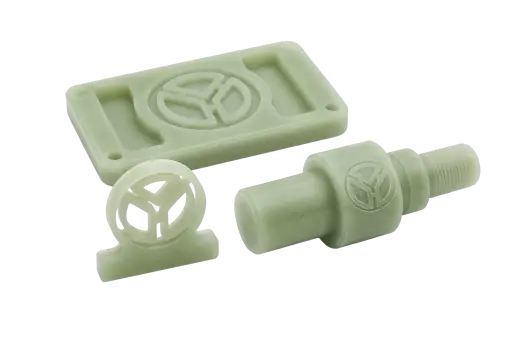
Material GuideGarolite (G10/FR4): Properties, Machining, and Applications
Garolite (commonly G10 or FR4) is a fiberglass-reinforced epoxy laminate widely used in industrial applications requiring electrical insulation, mechanical strength, and dimensional stability. It is typically processed through CNC machining services, CNC milling, and sheet cutting rather than molding.
For your project, Garolite is often selected when a combination of structural rigidity, electrical performance, and environmental resistance is required, especially in applications where metals are not suitable due to conductivity or weight.
Key manufacturing characteristics of Garolite
- Composite laminate structure: Made from fiberglass cloth layers bonded with epoxy resin, resulting in anisotropic properties.
- High mechanical strength: Stronger and stiffer than many thermoplastics, especially in-plane.
- Excellent electrical insulation: Widely used in electrical and electronic applications.
- Low moisture absorption: Performs reliably in humid environments compared to materials like nylon.
- Abrasive to tooling: Fiberglass content increases tool wear during CNC machining services.
- Available in sheet form: Commonly processed through sheet cutting and machining operations.
Mechanical and physical properties of Garolite
Garolite is typically selected for structural and electrical performance rather than ease of processing or cosmetic appearance. Compared to thermoplastics like acetal or ABS, it offers significantly higher stiffness and better thermal and electrical performance.
Typical performance profile
- High strength-to-weight ratio
- Excellent dielectric properties
- Good dimensional stability under load
- Low thermal expansion in-plane
- Stable performance in harsh environments
Why engineers choose it
- Provides electrical insulation with structural strength
- Performs well in high-humidity and industrial environments
- Maintains stability in precision components
- Suitable for replacing metals in non-conductive applications
Strengths and advantages of Garolite
- Electrical insulation performance: Excellent dielectric strength for electronic and electrical systems.
- High stiffness and strength: Outperforms most plastics in structural rigidity.
- Dimensional stability: Maintains shape under mechanical and thermal stress.
- Environmental resistance: Performs well in moisture, chemicals, and industrial conditions.
- Lightweight alternative to metal: Reduces weight while maintaining strength.
- Sheet-based manufacturing: Ideal for precision parts produced from plate or laminate stock.
Trade-offs and limitations of Garolite
- Tool wear during machining: Fiberglass reinforcement is abrasive and reduces tool life.
- Brittle failure mode: Can crack or delaminate under impact or improper machining.
- Limited machinability compared to thermoplastics: Requires controlled feeds and tooling.
- Dust generation: Machining produces fine fiberglass dust that requires proper handling.
- Not ideal for cosmetic applications: Surface finish is typically functional rather than aesthetic.
Fabrication and machining considerations for Garolite
Machining behavior
Garolite can be processed through CNC milling and drilling operations, but requires careful tooling selection and parameter control due to its abrasive fiberglass content.
- Use carbide or diamond-coated tooling to extend tool life
- Avoid aggressive feeds that can cause delamination
- Maintain proper support to prevent edge chipping
Sheet processing
Garolite is commonly supplied in sheet form and processed using sheet cutting for flat components and panels.
- Efficient for 2D geometries and plate-based designs
- Laser or waterjet cutting may be used depending on thickness
- Edge finishing may be required for functional or safety reasons
Hole features and geometry
- Drilled holes must be controlled to avoid fiber breakout
- Threading may require inserts depending on load requirements
- Sharp internal corners should be avoided to reduce stress concentration
Safety and handling
- Dust extraction is critical during machining
- Personal protective equipment is recommended
- Proper cleanup prevents contamination and health risks
Common applications for Garolite
Garolite is widely used in applications requiring electrical insulation, structural stability, and environmental resistance.
- Electrical insulation components
- Circuit board substrates (FR4)
- Industrial panels and structural plates
- Test fixtures and tooling plates
- Semiconductor and electronics components
- Aerospace and defense insulation parts
- High-performance mechanical supports
When Garolite is a strong material choice
Garolite is often the right choice when electrical performance, structural stability, and environmental resistance are more important than ease of machining or cosmetic finish.
- When electrical insulation is required in structural components
- When parts must perform in humid or harsh environments
- When replacing metal with a non-conductive material
- When dimensional stability under load is critical
- When working with sheet-based composite materials