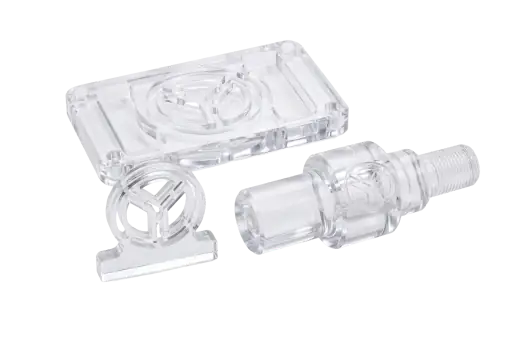
Material GuidePolycarbonate (PC): Properties, Processing, and Applications
Polycarbonate (PC) is a high-performance thermoplastic widely used in applications requiring exceptional impact resistance, transparency, and durability. It is commonly processed through CNC machining services, sheet cutting, and injection molding, as well as 3D printing services for prototyping.
When choosing a material, polycarbonate is often selected when parts must withstand mechanical stress, impact, and environmental exposure while maintaining transparency or structural integrity.
Key manufacturing characteristics of polycarbonate
- Exceptional impact resistance: One of the toughest transparent thermoplastics available.
- Optical clarity: Maintains transparency while offering significantly higher toughness than acrylic.
- Good dimensional stability: Suitable for both machined and molded components.
- Versatile processing: Compatible with CNC machining services, molding, and additive manufacturing.
- Moderate heat resistance: Performs better than many commodity plastics in elevated temperature environments.
- Wide availability in sheet and resin form: Supports both fabrication and production workflows.
Mechanical and physical properties of polycarbonate
Polycarbonate is typically selected for its combination of toughness and transparency. Compared to ABS, it offers higher impact resistance and heat performance. Compared to acrylic, it sacrifices some optical clarity for significantly improved toughness and durability.
Typical performance profile
- Very high impact strength even under harsh conditions
- Good transparency with slightly lower clarity than acrylic
- Moderate stiffness with high toughness
- Better heat resistance than many standard plastics
- Stable performance across a range of environments
Why engineers choose it
- Handles impact and abuse better than most transparent plastics
- Suitable for safety-critical or protective components
- Works for both structural and visual applications
- Balances performance with manufacturability
Strengths and advantages of polycarbonate
- Extreme impact resistance: Ideal for safety components and protective enclosures.
- Transparent and durable: Combines visibility with mechanical strength.
- Thermal performance: Better heat resistance than materials like ABS.
- Versatile manufacturing compatibility: Works in CNC machining services, molding, and additive processes.
- Good dimensional control: Suitable for engineered parts with moderate tolerances.
- High energy absorption: Performs well in dynamic and impact-loaded environments.
Trade-offs and limitations of polycarbonate
- Scratch sensitivity: Surface can scratch easily without coatings.
- Higher cost than commodity plastics: More expensive than materials like HDPE or ABS.
- UV sensitivity: Requires stabilization or coating for long-term outdoor use.
- Chemical sensitivity: Can be affected by certain solvents and cleaning agents.
- Machining challenges: Heat buildup must be controlled during machining to avoid surface defects.
Fabrication and processing considerations for polycarbonate
Machining behavior
Polycarbonate can be processed through CNC milling and CNC turning, but requires careful control to maintain surface quality and avoid heat-related defects.
- Sharp tooling improves surface finish and clarity
- Heat buildup must be minimized to prevent melting or hazing
- Lower feeds and proper cooling improve results
Sheet processing
Polycarbonate is widely available in sheet form and processed through sheet cutting for panels, guards, and transparent components.
- Waterjet and CNC routing are commonly used
- Laser cutting requires careful parameter control
- Edge finishing may be required for optical applications
Molding and production
Polycarbonate is frequently used in injection molding for high-volume production of durable plastic components.
- Supports complex geometries and integrated features
- Requires controlled processing to avoid internal stress
- Post-processing may be needed for optical clarity
Additive manufacturing
- Used in 3D printing services for functional prototypes
- Provides stronger prototypes than many standard materials
- Not always fully representative of molded properties
Common applications for polycarbonate
Polycarbonate is widely used in applications requiring durability, transparency, and impact resistance.
- Safety guards and protective shields
- Transparent machine enclosures
- Automotive lighting and components
- Electrical and electronic housings
- Medical and laboratory equipment
- Consumer product enclosures
- Impact-resistant panels and covers
When polycarbonate is a strong material choice
Polycarbonate is often the right choice when impact resistance, durability, and transparency are required in demanding environments.
- When parts must withstand impact or mechanical abuse
- When transparency is needed with higher toughness than acrylic
- When components are safety-critical or protective
- When moderate heat resistance is required
- When durability is more important than surface hardness